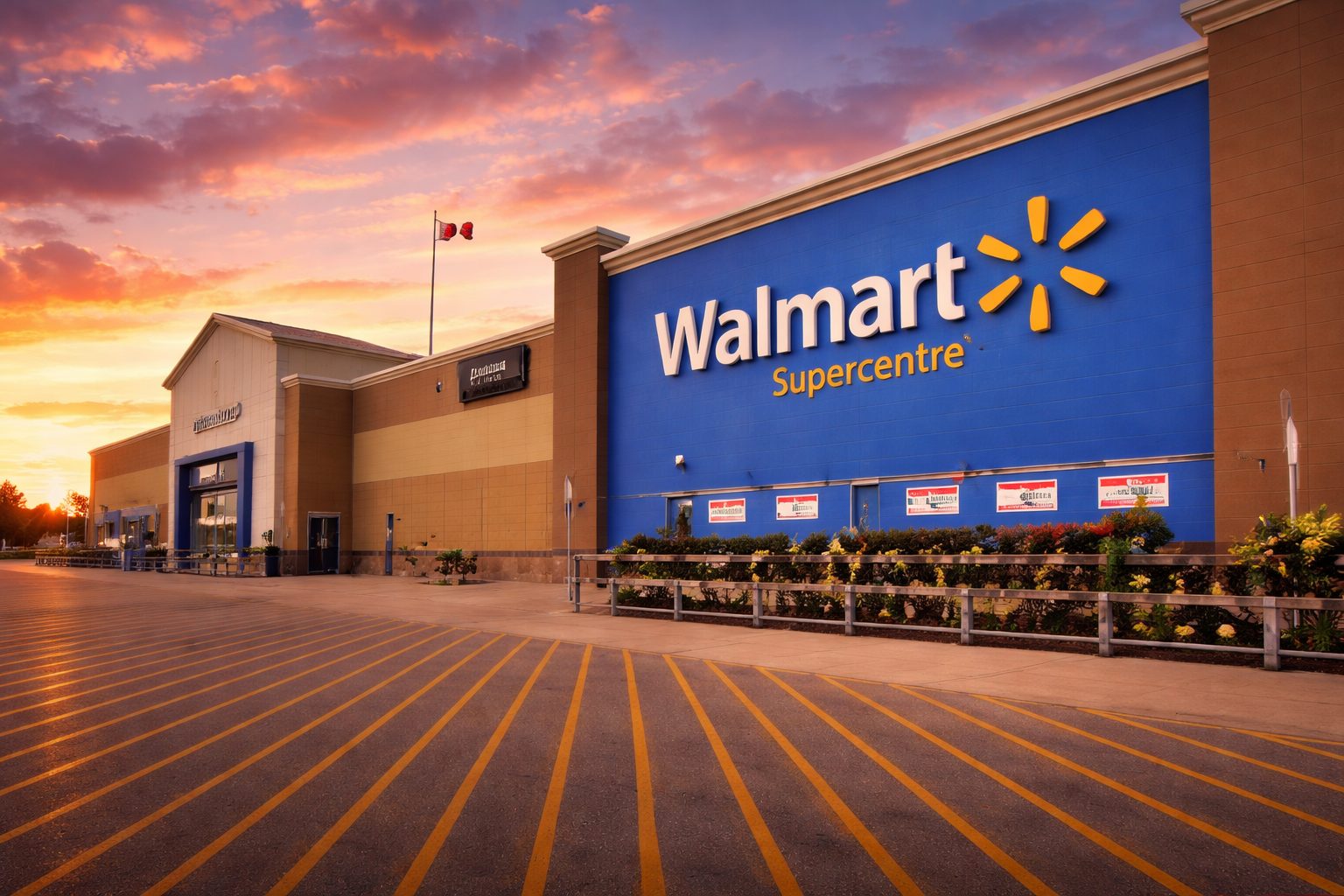

Walmart Inc. (Nasdaq: WMT) stock traded modestly lower on Friday, December 19, 2025, hovering around $114 as investors balanced fresh analyst target hikes against a busy slate of legal, regulatory, and policy headlines. The world’s largest retailer heads into the final stretch of the holiday season with Wall Street still largely constructive on the long-term story—but increasingly focused on whether the stock’s premium valuation is justified in 2026.
Walmart stock price today: WMT slips, but stays near highs
As of intraday trading on Dec. 19, 2025, Walmart shares were about $114.23, down roughly 0.5% on the day.
Market data trackers show Walmart remains close to its 52-week high (~$117.45), with year-to-date performance around +26% and a market cap near $910 billion—a scale that continues to put Walmart in the “mega-cap” conversation typically reserved for tech giants. Finviz
That “tech-like” framing has been reinforced recently by Walmart’s historic exchange transfer: the company shifted its stock listing to Nasdaq (ticker remains WMT) earlier this month, a move that Nasdaq and market observers have highlighted as one of the year’s most significant listing wins. Walmart Inc.+1
What’s new for Walmart stock on Dec. 19: Wells Fargo and Baird lift targets to $130
The biggest stock-specific catalyst hitting the tape on Dec. 19 was a pair of bullish target increases:
- Wells Fargo maintained an Overweight rating and raised its price target to $130 from $120.
- Baird also lifted its price target to $130 from $121, maintaining an Outperform stance (reported via MT Newswires coverage surfaced on MarketScreener).
While target changes don’t move markets by themselves, they matter for Walmart because the stock has already had a strong run. Investors are watching closely for signs that analysts still see additional upside even after the rally—especially as consumer spending, freight, labor, and policy risks remain in flux.
Walmart stock forecast: where Wall Street price targets sit now
Across major market-data platforms, the message is broadly consistent: analysts still expect moderate upside, but the easy money may have been made.
One widely followed market snapshot shows a consensus target price around $122.54, which implies roughly 7% upside from the $114 area. Finviz
Other aggregators show targets clustering in a similar “low-to-mid $120s” neighborhood, even as the most bullish analysts push toward the $130–$136 range. Finviz+1
The key point for readers following Walmart stock forecasts into 2026: the Street is not pricing Walmart as a turnaround. It’s pricing it as a high-quality compounder—a defensive retailer increasingly augmented by higher-margin businesses like advertising and services.
Next big checkpoint: Walmart’s Feb. 19, 2026 earnings date
Walmart has already posted fiscal Q3 results (released Nov. 20), and the next major scheduled catalyst is FY2026 Q4 earnings on Feb. 19, 2026 (7:00 a.m. U.S./Central), according to Walmart’s official events calendar.
Consensus forecasts tracked by market sites place expected EPS around $0.72 for the upcoming quarter, which sets the bar for what Walmart must deliver to keep the multiple supported.
The bull case: why investors still pay up for Walmart stock
Walmart’s investment narrative has strengthened over the past year because it’s no longer “just” a grocery-led big-box chain. Bulls argue it’s becoming a scaled omnichannel platform with multiple profit engines.
1) Walmart is gaining share in a value-focused consumer environment
In its latest quarterly report, Walmart delivered another solid performance and raised full-year guidance again, citing strong execution heading into the holidays. Reuters reported Walmart’s U.S. comparable sales growth beat expectations, and the company lifted its outlook for net sales and earnings.
Walmart’s own earnings materials for fiscal 2026 also show the company raised its outlook for net sales growth (4.8%–5.1%) and adjusted operating income growth (4.8%–5.5%), reinforcing a “steady momentum” read-through for long-term investors. Walmart Inc.
2) E-commerce is no longer a side project—and it’s helping margins
A major reason Walmart’s stock has been re-rated: online growth is accelerating. Reuters highlighted that Walmart’s quarter was supported by surging online sales, and management has increasingly positioned digital and delivery as central pillars of the strategy.
In Walmart’s earnings call cycle, executives have also emphasized tech and automation as structural advantages—an argument investors tend to reward with higher valuation multiples than traditional retail.
3) Walmart Connect and retail media are turning into a meaningful profit driver
Walmart’s advertising and retail media push has become one of the most closely watched pieces of the story, because ad revenue can carry significantly higher margins than core merchandising.
A deep dive published this week described how Walmart Connect is benefiting from the convergence of retail media and connected TV, noting strong recent growth and improved measurement capabilities—critical ingredients for winning brand ad budgets.
If Walmart can keep scaling ad revenue while also expanding marketplace and fulfillment services, the company may continue to look less like a low-margin discounter and more like a hybrid consumer-tech platform—the core framing behind many bullish price targets.
The bear case: what could derail Walmart shares
Even with upbeat analyst notes today, Walmart stock is not without real risks—and several of them have been in the headlines this week.
1) Legal and regulatory overhangs are piling up
Credit-card swipe fees: Walmart and other major retailers urged a judge to reject a proposed Visa/Mastercard antitrust settlement, arguing the deal provides limited fee relief and preserves network rules merchants oppose. Payment costs are a recurring margin battleground for big retailers, so investors track these cases closely.
Infant formula recall compliance: The U.S. FDA sent warning letters to Walmart and other retailers over continued sales of recalled ByHeart infant formula, according to Reuters. The agency gave companies a short window to respond—headlines like these can create reputational risk and operational scrutiny even if the financial impact is limited.
Price-fixing lawsuit: Walmart and PepsiCo were hit with a proposed consumer class action alleging a long-running price-fixing scheme related to Pepsi soft drink pricing, Reuters reported. Litigation is common for mega-caps, but recurring legal noise can weigh on sentiment.
2) Policy risk and workforce issues are back in focus
A union-aligned shareholder group pressed Walmart (and Amazon and Alphabet) to disclose how President Donald Trump’s immigration policies could affect finances and supply chains—specifically highlighting trucking, farming, and skilled labor constraints. Walmart did not immediately respond to Reuters’ request for comment in that report.
Separately, Reuters reported comments signaling a potential DEI enforcement “reckoning” in 2026 from the incoming EEOC chair—part of a broader policy environment that could influence compliance costs and corporate governance priorities for large employers. Reuters
3) Valuation: Walmart is priced like excellence—and that leaves less room for disappointment
One reason Walmart stock reacts sharply to even small changes in guidance: it trades at a premium. Market snapshots around Dec. 19 show Walmart with a forward P/E near the high-30s (with trailing P/E around ~40).
That’s a meaningful valuation for a retailer, and it has sparked a louder debate among bears. In recent commentary, some analysts and market writers have argued Walmart’s multiple is stretched relative to its growth rate—essentially warning that “great company” doesn’t always equal “great price.” Seeking Alpha
2026 catalysts: CEO transition and the next earnings report
Beyond day-to-day headlines, Walmart investors have two major calendar items to watch:
Leadership transition: John Furner set to take the helm in February 2026
Walmart has a high-profile CEO succession underway. Reuters reported that John Furner has been appointed as Walmart’s new CEO, effective February 2026, succeeding Doug McMillon. Reuters
Barron’s has also framed Walmart’s transition as one of several major “blue-chip leadership moments” investors are digesting as 2025 ends. Barron’s
For Walmart stock, the succession isn’t just a governance footnote—it’s part of the market’s confidence that Walmart can sustain its transformation into a faster, more digital, higher-margin operator without losing its core “everyday low price” identity.
Earnings: Feb. 19, 2026 is the next hard catalyst
Walmart’s official events listing confirms FY2026 Q4 earnings on Feb. 19, 2026, with materials expected early that morning and a live call shortly after.
Between now and then, investors will be parsing holiday demand signals, inflation prints, and any updates on the legal/policy fronts that could influence 2026 guidance.
Bottom line for Walmart stock on Dec. 19, 2025
Walmart stock ends this week with a familiar setup: strong fundamentals and supportive analyst sentiment—now reinforced by $130 price targets from multiple firms—competing against a growing list of headline risks and a valuation that assumes continued execution.
For long-term investors, the 2026 story likely hinges on three variables:
- whether Walmart can keep expanding higher-margin engines like advertising and services, Marketing Dive
- whether legal and policy risks remain manageable noise rather than margin pressure, Reuters+2Reuters+2
- whether the CEO transition and February earnings cycle preserve confidence in Walmart’s guidance trajectory.