
Applied Materials, Inc. NASDAQ:AMAT is closing out the week of December 19, 2025 with Wall Street firmly focused on a familiar mix of forces: AI-driven semiconductor capital spending, a growing advanced packaging opportunity, and the continuing uncertainty around U.S.-China export controls.
While the stock has pulled back from its early-December peak, the broader “AI infrastructure buildout” narrative is still shaping the investment case—and a new wave of analyst price-target changes this week shows just how fast sentiment can shift in semiconductor equipment.
Applied Materials stock today: where AMAT stands heading into Dec. 19, 2025
Applied Materials shares finished Thursday, December 18, 2025 at $253.50, up 2.11% on the day, snapping a short losing streak. The move left AMAT about 8.19% below its 52‑week high of $276.10, set on December 10, 2025, with trading volume above its recent average.
That positioning—strong year-to-date performance but choppier action near the highs—has become the defining setup for many chip-equipment names late in 2025: investors broadly believe in the 2026–2027 spending cycle, but they’re debating how much of that upside is already priced in.
The headline driver on Dec. 19: another price-target reset for AMAT
A central “today” item for Applied Materials watchers is the continued flow of analyst actions. On December 19, 2025, Deutsche Bank lifted its price target to $275 from $230, while maintaining a Hold rating. MarketScreener
That follows a busy mid-December stretch of revisions that has effectively re-anchored the conversation around where AMAT should trade if the next wafer-fab equipment upcycle materializes on schedule.
This week’s notable analyst actions and price targets for Applied Materials
Across December 2025, several firms moved targets higher—often without changing the basic thesis: near-term uncertainty, longer-term AI-led upside.
Key moves highlighted in widely circulated analyst note summaries include:
- B. Riley: target lifted to $305 from $270, Buy maintained (published Dec. 18).
- Mizuho: target lifted to $245 from $205, Neutral maintained (published Dec. 17).
- Jefferies: target lifted to $360 from $260, Buy maintained (published Dec. 15).
- Wells Fargo: target lifted to $290 from $255, Overweight maintained (published Dec. 15).
Stepping slightly earlier, KeyBanc Capital Markets also raised its AMAT price target to $285 from $240 on December 2, keeping an Overweight rating and pointing to relative valuation versus peers.
And one of the most-discussed calls of the past month remains UBS’s upgrade to Buy from Neutral, raising its price target to $285 from $250 and tying the thesis to a coming “spending surge”—particularly in memory. Barron’s
Why it matters: when multiple firms raise targets into the $275–$360 band in a compressed period, it’s usually not about a single quarter. It’s about investors repositioning for the next multi-year demand phase—especially one linked to AI compute, HBM/DRAM, and leading-edge logic.
The macro forecast behind the bull case: AI capex and wafer-fab equipment growth into 2026–2027
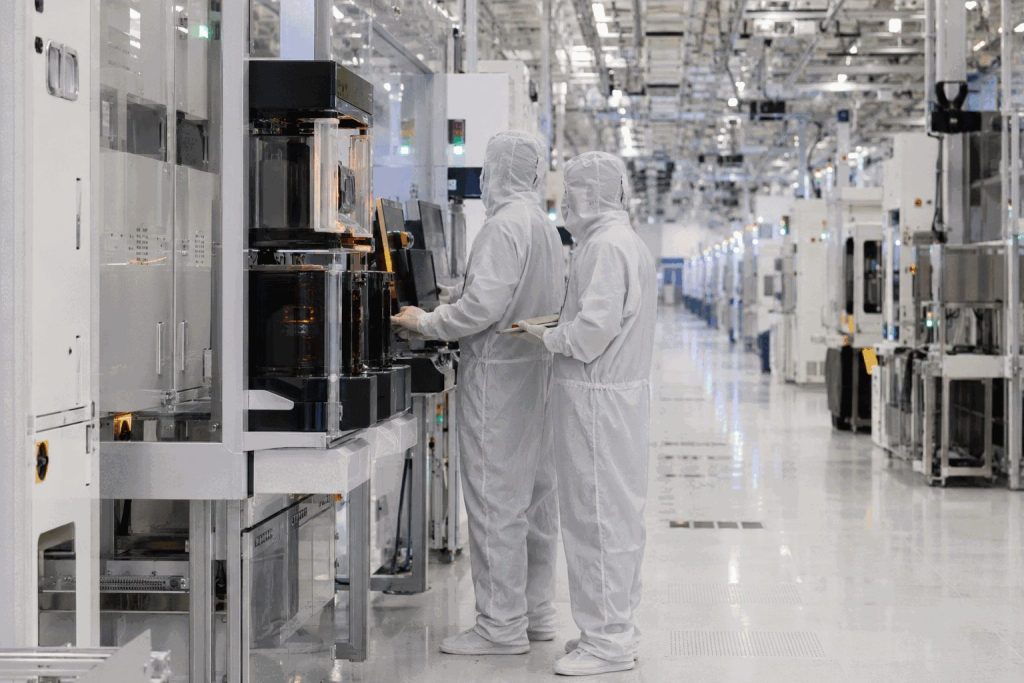
Applied Materials sits at the center of a global equipment supply chain, so industry spending forecasts often act like a “gravity field” around the stock.
This week, a major data point came from SEMI, reported by Reuters: equipment sales for manufacturing chip wafers are forecast to rise 9% to $126 billion in 2026, then increase 7.3% to $135 billion in 2027, driven by demand for logic and memory capacity used in AI.
That same SEMI outlook underscores two important context points for AMAT investors:
- Asia remains the dominant investment region, with China, Taiwan, and South Korea projected as top markets through 2027.
- Major beneficiaries in an upcycle include not only ASML, but also Applied Materials, KLA, and Lam Research, among others.
Meanwhile, UBS’s upgrade thesis (as summarized by Barron’s) also projected a sharp expansion in the wafer-fab equipment market, with UBS modeling WFE growth over 20% to $136.5 billion in 2026, potentially reaching $145 billion by 2027, aided by memory markets.
The takeaway: whether you lean on SEMI’s baseline or UBS’s more aggressive scenario, the common thread is that 2026–2027 is still widely seen as a period of elevated equipment demand—exactly the environment in which AMAT tends to command premium attention.
What Applied Materials told investors: record fiscal 2025, but a “second-half weighted” 2026 setup
The latest quarterly and annual commentary continues to shape how analysts model the next 12–24 months.
From management’s fiscal 2025 discussion and follow-on coverage:
- Applied delivered record annual revenue around $28.4 billion (about +4% year over year) and reported strong profitability metrics, including non‑GAAP gross margin around 48.8%, described as the highest level in decades in at least one earnings-call recap.
- The company emphasized rising R&D investment (including references to a ~10% increase in non‑GAAP R&D), consistent with the push into advanced transistor architectures, DRAM, and packaging-related opportunities.
- Guidance for the next quarter (fiscal Q1 2026) was framed at $6.85 billion revenue (± $500 million) and non‑GAAP EPS of $2.18 (± $0.20).
Importantly for the “next cycle” narrative, Reuters reported CFO commentary that customers were signaling wafer-fab equipment spending is likely to accelerate beginning in the second half of calendar 2026. Reuters
That “second-half weighted” framing has become a key point in the debate: bulls see it as a roadmap to an upcycle; bears see it as an admission that growth may be delayed or uneven in the near term.
The biggest risk still hanging over AMAT: China export controls and market-access limits
If AI capex is the upside story for Applied Materials stock, China policy remains the biggest swing factor.
Reuters reported that the company flagged a $600 million hit to fiscal 2026 revenue after the U.S. expanded its restricted export list—specifically, rules that make it harder to export certain products and provide parts/services to select China-based customers without a license.
In November, Reuters also reported management commentary that tighter controls mean Applied can no longer supply parts of China’s memory and older-generation chip markets, even as foreign competitors may face fewer restrictions. Reuters also noted Applied’s China revenue share has dropped back toward the mid‑20% range from higher recent levels.
That policy pressure has already translated into cost actions. In an Oct. 23 Reuters report carried by Investing.com, Applied said it would cut about 4% of its workforce (roughly 1,400 jobs) and take a $160 million to $180 million charge, largely tied to fiscal 2025, as export controls weighed on business.
Why investors care: China has been one of the largest chip-equipment markets globally for years. Even if AI-led demand elsewhere is accelerating, the market still needs clarity on how much of China demand is (a) delayed, (b) permanently inaccessible, or (c) shifting to non-U.S. suppliers.
Dividend and capital returns: Applied keeps paying shareholders as it invests for AI
Even in a capex-heavy industry, capital returns can meaningfully shape the shareholder narrative—especially when growth timing is debated.
On December 12, 2025, Applied Materials announced its board approved a quarterly cash dividend of $0.46 per share, payable March 12, 2026, to shareholders of record Feb. 19, 2026.
The same dividend announcement also emphasized the scale of recent shareholder returns: nearly $6.3 billion returned in fiscal 2025 through dividends and share repurchases, with about $14.0 billion remaining under the company’s repurchase authorization at the end of the period.
For long-term investors, that matters because it frames AMAT not just as a cyclical AI-capex play, but also as a company trying to balance (1) investment in next-gen tools and packaging with (2) consistent capital returns.
Advanced packaging: the “quiet” growth engine becoming louder in 2025–2026 models
A recurring theme in late-2025 analysis is that advanced packaging is no longer a niche add-on—it’s increasingly central to AI performance, power efficiency, and system-level scaling.
In a September conference transcript recap, Investing.com reported Applied’s commentary that it plans to double its advanced packaging business to $3 billion, positioning AI as a major growth driver.
This matters for the stock narrative because packaging and services can be framed as structural growth levers that may help smooth cyclicality compared with pure wafer-fab tool cycles—one reason investors pay close attention to how packaging attaches to leading-edge logic and HBM ramps.
Valuation debate on Dec. 19: is AMAT “still early” in the AI tool cycle—or already fully priced?
With AMAT still up sharply over the past year, valuation has become a front-and-center topic.
A Nasdaq/Zacks analysis this month highlighted:
- AMAT shares up roughly 53% over the past year, outpacing its industry in that period
- a forward price-to-sales ratio around 7.05x, below the industry average in that comparison
- consensus earnings growth expectations implying ~1.27% growth for fiscal 2026 and ~17.20% for fiscal 2027 (with revisions trending upward in the preceding 30 days) Nasdaq
On the more cautionary side, a Simply Wall St valuation piece dated December 19, 2025 pointed out the stock’s strong longer-term run (including a three-year total shareholder return cited around 140.85%) and framed the key question as whether AI-driven growth is already reflected in the price. The same analysis presented divergent valuation outcomes depending on methodology, illustrating how sensitive “fair value” can be to growth and margin assumptions. Simply Wall St
What that means in plain English: even among bulls, the debate is shifting from “will AI drive a cycle?” to “how much of that cycle is already priced into AMAT at the current multiple?”
What to watch next for Applied Materials stock
For investors tracking AMAT into early 2026, the next set of catalysts is likely to cluster around a few themes:
- Evidence that the AI-driven equipment cycle is materializing on schedule
Industry forecasts (SEMI) and bullish analysts (like UBS) are pointing to acceleration into 2026–2027. The market will look for confirming signals in customer capex plans, bookings commentary, and tool lead times. - China policy and licensing clarity
The revenue hit tied to export restrictions and the evolving definition of “restricted” end customers remain major swing variables for estimates and multiples. Reuters+1 - Advanced packaging execution
If the company can demonstrate sustained momentum toward its stated packaging expansion goals, investors may increasingly model AMAT as a broader “AI infrastructure enabler,” not only a front-end wafer-fab tools story. Investing.com - Shareholder return pace
With the new dividend reaffirmed and buybacks still sizable, capital allocation will remain part of the bull case—especially if near-term demand remains “lumpy.” GlobeNewswire
Bottom line: AMAT’s Dec. 19, 2025 setup is bullish on the cycle—cautious on the path
As of December 19, 2025, the Applied Materials stock story is defined by a clear tension:
- The macro and industry signals (SEMI forecasts, AI capex expectations, memory/logic expansion) remain supportive.
- The street is actively moving targets higher—sometimes sharply—reflecting increased confidence that AMAT participates meaningfully in the next upcycle.
- But China exposure and export controls continue to inject uncertainty into both revenue visibility and long-term share assumptions in one of the world’s biggest equipment markets.