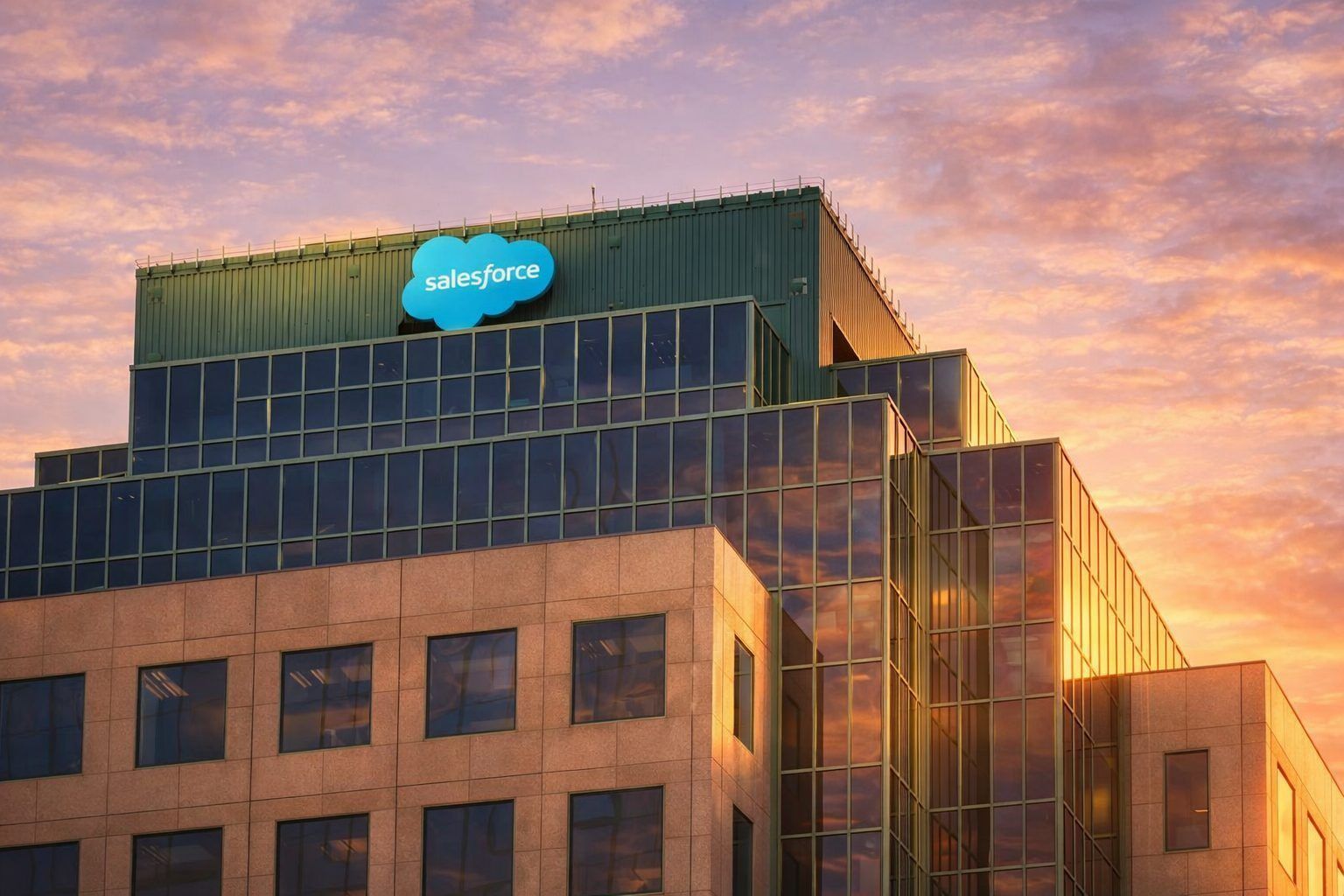
Salesforce, Inc. NYSE:CRM enters the final stretch of 2025 with investors focused on one core question: can the company turn “agentic AI” from a product narrative into measurable revenue acceleration—without sacrificing the margin discipline that has become central to the Salesforce stock story?
On Friday, December 19, CRM shares traded around $258, modestly higher versus the prior close, as markets digested a burst of AI- and go-to-market-related headlines from earlier in the week.
Below is a comprehensive, publication-ready roundup of the current news, forecasts, and analyst analyses relevant as of 19.12.2025, plus what matters most for Salesforce stock into 2026.
Salesforce stock today: what investors are watching on December 19, 2025
Salesforce stock is being pulled by three powerful forces at once:
- Distribution: Salesforce is pushing its “Agentforce” capabilities into where work happens—now including ChatGPT—to reduce friction and increase usage.
- Pipeline creation: Salesforce is adding “agentic marketing” capabilities via its planned acquisition of Qualified, aiming to automate early-funnel conversion and meeting setting.
- Proof points: Investors still want hard evidence that AI features drive expansion, retention, and incremental spend—especially after earlier skepticism in 2025 about near-term AI monetization.
That mix explains why CRM’s near-term trading often reacts as much to product and partner moves as it does to macro or broad software multiples.
Headline 1: Salesforce brings Agentforce Sales into ChatGPT as OpenAI expands its app directory
One of the most consequential “new distribution” developments for Salesforce this week is its move to put CRM actions directly inside ChatGPT.
Salesforce announced the Agentforce Sales app in ChatGPT, positioning it as a way for reps to prioritize deals, plan accounts, and update Salesforce from within the conversational interface—reducing the “toggle tax” between research, CRM updates, email, and calendars. Salesforce says an open beta is available for eligible customers, and that users can connect via the ChatGPT app directory. Salesforce
This launch matters for Salesforce stock because it reframes the AI battleground:
- It’s not just about whose model is best.
- It’s about who owns the workflow—and who can embed AI into daily execution with fewer clicks.
OpenAI’s rollout of a broader ChatGPT app directory / “app store”-like experience has also been widely reported as part of ChatGPT becoming more of a platform, which increases the strategic value of being present inside that interface. The Verge+1
Separately, a Reuters item about the directory indicated major apps—including Salesforce—would be available in the new directory. TradingView
Stock implication: If Salesforce can convert ChatGPT-based usage into paid Agentforce adoption (or attach higher-value bundles), investors may start modeling AI as a tailwind to net retention rather than a feature arms race that compresses pricing.
Headline 2: Salesforce signs a deal to acquire Qualified to add “agentic marketing” to Agentforce
Salesforce also announced it has signed a definitive agreement to acquire Qualified, described as a provider of agentic AI marketing solutions designed to engage and convert inbound buyers—turning websites into conversational experiences that qualify and nurture leads.
Salesforce’s rationale is straightforward: as enterprises chase AI productivity, the biggest ROI often comes from automating repetitive revenue motions—especially early funnel steps that are expensive and inconsistent when handled purely by humans.
Key detail for investors: Salesforce said the transaction is expected to close in the first quarter of Salesforce’s fiscal year 2027, subject to customary conditions and regulatory approvals.
Industry coverage framed the deal as a meaningful reinforcement of Salesforce’s Agentforce strategy—specifically by bringing marketing-to-sales handoff automation deeper into the core platform.
A Constellation Research “Hot Take” argued that smaller, go-to-market-centric acquisitions can have outsized impact because they plug directly into daily revenue execution—highlighting Qualified’s conversational tooling and its role in converting high-intent visitors into pipeline. Constellationr
Stock implication: Investors will likely watch for (a) how quickly Qualified’s functionality is packaged into Agentforce SKUs, (b) whether it boosts Marketing Cloud and Sales Cloud expansion, and (c) whether Salesforce can show measurable lift in pipeline velocity and conversion metrics across its installed base.
Earnings backdrop: Salesforce raised its FY2026 outlook and highlighted AI and Data 360 momentum
While this week’s product and M&A headlines are grabbing attention, Salesforce stock still trades on fundamentals—especially forward revenue durability and margin/FCF trajectory.
In its fiscal Q3 2026 results (reported earlier in December), Salesforce posted revenue of $10.26 billion and adjusted EPS of $3.25, and raised full-year guidance to $41.45–$41.55 billion in revenue and $11.75–$11.77 in adjusted EPS.
Salesforce also highlighted that Agentforce and Data 360 reached roughly $1.4 billion in annual recurring revenue, more than doubling year over year—one of the clearer numeric signals the company has offered that its AI/data portfolio is scaling.
MarketWatch noted Salesforce pointed to a “powerful pipeline of future revenue,” and linked the outlook lift partly to AI momentum and performance obligations (cRPO) growth—metrics investors use to judge forward visibility. MarketWatch
Salesforce leadership has repeatedly connected the Agentforce push to a longer-range ambition of reaching $60 billion in annual revenue by fiscal 2030—an important narrative anchor for long-duration investors.
Stock implication: The market is increasingly treating Salesforce as a “show-me” AI story. Strong EPS and cash generation have helped, but sustained multiple expansion likely requires confidence that AI is incremental, not just defensive.
Salesforce stock forecast: analyst price targets, upgrades, and where consensus sits on Dec. 19, 2025
Analyst forecasting around Salesforce stock remains broadly constructive, with notable dispersion—typical for mega-cap software navigating a platform transition.
Consensus: mid-$320s price targets, generally bullish ratings
Multiple tracking services show an average one-year CRM price target clustered around the low-to-mid $320s, implying meaningful upside from the ~$250s–$260s trading range seen in recent sessions.
Notable recent analyst actions (December 2025)
- BTIG initiated coverage with a Buy rating and a $335 price target (published this week).
- Morgan Stanley maintained an Overweight rating while trimming its price target to $398 from $405 after earnings-related estimate/valuation updates.
- A Mizuho note (as reported by Barchart) argued Salesforce is a top software stock to buy in 2026, assigning an Outperform rating and a $360 target in that coverage.
- A MarketWatch column citing HSBC positioned Salesforce among “unloved” software names that could benefit as the AI trade shifts toward applications, putting a $336 target on Salesforce. MarketWatch
A more cautious data point: CIO survey signals monetization questions
A Barron’s piece citing a KeyBanc CIO survey highlighted a potential friction point: while AI budget allocation is rising, willingness to pay specifically for CRM-provider AI features may be uneven, and reported usage of Salesforce Agentforce tools was still relatively limited in that survey snapshot.
Stock implication: The market’s “AI agent” valuation upside case is visible in targets like ~$350–$400, but the proof threshold is high. Investors will likely demand customer adoption metrics and clear packaging/pricing evidence (attach rates, expansion, renewal uplift).
Fresh analysis on Dec. 19: valuation models, institutional flows, and options signals
Beyond headlines and sell-side notes, today’s “market texture” around CRM also includes third-party valuation work, filings-driven positioning, and derivatives-based sentiment.
Valuation models: “undervalued” claims, but assumptions matter
A Simply Wall St analysis dated December 19, 2025 argued Salesforce appears undervalued under its DCF framework, presenting an intrinsic value estimate and a discount versus market price. It also contextualized CRM’s recent drawdown and volatility in 2025. Simply Wall St+1
As with any DCF, the result is extremely sensitive to assumptions about long-term growth, margins, and discount rates—so investors generally treat it as a scenario tool, not a forecast.
Institutional activity: mixed 13F-driven positioning
MarketBeat filings published today highlighted position changes by specific investment firms (including sharp reductions by one manager), reflecting the normal churn of institutional rebalancing rather than a single unified view.
Options-implied expectations: elevated but not extreme
Options analytics for the Dec. 19 expiration indicated implied volatility in the low-30% range and a probabilistic expected closing range for CRM (model-based). Quantcha+1
This suggests the options market is pricing ongoing movement, but not a “binary-event” shock typical of earnings days.
The key debate for 2026: can Salesforce monetize AI agents without eroding unit economics?
Salesforce signals near-term margin flexibility for long-term AI adoption
One of the more discussed strategic signals in December is Salesforce’s messaging that it can tolerate short-term financial pressure in order to seed adoption of AI agents—particularly through a flat-rate pricing approach called the Agentic Enterprise License Agreement (AELA), discussed publicly by its CRO at a major conference.
This matters for Salesforce stock because the “agentic AI” era could pressure traditional seat-based pricing if heavy AI usage shifts compute costs upward—unless pricing architecture is redesigned.
CIO pushback risk: data ecosystem control and integration costs
At the same time, CIO.com reported growing concern among ecosystem partners and buyers that higher costs (and tighter controls) around Salesforce data access could raise integration expenses and complicate AI plans. The report discussed potential ripple effects from Connector program/API access charges and the risk of customers feeling steered toward Salesforce-native tooling.
Stock implication: Salesforce’s optimal outcome is clear: become the “operating system” for customer engagement in an agentic enterprise, capturing workflow and data gravity. The risk is that tighter ecosystem economics trigger buyer resistance or encourage alternative architectures.
What to watch next for Salesforce (CRM) stock
For readers tracking Salesforce stock into 2026, these are the catalysts that can most directly shift forecasts and valuation:
- Agentforce adoption metrics
Look for disclosures beyond ARR headlines: number of paying customers, product attach rates, expansion contribution, and renewal impact. - Monetization clarity for ChatGPT distribution
The Agentforce Sales app inside ChatGPT is strategically meaningful, but investors will want clarity on whether it drives incremental paid usage or simply improves retention. - Qualified integration roadmap
Salesforce investors should watch how quickly Qualified becomes a standardized, scalable motion inside Sales Cloud/Marketing Cloud—and whether Salesforce can quantify pipeline lift. - Margin and cash flow durability under AI compute pressure
If AELA accelerates usage, the market will watch gross margin, operating margin, and free cash flow to see whether pricing keeps pace with cost-to-serve. - Ecosystem economics and partner sentiment
Integration cost increases and “lock-in” concerns can turn into procurement friction—especially for large enterprises with complex data stacks. CIO
Bottom line: Salesforce stock is trading as an “AI execution” story again
As of December 19, 2025, Salesforce stock sits at the intersection of two narratives:
- A credible platform shift toward agentic workflows, reinforced by ChatGPT distribution and targeted M&A (Qualified).
- A market that still demands measurable monetization proof, even after upbeat Q3 results and raised guidance.
Wall Street’s price targets—ranging from the low-$300s to near-$400 in some bullish cases—show meaningful upside if Salesforce can translate Agentforce momentum into durable revenue acceleration and defensible margins.