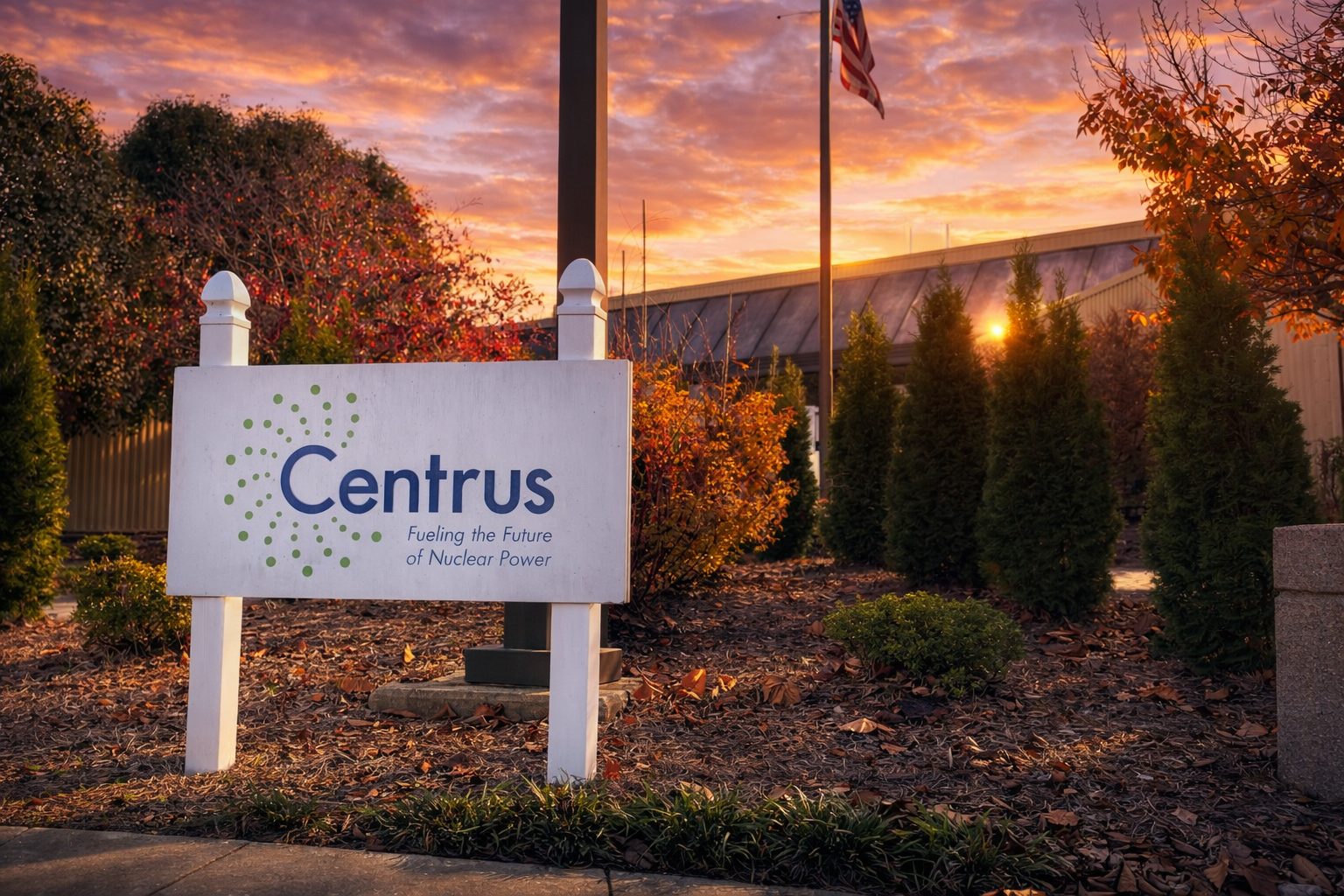

Centrus Energy Corp. (LEU) has spent most of the past year behaving like a reminder that “nuclear fuel supply chains” are not, in fact, boring plumbing. They’re geopolitics, industrial policy, national security, and—when investors decide to notice—violent stock moves.
As of Dec. 20, 2025, the latest catalyst for Centrus Energy stock is the company’s announcement that it has begun domestic centrifuge manufacturing to support commercial low-enriched uranium (LEU) enrichment tied to its planned expansion in Piketon, Ohio. The news helped re-ignite the bull case around Centrus as a potential cornerstone of U.S.-owned uranium enrichment capacity, especially with Russian enriched uranium imports slated to be fully banned starting in 2028.
LEU stock jumps as investors price in a bigger enrichment story
On the most recent session reflected in widely cited market data, LEU closed at $261.77 on Dec. 19, 2025, up 13.97%—a sharp move that pushed the stock back into the center of the nuclear-energy trade.
The surge followed Centrus’ Dec. 19 update that it has started manufacturing centrifuges domestically—an operational step that investors often read as “this is getting real,” not merely “this is on a slide deck.” Centrus Energy Corp+1
What Centrus announced: domestic centrifuge manufacturing and commercial LEU enrichment
Centrus’ Dec. 19 statement is straightforward but strategically loud: the company says it has begun domestic centrifuge manufacturing to support commercial LEU enrichment activities at its Piketon, Ohio facility. It also points to a longer runway—the first new production capacity is expected to come online in 2029.
Key elements investors are zeroing in on:
- Backlog/commitments: Centrus ties the plan to $2.3 billion in contingent LEU sales linked to customer contracts and commitments (with milestones that must be met).
- Where manufacturing is happening: The company says centrifuge manufacturing has begun at its facility in Oak Ridge, Tennessee, intended to feed enrichment expansion in Ohio.
- National security angle: Centrus says its AC100M centrifuge is the only deployment-ready, U.S.-origin enrichment technology positioned for certain national security missions, noting the National Nuclear Security Administration (NNSA) announced intent (in October) to contract with Centrus for LEU enrichment for national security.
- The “why now” macro claim: Centrus argues new domestic enrichment is urgent given anticipated nuclear demand growth and the stated timeline for the complete ban on imports of Russian enriched uranium starting in 2028. Centrus Energy Corp
This is the kind of announcement that tends to matter more for future capacity optionality than for next quarter’s revenue. The market response suggests investors are re-pricing the probability that Centrus becomes a scaled U.S. enrichment provider rather than remaining primarily a fuel supplier and contractor.
The financing puzzle: DOE task orders, convertible notes, and a $1 billion ATM program
Building enrichment capacity at scale is not cheap, and Centrus is explicitly framing its plan as a public-private funding stack rather than a “we’ll just bootstrap a uranium centrifuge industrial base” fantasy.
In its Dec. 19 release, Centrus outlines three especially market-moving funding pillars:
- Potential Department of Energy task orders: Centrus says it is a finalist for DOE task orders for both LEU and HALEU production, and that DOE has indicated these could be about ~$900 million per task order.
- Private capital already raised: The company cites $1.2 billion raised via convertible note transactions (Nov. 2024 and Aug. 2025) and reports cash of more than $1.6 billion as of Sept. 30, 2025.
- Equity flexibility via an ATM offering: Centrus also points to a recently launched $1 billion at-the-market (ATM) offering.
The ATM is particularly relevant for shareholders because it creates a clear path to raise capital—but also raises dilution risk if used aggressively. In its ATM press release, Centrus emphasizes it’s not obligated to sell shares and describes broad potential uses of proceeds (working capital, technology investment, capex, etc.).
Why Centrus matters in the nuclear “fuel bottleneck” debate
If you strip away the ticker chatter, the strategic premise is simple: advanced reactors and SMRs (small modular reactors) are only as viable as their fuel supply chain. And for many next-gen designs, that fuel is HALEU (high-assay low-enriched uranium).
Reuters reporting earlier in 2025 captured the broader constraint: the U.S. Department of Energy estimates domestic demand for HALEU could reach 50 metric tons per year by 2035, while Centrus—described as the only U.S. HALEU maker at the time—was operating at far smaller levels.
That mismatch is exactly why federal dollars keep showing up in this story. Reuters also reported DOE awarded multiple contracts tied to establishing U.S. supplies of HALEU and LEU, with up to $3.4 billion available under a funding framework connected to the Inflation Reduction Act.
Centrus is positioning itself as a direct beneficiary of this push—especially as the industry tries to de-risk reliance on foreign enrichment capacity and navigate tightening rules around Russian supply.
HALEU contract extension: production through June 30, 2026, with more options possible
Centrus’ HALEU role isn’t just theoretical. In mid-2025, the company announced a DOE contract extension that kicked off Phase III of its HALEU production work with additional production through June 30, 2026, and noted that further options could extend production for additional years (subject to DOE discretion and appropriations).
Industry coverage from the American Nuclear Society similarly described the one-year extension and emphasized that HALEU produced under the contract is owned/controlled by DOE.
For investors, the key takeaway is that Centrus’ HALEU work is not only a “future market” idea—it is already embedded in government contracting cycles, which can be both stabilizing (funding-backed work) and frustrating (timing uncertainty).
Recent corporate milestones investors are tracking in December 2025
Beyond the Dec. 19 centrifuge news, several other late-2025 updates remain “current” for anyone evaluating Centrus Energy stock as of Dec. 20:
1) Uplisting to the New York Stock Exchange
Centrus announced it was approved to uplist to the NYSE from NYSE American, with trading on the NYSE beginning Dec. 4, 2025 under the same ticker, LEU. The company framed the move as a liquidity and visibility upgrade.
2) New Ohio training/operations facility design work
On Dec. 11, Centrus said it initiated design work on a 150,000-square-foot Training, Operations & Maintenance Facility in Piketon, Ohio, describing it as infrastructure needed to support its planned enrichment expansion. Centrus said construction activities were expected to begin early next year and the facility could accommodate up to 200 new employees.
3) The $1 billion ATM program announcement
In early November, Centrus formally announced its ATM equity offering program (up to $1 billion), describing how sales may be executed and how proceeds may be used.
Taken together, these updates point to a company acting less like a niche fuel vendor and more like an industrial-scale capacity builder—again, with all the financing and execution risk that implies.
Earnings and backlog: what the latest quarterly numbers say
Centrus’ most recent quarterly results on record in major releases are for Q3 2025 (ended Sept. 30, 2025). The company reported:
- Net income:$3.9 million (vs. a net loss of $5.0 million in Q3 2024)
- Revenue:$74.9 million (vs. $57.7 million in Q3 2024) PR Newswire
A critical number for the long-term narrative is backlog. Centrus reported a $3.9 billion backlog as of Sept. 30, 2025, extending to 2040, and described a large portion of LEU backlog as tied to future deliveries and contingent commitments connected to potential new production capacity in Ohio.
It also highlighted balance sheet actions, including an upsized convertible notes offering that helped increase unrestricted cash (and later communications repeatedly cite cash levels around $1.6 billion as of Sept. 30, 2025).
Analyst forecasts and price targets: wide range, big disagreement
If you’re looking for a single clean “Wall Street view” on LEU stock, you’ll be disappointed—in the educational sense. Analysts are all staring at the same basic variables (DOE funding, enrichment demand, SWU pricing, execution timeline), but they’re assigning very different probabilities and valuations.
Here’s what’s visible in widely circulated analyst coverage and aggregator summaries:
- MarketBeat (consensus snapshot): reports a “Moderate Buy” consensus from 14 analyst ratings, with an average price target of $239.36 and a wide range (high $357, low $104). MarketBeat
- Needham initiation: Nasdaq-hosted coverage notes Needham initiated coverage with a Buy recommendation in early December 2025 (via Fintel reporting).
- UBS view (more cautious): Investing.com reported UBS raised its price target to $245 from $215 while maintaining a Neutral rating, pointing to near-term headwinds tied to SWU pricing dynamics but potential longer-term upside as contract pricing resets over time.
One practical way to interpret this dispersion: LEU is being valued as an option on U.S. enrichment scale. Analysts who think Centrus will land major DOE awards and execute into the late 2020s tend to justify much higher targets; analysts who focus on timing, pricing cycles, and dilution risk land lower.
What investors are watching next
As of Dec. 20, 2025, the next high-signal items for Centrus Energy stock are fairly clear:
- DOE award timing and size: Centrus explicitly references being a finalist for task orders potentially around $900 million each for LEU and HALEU production. Confirmation (or delay) could move the stock sharply.
- Execution milestones toward 2029: Management points to first new production capacity expected online in 2029—which makes intermediate milestones (facility upgrades, hiring, manufacturing scale-up) important credibility checks.
- Capital strategy and dilution: The ATM program exists; how heavily it gets used—and at what prices—matters for per-share outcomes.
- Market structure for SWU and enrichment: UBS explicitly flags SWU pricing dynamics as relevant to near-term vs. long-term results, and Centrus itself frequently links demand to tight enrichment markets later in the decade.
Risks that could hit LEU stock (even if the long-term thesis is right)
Nuclear investors sometimes talk like demand curves are destiny. Reality is messier. Key risks that show up repeatedly across company statements and analyst commentary include:
Long timelines and execution risk: A target of 2029 for meaningful new production capacity gives plenty of time for cost inflation, permitting complexity, and schedule slips.
Funding dependence: Centrus explicitly ties expansion scale to DOE funding decisions and broader public/private investment. If those come in smaller, later, or with strings, the growth path changes.
Contract “contingency” clauses: The company’s $2.3 billion figure is tied to contracts and commitments that are contingent on achieving milestones and securing financing for capacity build-out—meaning it’s not the same thing as guaranteed near-term revenue. Centrus Energy Corp+1
Dilution and capital structure: A $1 billion ATM program is flexibility, but it can also be a headwind for valuation if the market expects frequent issuance.
Stock volatility: Even bullish takes have to admit the ride has been wild—LEU has shown large swings around sector sentiment and earnings reactions, consistent with “high narrative, high optionality” names. The Motley Fool+1
Bottom line: Centrus is trading like an “industrial policy” stock—and that cuts both ways
As of Dec. 20, 2025, Centrus Energy is not being valued like a sleepy supplier. It’s being valued like a rare public-market proxy for rebuilding a strategically critical capability: domestic uranium enrichment, spanning LEU for today’s reactors and HALEU for the reactors the industry hopes to deploy at scale in the next decade.
The Dec. 19 announcement—domestic centrifuge manufacturing underway, capacity aimed for 2029, and funding pathways spelled out—helped snap investor attention back to the core question: Will Centrus translate first-mover advantage and government alignment into durable, scaled production and earnings power? Centrus Energy Corp+1