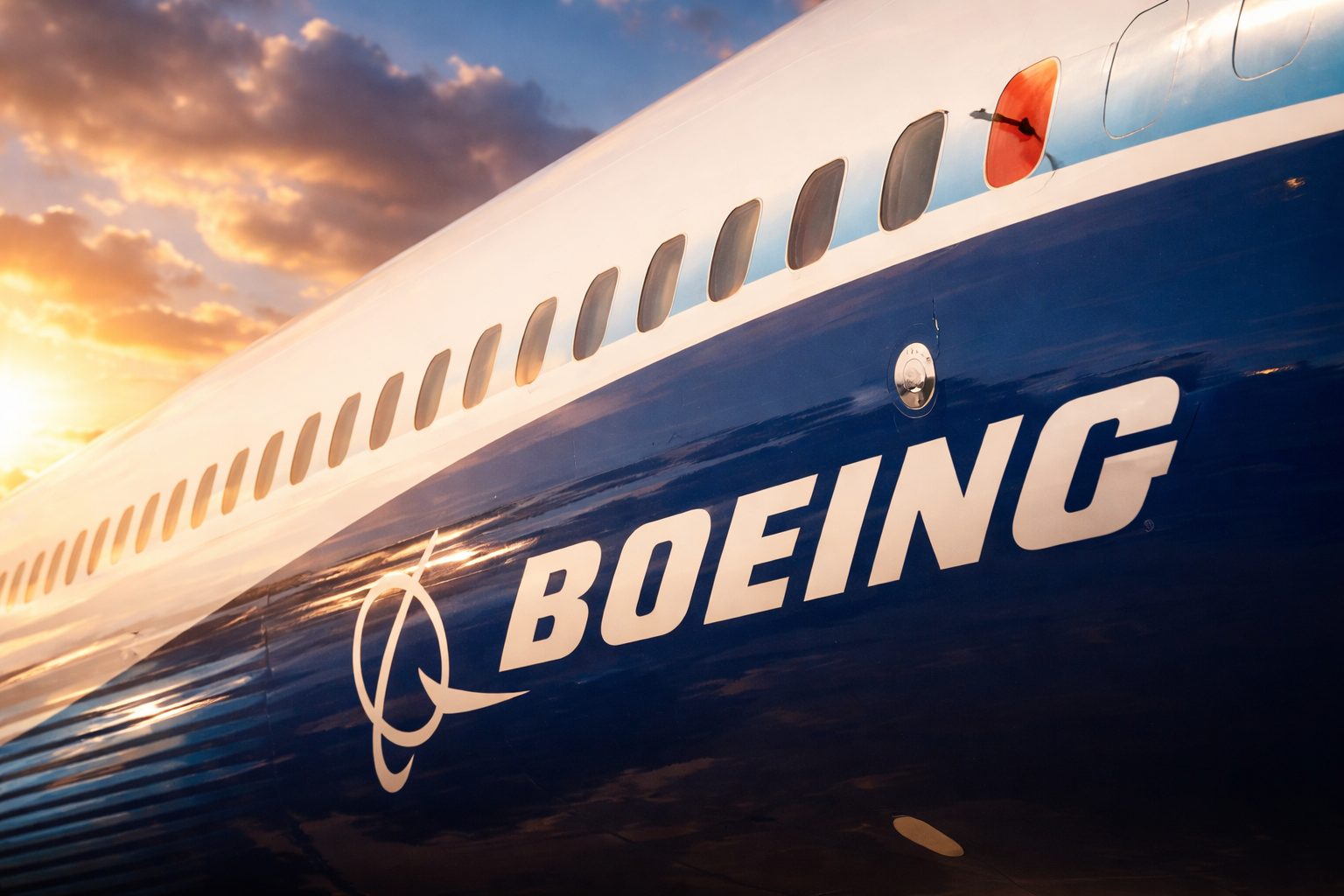

Boeing Stock News Today (Dec. 20, 2025): BA Holds Near $214 as Wall Street Bets on a 2026 Cash-Flow Turnaround
Boeing NYSE:BA enters the weekend with momentum—and with investors laser-focused on whether 2026 becomes the year the company finally turns operational progress into durable cash generation.
Because U.S. markets are closed on Saturday, December 20, 2025, the latest tape for Boeing stock is Friday’s close: $214.08, up 2.79% on the session. MarketWatch
That move mattered beyond Boeing’s chart: a strong Boeing session was one of the notable contributors to the Dow’s advance on December 19.
What makes Boeing stock especially watchable right now is that several “big levers” are moving at once—production rates, certification timelines, freighter demand, supply-chain control after the Spirit deal, and Wall Street’s 2026 free-cash-flow debate.
What’s driving Boeing stock heading into Dec. 20
Here are the most important current Boeing headlines and analyst themes circulating as of December 20, 2025:
- A major analyst vote of confidence: JPMorgan raised its price target to $245 and positioned Boeing as a top pick in its aerospace & defense outlook, reinforcing the “2026 recovery” narrative that has been building since late 2025. Investors+1
- A regulatory-and-demand story in cargo: Boeing is seeking an FAA emissions waiver that would allow sales of 35 additional 777F freighters, pointing to strong demand—but also reminding investors how closely product timing and regulation are now intertwined.
- Supply-chain control meets labor reality: After Boeing closed its Spirit AeroSystems acquisition, contract talks for about 1,600 former-Spirit white-collar union workers in Wichita were paused until January 5, 2026—a near-term execution detail with long-term implications for integration and stability.
- Certification remains a market-moving variable: The FAA is reviewing Boeing’s cockpit alerting approach tied to the 737 MAX 10, and regulators are also formalizing oversight around required safety enhancements—another reminder that Boeing’s path back to “normal” is still regulated step-by-step. Reuters+2Federal Register+2
- Defense and space headlines add cross-currents: The U.S. Air Force said it will buy two Boeing 747-8 aircraft for $400 million to support the future presidential airlift fleet—while the VC-25B (new Air Force One) effort remains delayed. Reuters
Separately, NASA modified Boeing’s Starliner contract, reducing planned missions—a negative headline for the space narrative even if it’s not the core driver of Boeing’s equity story.
Boeing’s 777F emissions waiver: a “freighter demand” catalyst with a regulatory clock
The headline Boeing investors are digesting this weekend: Boeing has asked the FAA for a waiver tied to upcoming aircraft emissions rules, aiming to sell 35 more 777F freighters beyond the compliance cutoff.
Why this matters for BA stock:
- Freighters are a high-value niche with relatively concentrated global demand. If Boeing gets the waiver, it potentially extends a profitable production runway for a mature program.
- The request is also a window into timing risk: Boeing argued it needs the exemption in part because certification of the next-generation 777-8 Freighter is behind schedule; Reuters reported expectations of first 777-8F deliveries around 2029, with the 777-9 expected in 2027.
- The market takeaway is mixed: freighter demand is supportive, but regulatory dependencies and certification timelines remain central to Boeing’s forward earnings and cash-flow expectations.
Bloomberg also highlighted the waiver angle, underscoring that the request relates to emissions rules and the 777 freighter’s future production window.
737 MAX reality check: production rate progress, but certification is still the headline risk
If you want the “one chart that matters” for Boeing—but in words—think in terms of rate + certification + delivery conversion.
Production: the 42-per-month ceiling is crucial
The FAA approved Boeing’s move to increase 737 MAX output to 42 planes per month, lifting a cap that had been in place since early 2024—an approval widely viewed as key to Boeing’s financial trajectory.
Boeing itself has emphasized the production ramp and operational stabilization in its 2025 reporting. In its third-quarter update, Boeing said the 737 program stabilized at 38 per month and reached agreement with the FAA to increase to 42 per month.
Certification: MAX 10 (and MAX 7) remains the swing factor
Reuters reported the FAA is reviewing Boeing’s cockpit alerting system for the MAX 10—part of the long-running certification journey for the MAX 7 and MAX 10 variants.
For investors, the key point isn’t just “certified vs. not certified.” It’s what certification unlocks:
- more deliverable configurations
- improved inventory conversion
- better working-capital dynamics
- and, ultimately, the free cash flow Wall Street wants Boeing to deliver consistently
Regulators are also formalizing how required safety enhancements will be implemented and overseen—another sign this remains a monitored program rather than business-as-usual.
Deliveries and backlog: Boeing’s demand is strong, but the delivery cadence still fluctuates
Boeing’s delivery data continues to send mixed short-term signals—without changing the longer-term demand picture.
Reuters reported Boeing delivered 44 jets in November, down from 53 in October, continuing to trail Airbus in month-to-month deliveries. Through November 30, Boeing had delivered 537 jets in 2025 and had booked 1,000 gross orders (net 908 after cancellations and conversions), with a backlog of 6,019 at month-end.
Separately, Boeing reported a total company backlog of $636 billion, including over 5,900 commercial airplanes—evidence that demand is not Boeing’s bottleneck; execution is.
Spirit AeroSystems integration: supply-chain control is the strategy, execution is the test
Boeing closed its takeover of Spirit AeroSystems in early December, a major supply-chain reshaping intended to reduce quality escapes and stabilize production—especially across the 737 line.
This is a big deal for Boeing stock for a simple reason: if Boeing can reduce “surprises” in fuselage and structural flow, it can reduce rework, smooth deliveries, and improve cash conversion.
But integration is not frictionless. Reuters reported Boeing and the SPEEA union paused contract talks covering roughly 1,600 former Spirit white-collar workers in Wichita until January 5, 2026.
From an equity perspective, that’s not just a labor story—it’s a timeline story. Boeing is trying to synchronize:
- supplier integration
- workforce alignment
- quality systems
- and regulated rate increases
Any slippage can show up in deliveries, margins, and cash.
Defense and space: helpful cash flows, but headline risk persists
Boeing’s stock is often priced primarily off commercial recovery, but defense and space are still important—especially when they generate contract wins (or negative surprises).
Presidential fleet support: two 747-8s ordered
Reuters reported the U.S. Air Force will buy two Boeing 747-8 aircraft for $400 million for future presidential airlift fleet support, with deliveries expected in early and late 2026—separate from the VC-25B aircraft being modified into the next Air Force One.
Starliner: fewer missions, smaller contract value
NASA modified Boeing’s Starliner contract and reduced the number of planned flights (with a reported contract value reduction), showing ongoing program uncertainty and limiting the near-term upside narrative for Boeing’s space segment.
The core investment debate: can Boeing actually deliver positive free cash flow in 2026?
The single most “stock-moving” theme under BA right now is cash flow.
Reuters reported Boeing CFO Jay Malave said Boeing expects higher 737 and 787 deliveries next year and aims to return to positive free cash flow in 2026—a metric closely watched by investors after years of disruption and elevated debt.
Barron’s framed the same CFO message as a meaningful sentiment shift: investors reacted strongly to the idea that Boeing’s 2025 cash outflow could improve into positive territory in 2026, even if the recovery is gradual.
This matters because Boeing’s equity multiple and “turnaround credibility” depend less on one quarter’s EPS and more on whether Boeing can consistently convert backlog into deliveries and cash.
Boeing stock forecast: what analysts are projecting as of Dec. 20, 2025
Analyst targets differ depending on methodology and timing, but the consensus picture going into late December is broadly constructive—while still acknowledging substantial execution risk.
A snapshot of widely cited consensus ranges:
- MarketWatch shows an average target price around $247.74 (as of its latest update), implying mid-teens upside from the ~$214 area.
- StockAnalysis lists an average target near $241.16 with a “Strong Buy” style consensus framing (based on its tracked analysts) and a wide target range. StockAnalysis
- MarketBeat shows an average target around $233.17, with a broad dispersion between low and high targets—evidence that Boeing remains a “two-story stock” depending on whether you believe the recovery trajectory. MarketBeat
And notably, JPMorgan’s $245 target hike (and “top pick” framing) has been one of the most-circulated catalyst notes in the latest news cycle. Investors+1
How to interpret these forecasts (without over-trusting them):
Price targets in turnarounds tend to move in “steps” after operational evidence accumulates—production stability, certification milestones, and delivery conversion. They can also reverse quickly if regulators or quality issues interrupt momentum.
Bull case vs. bear case for BA stock into 2026
The bull case: a multi-year backlog finally turns into cash
Supporters of the long thesis point to:
- FAA-approved higher production ceilings and evidence of stabilization in core programs Reuters+1
- strong backlog that offers multi-year demand visibility Boeing Investors+1
- CFO-guided confidence in positive 2026 free cash flow, implying the turnaround is reaching the phase equity markets reward Reuters
- freighter demand that remains strong enough for Boeing to seek regulatory relief to extend 777F sales Reuters
The bear case: certification/quality and integration risk can still break the model
Skeptics focus on:
- the still-active regulatory pipeline around MAX variants and safety enhancements Reuters+1
- program delays (including widebody timelines that affect product mix and margins) Reuters+1
- integration and labor friction following Spirit’s return to Boeing Reuters+1
- headline risk in space programs like Starliner that can weigh on sentiment even if commercial is improving Reuters
What to watch next: Boeing catalysts investors are tracking into January 2026
If you’re following Boeing stock closely, the next “tell” likely comes from measurable operational checkpoints:
- January 5, 2026: scheduled resumption of paused contract talks for former Spirit AeroSystems white-collar workers Reuters
- ongoing FAA actions tied to MAX 10 certification items and mandated safety enhancements Reuters+1
- monthly delivery updates (and whether Boeing’s 737/787 cadence improves into 2026) Reuters+1
- any incremental news on the 777-8F / 777-9 certification and delivery timeline Reuters
Bottom line
As of December 20, 2025, Boeing stock near $214 reflects a market that’s increasingly willing to price in a 2026 improvement—but still demands proof. The news cycle is supportive (analyst target hikes, supply-chain control moves, freighter demand), yet the company remains highly exposed to the same variables that have defined the last several years: regulatory milestones, quality execution, and delivery conversion into free cash flow. Investors+2Reuters+2Boeing NYSE:BA enters the weekend with momentum—and with investors laser-focused on whether 2026 becomes the year the company finally turns operational progress into durable cash generation.
Because U.S. markets are closed on Saturday, December 20, 2025, the latest tape for Boeing stock is Friday’s close: $214.08, up 2.79% on the session. MarketWatch
That move mattered beyond Boeing’s chart: a strong Boeing session was one of the notable contributors to the Dow’s advance on December 19.
What makes Boeing stock especially watchable right now is that several “big levers” are moving at once—production rates, certification timelines, freighter demand, supply-chain control after the Spirit deal, and Wall Street’s 2026 free-cash-flow debate.
What’s driving Boeing stock heading into Dec. 20
Here are the most important current Boeing headlines and analyst themes circulating as of December 20, 2025:
- A major analyst vote of confidence: JPMorgan raised its price target to $245 and positioned Boeing as a top pick in its aerospace & defense outlook, reinforcing the “2026 recovery” narrative that has been building since late 2025. Investors+1
- A regulatory-and-demand story in cargo: Boeing is seeking an FAA emissions waiver that would allow sales of 35 additional 777F freighters, pointing to strong demand—but also reminding investors how closely product timing and regulation are now intertwined.
- Supply-chain control meets labor reality: After Boeing closed its Spirit AeroSystems acquisition, contract talks for about 1,600 former-Spirit white-collar union workers in Wichita were paused until January 5, 2026—a near-term execution detail with long-term implications for integration and stability.
- Certification remains a market-moving variable: The FAA is reviewing Boeing’s cockpit alerting approach tied to the 737 MAX 10, and regulators are also formalizing oversight around required safety enhancements—another reminder that Boeing’s path back to “normal” is still regulated step-by-step. Reuters+2Federal Register+2
- Defense and space headlines add cross-currents: The U.S. Air Force said it will buy two Boeing 747-8 aircraft for $400 million to support the future presidential airlift fleet—while the VC-25B (new Air Force One) effort remains delayed. Reuters
Separately, NASA modified Boeing’s Starliner contract, reducing planned missions—a negative headline for the space narrative even if it’s not the core driver of Boeing’s equity story.
Boeing’s 777F emissions waiver: a “freighter demand” catalyst with a regulatory clock
The headline Boeing investors are digesting this weekend: Boeing has asked the FAA for a waiver tied to upcoming aircraft emissions rules, aiming to sell 35 more 777F freighters beyond the compliance cutoff.
Why this matters for BA stock:
- Freighters are a high-value niche with relatively concentrated global demand. If Boeing gets the waiver, it potentially extends a profitable production runway for a mature program.
- The request is also a window into timing risk: Boeing argued it needs the exemption in part because certification of the next-generation 777-8 Freighter is behind schedule; Reuters reported expectations of first 777-8F deliveries around 2029, with the 777-9 expected in 2027.
- The market takeaway is mixed: freighter demand is supportive, but regulatory dependencies and certification timelines remain central to Boeing’s forward earnings and cash-flow expectations.
Bloomberg also highlighted the waiver angle, underscoring that the request relates to emissions rules and the 777 freighter’s future production window.
737 MAX reality check: production rate progress, but certification is still the headline risk
If you want the “one chart that matters” for Boeing—but in words—think in terms of rate + certification + delivery conversion.
Production: the 42-per-month ceiling is crucial
The FAA approved Boeing’s move to increase 737 MAX output to 42 planes per month, lifting a cap that had been in place since early 2024—an approval widely viewed as key to Boeing’s financial trajectory.
Boeing itself has emphasized the production ramp and operational stabilization in its 2025 reporting. In its third-quarter update, Boeing said the 737 program stabilized at 38 per month and reached agreement with the FAA to increase to 42 per month.
Certification: MAX 10 (and MAX 7) remains the swing factor
Reuters reported the FAA is reviewing Boeing’s cockpit alerting system for the MAX 10—part of the long-running certification journey for the MAX 7 and MAX 10 variants.
For investors, the key point isn’t just “certified vs. not certified.” It’s what certification unlocks:
- more deliverable configurations
- improved inventory conversion
- better working-capital dynamics
- and, ultimately, the free cash flow Wall Street wants Boeing to deliver consistently
Regulators are also formalizing how required safety enhancements will be implemented and overseen—another sign this remains a monitored program rather than business-as-usual.
Deliveries and backlog: Boeing’s demand is strong, but the delivery cadence still fluctuates
Boeing’s delivery data continues to send mixed short-term signals—without changing the longer-term demand picture.
Reuters reported Boeing delivered 44 jets in November, down from 53 in October, continuing to trail Airbus in month-to-month deliveries. Through November 30, Boeing had delivered 537 jets in 2025 and had booked 1,000 gross orders (net 908 after cancellations and conversions), with a backlog of 6,019 at month-end.
Separately, Boeing reported a total company backlog of $636 billion, including over 5,900 commercial airplanes—evidence that demand is not Boeing’s bottleneck; execution is.
Spirit AeroSystems integration: supply-chain control is the strategy, execution is the test
Boeing closed its takeover of Spirit AeroSystems in early December, a major supply-chain reshaping intended to reduce quality escapes and stabilize production—especially across the 737 line.
This is a big deal for Boeing stock for a simple reason: if Boeing can reduce “surprises” in fuselage and structural flow, it can reduce rework, smooth deliveries, and improve cash conversion.
But integration is not frictionless. Reuters reported Boeing and the SPEEA union paused contract talks covering roughly 1,600 former Spirit white-collar workers in Wichita until January 5, 2026.
From an equity perspective, that’s not just a labor story—it’s a timeline story. Boeing is trying to synchronize:
- supplier integration
- workforce alignment
- quality systems
- and regulated rate increases
Any slippage can show up in deliveries, margins, and cash.
Defense and space: helpful cash flows, but headline risk persists
Boeing’s stock is often priced primarily off commercial recovery, but defense and space are still important—especially when they generate contract wins (or negative surprises).
Presidential fleet support: two 747-8s ordered
Reuters reported the U.S. Air Force will buy two Boeing 747-8 aircraft for $400 million for future presidential airlift fleet support, with deliveries expected in early and late 2026—separate from the VC-25B aircraft being modified into the next Air Force One.
Starliner: fewer missions, smaller contract value
NASA modified Boeing’s Starliner contract and reduced the number of planned flights (with a reported contract value reduction), showing ongoing program uncertainty and limiting the near-term upside narrative for Boeing’s space segment.
The core investment debate: can Boeing actually deliver positive free cash flow in 2026?
The single most “stock-moving” theme under BA right now is cash flow.
Reuters reported Boeing CFO Jay Malave said Boeing expects higher 737 and 787 deliveries next year and aims to return to positive free cash flow in 2026—a metric closely watched by investors after years of disruption and elevated debt.
Barron’s framed the same CFO message as a meaningful sentiment shift: investors reacted strongly to the idea that Boeing’s 2025 cash outflow could improve into positive territory in 2026, even if the recovery is gradual.
This matters because Boeing’s equity multiple and “turnaround credibility” depend less on one quarter’s EPS and more on whether Boeing can consistently convert backlog into deliveries and cash.
Boeing stock forecast: what analysts are projecting as of Dec. 20, 2025
Analyst targets differ depending on methodology and timing, but the consensus picture going into late December is broadly constructive—while still acknowledging substantial execution risk.
A snapshot of widely cited consensus ranges:
- MarketWatch shows an average target price around $247.74 (as of its latest update), implying mid-teens upside from the ~$214 area.
- StockAnalysis lists an average target near $241.16 with a “Strong Buy” style consensus framing (based on its tracked analysts) and a wide target range. StockAnalysis
- MarketBeat shows an average target around $233.17, with a broad dispersion between low and high targets—evidence that Boeing remains a “two-story stock” depending on whether you believe the recovery trajectory. MarketBeat
And notably, JPMorgan’s $245 target hike (and “top pick” framing) has been one of the most-circulated catalyst notes in the latest news cycle. Investors+1
How to interpret these forecasts (without over-trusting them):
Price targets in turnarounds tend to move in “steps” after operational evidence accumulates—production stability, certification milestones, and delivery conversion. They can also reverse quickly if regulators or quality issues interrupt momentum.
Bull case vs. bear case for BA stock into 2026
The bull case: a multi-year backlog finally turns into cash
Supporters of the long thesis point to:
- FAA-approved higher production ceilings and evidence of stabilization in core programs Reuters+1
- strong backlog that offers multi-year demand visibility Boeing Investors+1
- CFO-guided confidence in positive 2026 free cash flow, implying the turnaround is reaching the phase equity markets reward Reuters
- freighter demand that remains strong enough for Boeing to seek regulatory relief to extend 777F sales Reuters
The bear case: certification/quality and integration risk can still break the model
Skeptics focus on:
- the still-active regulatory pipeline around MAX variants and safety enhancements Reuters+1
- program delays (including widebody timelines that affect product mix and margins) Reuters+1
- integration and labor friction following Spirit’s return to Boeing Reuters+1
- headline risk in space programs like Starliner that can weigh on sentiment even if commercial is improving Reuters
What to watch next: Boeing catalysts investors are tracking into January 2026
If you’re following Boeing stock closely, the next “tell” likely comes from measurable operational checkpoints:
- January 5, 2026: scheduled resumption of paused contract talks for former Spirit AeroSystems white-collar workers Reuters
- ongoing FAA actions tied to MAX 10 certification items and mandated safety enhancements Reuters+1
- monthly delivery updates (and whether Boeing’s 737/787 cadence improves into 2026) Reuters+1
- any incremental news on the 777-8F / 777-9 certification and delivery timeline Reuters
Bottom line
As of December 20, 2025, Boeing stock near $214 reflects a market that’s increasingly willing to price in a 2026 improvement—but still demands proof. The news cycle is supportive (analyst target hikes, supply-chain control moves, freighter demand), yet the company remains highly exposed to the same variables that have defined the last several years: regulatory milestones, quality execution, and delivery conversion into free cash flow.
Related articles: NYSE:BA