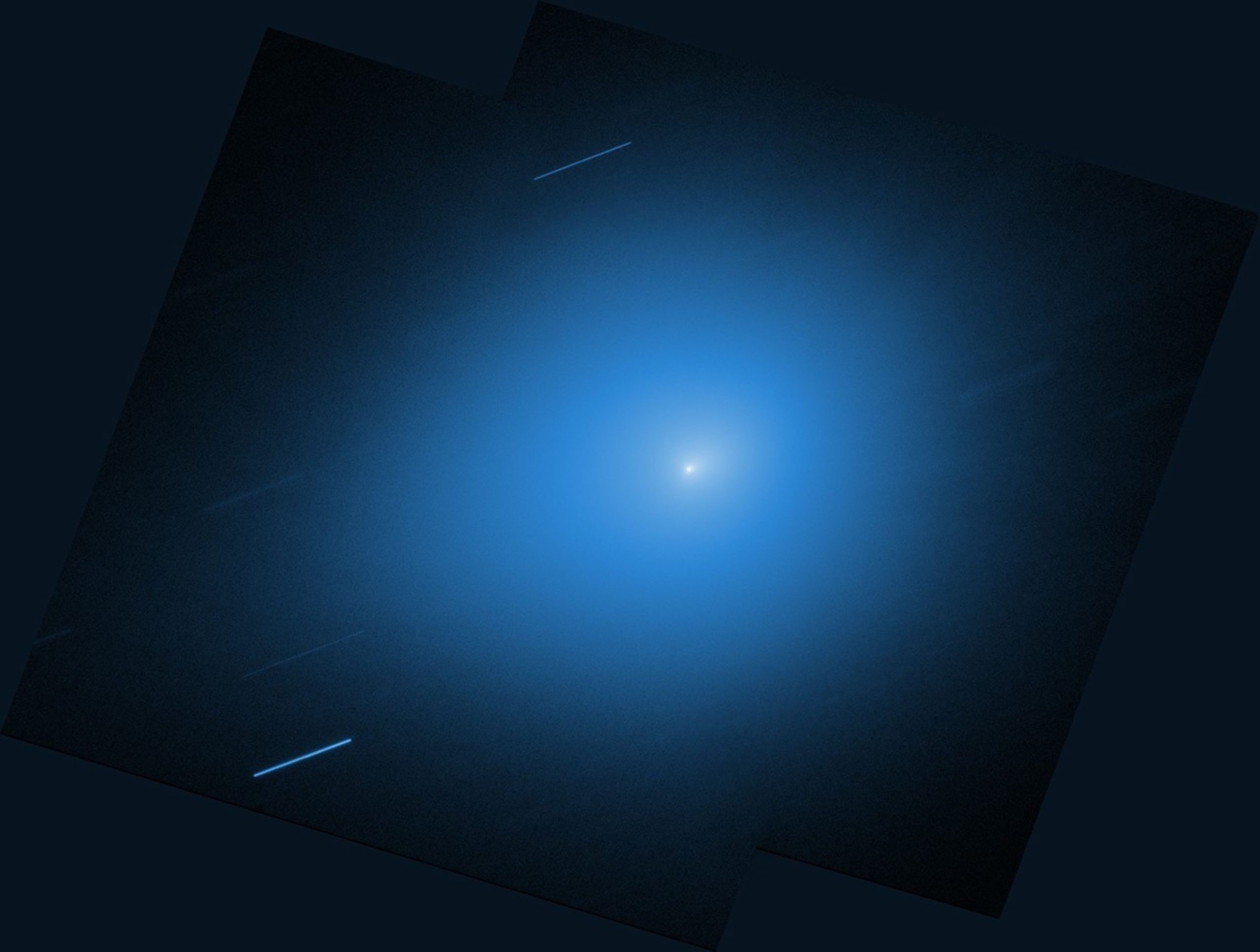

On Sunday, December 21, 2025, the interstellar comet 3I/ATLAS is already on the “goodbye” leg of its once-in-a-lifetime pass through our solar system—two days after its closest approach to Earth. The comet is still observable with amateur gear, but it’s fading night by night as it retreats outward, while scientists race to squeeze out every last clue about what formed around another star. AP News+2NASA Science+2
This week-ahead report pulls together the key news, observing forecasts, and scientific analyses available as of Dec. 21, 2025, including new space-telescope results (X-rays!), radio searches, and NASA mission updates—plus what to expect in the sky through Dec. 28.
Comet 3I/ATLAS today (Dec. 21, 2025): where it is, how bright it is, and what that means
As of Dec. 21, comet trackers put 3I/ATLAS at about:
- Estimated brightness: around magnitude 12.9 (telescope territory, not naked-eye)
- Distance from Earth: about 1.80 AU
- Distance from the Sun: about 2.36 AU
- Sky position: in the general region of Leo, near the bright star Regulus (a convenient landmark for star-hopping)
Those numbers matter for practical viewing. Magnitude ~13 usually means:
- You’ll want dark skies and at least a modest telescope (especially if you’re not imaging).
- A camera will outperform your eye: even a short series of stacked exposures can pull a faint coma out of the background.
NASA continues to emphasize the bottom line for anyone nervously Googling “comet near Earth”: 3I/ATLAS is not a threat. Even at closest approach, it stayed about 1.8 AU (~170 million miles / ~270 million km) away—nearly twice Earth’s distance from the Sun. NASA Science+2NASA Science+2
What just happened: 3I/ATLAS made its closest approach to Earth on Dec. 19
The big “event” everyone circled on the calendar was Friday, Dec. 19, 2025, when 3I/ATLAS made its closest pass by Earth at roughly 167–168 million miles (about 269–270 million km). AP News+1
In classic comet fashion, that doesn’t mean it suddenly became bright. It means we got the best geometry (closest distance) while the comet was already heading outward, fading as it exits.
And “exits” is literal: 3I/ATLAS is on a hyperbolic trajectory, moving too fast to remain bound to the Sun—one reason astronomers classify it as interstellar in the first place. NASA Science+1
Why 3I/ATLAS is such a big deal: a third confirmed interstellar visitor, with months of lead time
3I/ATLAS is only the third known object confirmed to originate outside our solar system, following 1I/‘Oumuamua (2017) and 2I/Borisov (2019). Unlike those earlier surprises, 3I/ATLAS was discovered with enough lead time to organize a global observing campaign across wavelengths.
NASA’s overview notes the object was first reported on July 1, 2025 by the NASA-funded ATLAS survey telescope in Chile, with “pre-discovery” detections found in earlier archival images. NASA Science
Size is still uncertain, but NASA’s Hubble-based estimates place the nucleus diameter somewhere between roughly 440 meters and 5.6 kilometers.
The science headlines you should know this week: X-rays, radio observations, and a UN-backed tracking campaign
1) X-rays from an interstellar comet: XRISM and XMM-Newton deliver a first
One of the most striking developments in the days leading up to the Earth flyby: 3I/ATLAS has now been imaged in X-rays, letting astronomers study how an interstellar comet’s gases interact with the solar wind.
- XRISM (JAXA-led, with NASA and ESA participation) observed 3I/ATLAS for about 17 hours (Nov. 26–28), with preliminary analysis showing a faint X-ray glow extending roughly 400,000 km around the nucleus.
- ESA’s XMM-Newton followed with around 20 hours of observations on Dec. 3, seeing the comet glowing in low-energy X-rays—an effect expected when outflowing comet gas collides with solar wind ions.
ESA also highlights why X-rays are uniquely valuable here: they can be sensitive to gases that are hard to measure in visible/UV, adding another layer to what Webb and other instruments have already been probing.
2) The “radio signal” story: natural comet chemistry, not a transmission
A separate—and widely misunderstood—headline this season has been talk of a “radio signal” from 3I/ATLAS. The most careful reporting and technical summaries converge on an unflashy conclusion: the detections are consistent with normal cometary physics.
- Live Science reports MeerKAT detected features explained as hydroxyl (OH) absorption—a classic marker related to water being broken down by sunlight in an active comet coma.
- WIRED likewise describes the detection as OH absorption at the 1665 and 1667 MHz lines, consistent with comet activity and viewing geometry near perihelion.
Meanwhile, Breakthrough Listen used major radio facilities—including the 100-meter Green Bank Telescope right before closest approach—and reported no artificial radio emission localized to 3I/ATLAS.
3) Why the UN’s asteroid-warning network is watching a harmless comet
Even though 3I/ATLAS poses no threat, it has become an ideal real-world target for improving global tracking methods. Live Science reports that the International Asteroid Warning Network (IAWN)—a UN-backed coordination effort—has been using 3I/ATLAS as a test case to strengthen astrometry and reporting techniques, with NASA coordinating the campaign and many observatories participating.
NASA’s newest mission update: Parker Solar Probe tracked 3I/ATLAS when Earth couldn’t
One of the freshest official updates as the comet passed Earth: NASA says Parker Solar Probe observed 3I/ATLAS from Oct. 18 to Nov. 5, 2025 using its WISPR imager—capturing a period when the comet was difficult or impossible to observe from Earth because it appeared too close to the Sun in our sky.
That matters for week-ahead coverage because it underscores a theme: even as ground observers watch 3I/ATLAS fade, researchers are still stitching together a much longer, multi-mission timeline of the comet’s behavior around solar conjunction and perihelion.
Week-ahead forecast: how Comet 3I/ATLAS is expected to change from Dec. 22–28, 2025
The short version: it fades, it drifts across Leo, and the viewing geometry slowly improves.
Ephemerides for the coming week indicate:
- Brightness: about mag 13.0 → 13.5 from Dec. 22 to Dec. 28
- Earth distance (Δ): about 1.801 AU → 1.833 AU (slowly increasing)
- Solar elongation: about 113° → 126.7° (increasing separation from the Sun, generally helpful for night observing windows)
Night-by-night snapshot (00:00 UT values)
Based on the published ephemerides, here’s the expected trend through the week ahead:
- Mon, Dec. 22: mag ~13.0
- Tue, Dec. 23: mag ~13.1
- Wed, Dec. 24: mag ~13.2
- Thu, Dec. 25: mag ~13.2
- Fri, Dec. 26: mag ~13.3
- Sat, Dec. 27: mag ~13.4
- Sun, Dec. 28: mag ~13.5
The coordinates also show a steady drift (RA decreasing from ~10h33m to ~10h04m, declination rising from ~+8° to ~+10.5°), consistent with the comet remaining in the same broad patch of sky rather than streaking into a new “easy” naked-eye configuration. Astro Van Buitenen+1
How to see Comet 3I/ATLAS this week: practical viewing guidance that actually works
Use Regulus as your anchor—then let software do the precision
National Geographic’s observer guidance points to the comet being found in Leo near Regulus, which is one of the simplest “bright-star starting points” you can ask for. In practice:
- Locate Regulus (easy even in suburban skies).
- Use a sky app (or your telescope’s go-to alignment) to jump from Regulus to the comet’s exact coordinates for your time and location.
- Expect a faint, fuzzy patch—more like a smudge than a dramatic tailed comet—unless you’re imaging.
Choose the right time window
Because 3I/ATLAS is now positioned well away from the Sun (elongation rising through the week), it’s not stuck in twilight—but it’s still generally described as a late-night to pre-dawn object for many observers.
Match your expectations to your equipment
For the coming week’s ~13th magnitude brightness:
- Visual observing: best with a moderate-to-large aperture and dark skies.
- Imaging: a much better bet. Even modest rigs can detect comets in this range with tracking + stacking.
- Binoculars alone: usually not enough at these magnitudes unless conditions are exceptional.
One forecast caveat that matters
Comet brightness forecasts are notoriously uncertain, and the ephemeris source itself notes recalculations based on ongoing observational reports. In other words: treat magnitudes as best estimates, not guarantees.
What happens after this week: Jupiter in March 2026, then a long fade into the dark
Even though Earth’s moment has passed, 3I/ATLAS still has a few key milestones ahead:
- It is expected to pass much closer to Jupiter in March 2026, at around 33 million miles (53 million km), according to AP’s reporting.
- NASA says the comet should remain observable until spring 2026 (for those with the gear and patience).
- On the longer timeline, AP quotes NASA’s Near-Earth Object Studies leadership saying it will be the mid-2030s before the comet fully reaches interstellar space again, never to return.
The bottom line for Dec. 21–28: a fading target for observers, a gold mine for scientists
If you’re hoping for a casual “step outside and see it” comet, 3I/ATLAS isn’t that—not this week. But if you have a telescope (or you’re willing to watch via online observatories and follow the data releases), the coming days are still part of the most sustained, multi-wavelength investigation we’ve ever mounted for an interstellar visitor.
And from X-rays to radio checks to solar-probe imagery, the real story going into the last full week of 2025 is that 3I/ATLAS is behaving like a comet—just one that was born somewhere else.
Related articles: Stock Market