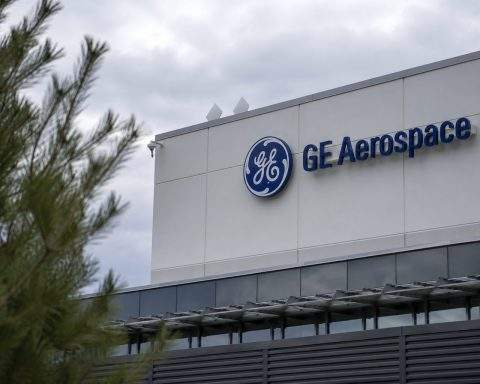
GE Aerospace NYSE:GE heads into the Christmas-shortened trading week with shares hovering near record territory after a volatile mid-December tape. The stock closed Friday, December 19 at $307.21, extending a two-day rebound and leaving it just under the $316.67 52-week high set in late October.
For investors sizing up GE Aerospace stock in the week ahead (Monday, Dec. 22 through Friday, Dec. 26), the setup is defined by three forces:
- Holiday market structure (lighter liquidity, shorter session midweek),
- A dense U.S. macro calendar on Tuesday, and
- A steady stream of engine-order headlines and regulatory developments that reinforce why GE is increasingly traded as a “commercial aerospace aftermarket + production ramp” story rather than a traditional industrial conglomerate.
Below is a week-ahead, publication-ready briefing based on the latest reporting and analyst commentary available as of 21.12.2025.
Where GE Aerospace stock stands heading into the holiday week
GE Aerospace shares finished the last full week before Christmas on a stronger note, with volume on December 19 running notably above recent averages.
From a market-structure perspective, two details matter for the week ahead:
- The stock is still within striking distance of its late-October high (a level that often acts like a magnet in year-end, momentum-driven trading).
- Technical-focused coverage on December 21 flagged GE among stocks “in buy zones,” while also noting that holiday trading can be light—often amplifying moves when big orders hit the tape. Investors.com+1
None of that guarantees direction, but it does frame the near-term: if the broader market stabilizes, GE’s combination of “industrial quality + aerospace growth” can keep it on screens; if risk appetite fades, a high-profile winner near highs can also see sharper profit-taking.
Week-ahead calendar: U.S. market hours and the macro events that can move industrials
U.S. stock market hours (Christmas week)
Expect a non-standard rhythm:
- Wednesday, Dec. 24 (Christmas Eve): early close for U.S. equities.
- Thursday, Dec. 25: markets closed for Christmas Day.
- Friday, Dec. 26: markets open for a regular session.
For GE Aerospace stock specifically, that matters because large-cap industrials can see outsized intraday swings when liquidity thins—especially if a headline breaks during a shortened session.
The key U.S. data cluster: Tuesday, Dec. 23
According to S&P Global Market Intelligence’s week-ahead preview, Tuesday is the main event for U.S. economic releases, including:
- U.S. GDP (Q3, third estimate)
- Durable goods orders (October)
- Industrial production (November)
- Conference Board consumer confidence (December)
- New home sales (November)
Wednesday, Dec. 24 (pre-close): jobless claims
The same preview flags U.S. initial jobless claims on Wednesday.
Why macro still matters for GE: GE Aerospace is not priced like a slow-growth industrial. Rate expectations and “soft landing vs. hard landing” narratives can flow through to premium industrials, especially those near highs.
The biggest GE Aerospace headlines investors are digesting as of 21.12.2025
Here’s what’s shaping sentiment right now—news, forecasts, and analyst takes circulating on December 21:
1) JPMorgan’s aerospace stance stays constructive (even with rich valuations)
A JPMorgan sector outlook circulated this weekend emphasized strong commercial aerospace fundamentals—pointing to Boeing/Airbus backlogs, global air traffic expansion, an aging fleet, and rising production, which support both OEM activity and aftermarket services (a key profit pool for GE).
2) Technical coverage keeps GE on leadership lists
Investor’s Business Daily’s December 21 market briefing highlighted GE among actionable leaders and noted the expectation of light holiday trading.
3) A fresh, high-visibility engine order: Pegasus + CFM (LEAP-1B)
CFM International (GE Aerospace / Safran JV) announced on December 18 an agreement with Pegasus Airlines for up to 300 LEAP‑1B engines to power the carrier’s future Boeing 737‑10 fleet, including spares and a long-term maintenance agreement.
Even without a dollar value disclosed in the CFM release, the structure matters to equity investors: these deals often include service components that can translate into higher-margin, longer-duration revenue streams.
4) Dividend clock is approaching (next Monday)
GE Aerospace’s board declared a $0.36 per share dividend payable January 26, 2026, with a record date of December 29, 2025 and an ex-dividend date of December 29, 2025.
That date falls just after the coming week, but it can influence positioning into the final trading days of the year.
5) FAA regulatory watch: LEAP engine directive effective Dec. 29
A Federal Register posting describes an FAA airworthiness directive affecting certain CFM International LEAP‑1A engines, with the rule effective December 29, 2025, and centered on inspection requirements tied to high-pressure turbine components.
Investors tend to read such items in two ways: (a) near-term operational risk for airlines and the supply chain, and (b) potential longer-run service-shop demand—though the real financial impact depends on scope, timing, and cost-sharing mechanisms.
Why GE Aerospace’s fundamentals still center on services, output, and durability
To understand why the market reacts to orders and directives, it helps to anchor to GE’s own operating snapshot.
In its third-quarter 2025 results, GE Aerospace reported:
- Total orders of $12.8B (up 2%)
- GAAP revenue of $12.2B (up 24%) and adjusted revenue of $11.3B (up 26%)
- Adjusted EPS of $1.66 (up 44%)
- Free cash flow of $2.4B (up 30%)
- And it raised 2025 guidance across the board, citing robust demand and improved output.
GE also pointed to supplier input improvements and strong momentum in its commercial services engine: it cited services revenue growth and rising deliveries, including record LEAP deliveries year-over-year in the quarter.
This is the backdrop for why “week-ahead” investors care so much about any incremental datapoint on:
- LEAP durability and shop-visit cycles,
- Production cadence and supplier throughput, and
- The mix between engine sales now vs. service revenue later.
Commercial catalysts: the LEAP engine news cycle stays front and center
The Pegasus order is a LEAP + services headline, not just an engine-count headline
The Pegasus Airlines agreement is particularly relevant because it ties a large narrowbody fleet plan (737‑10) to LEAP‑1B propulsion with long-term maintenance services included.
For GE Aerospace stock, that helps reinforce a key equity narrative: aftermarket and services economics can be as important as the upfront engine delivery.
LEAP program sensitivity: durability, directives, and airline operational constraints
At the same time, any durability-related issue in next-generation engines can hit sentiment quickly—especially when it intersects with regulatory action.
The FAA’s LEAP‑1A directive effective December 29, 2025 is likely to remain on investor radar into year-end.
Week-ahead implication: While the rule’s effective date is next week, traders often “pull forward” attention. If aviation media expands on airline impact, maintenance slot pressure, or parts availability, GE can move on the headline even before any measurable financial effect is clear.
Widebody momentum: GE9X and GEnx orders keep stacking up
Although narrowbody engines dominate the global installed base growth story, widebody orders matter because they often arrive with large service agreements and high visibility.
Emirates: 130 additional GE9X engines (and services)
GE Aerospace announced in mid-November that Emirates signed an agreement for 130 GE9X engines to power 65 additional Boeing 777‑9 aircraft, including spare engines and a long-term services agreement—and said the carrier’s total GE9X engines on order exceeded 540.
The market takeaway is twofold:
- It reinforces GE’s position on one of the highest-profile future widebody programs, and
- It emphasizes services—again—because long-term agreements are explicitly part of the structure.
Turkish Airlines: engines + services for 75 Boeing 787s
Reuters also reported that Turkish Airlines reached an engine deal with GE Aerospace for 75 Boeing 787 aircraft, covering engines, spares, and maintenance services.
Week-ahead implication: This is the kind of “sticky services backlog” headline that tends to support valuation, especially when combined with a macro narrative that global travel demand and long-haul capacity are still rebuilding.
Defense and marine: smaller headlines, but supportive to the “diversified propulsion” thesis
GE Aerospace is widely traded as a commercial jet cycle winner, but defense and marine updates matter at the margin—particularly when defense budgets and geopolitical risk remain in the background.
Recent company and industry releases include:
- LM2500 marine gas turbine orders tied to U.S. Navy destroyers (GE’s marine engines and systems business).
- A report that the U.S. Navy awarded a $22.2M R&D contract connected to F414 engine upgrades for the Super Hornet and Growler fleets.
For week-ahead trading, these aren’t likely to be primary catalysts unless followed by additional large awards—but they contribute to the “GE isn’t a single-program story” narrative that can be valuable in risk-off tapes.
Analyst forecasts and price targets: what Wall Street is signaling into year-end
The price-target spread is wide, but the direction is mostly bullish
As of mid-to-late December, a key feature of GE Aerospace stock coverage is that price targets have moved higher broadly—even if upside to “consensus” varies by data vendor.
- TipRanks shows an average price target around the low-to-mid $340s, with a high forecast of $386 and a low forecast of $275, based on recent analyst updates.
- A MarketBeat recap of recent notes cites multiple raised targets and reiterations, including Citigroup’s $386, Bank of America’s $365, and UBS’s $366, among others.
- Citi’s initiation (covered in financial press earlier this month) framed GE as a potential $1 trillion market-cap company over a multi-year horizon, and highlighted a $316.67 technical buy point in the stock at the time of that note’s circulation.
Week-ahead implication: When a stock is near highs, the market often reacts more to changes in targets and tone (upgrades, initiations, thesis shifts) than to the absolute consensus number.
Near-term earnings expectations and the next major company date
Some market previews are already leaning toward the next quarterly print:
- Nasdaq.com coverage points to consensus expectations for GE’s next report, including forecast EPS and revenue figures (as of the date of that publication).
- GE Aerospace’s investor calendar lists its 4Q 2025 / full-year earnings webcast on January 22, 2026 (7:30 a.m. ET).
For the coming week, that means there is no scheduled GE earnings catalyst—but positioning can start early because January earnings often become the next “big narrative reset” for high-momentum industrial names.
Risks and watch-items for GE Aerospace stock this week
A week-ahead outlook is incomplete without the risk side—especially in a holiday week when moves can look bigger than they are.
1) Liquidity risk (holiday effect): Early closes and lighter participation can exaggerate both breakouts and pullbacks.
2) Macro sensitivity concentrated on Tuesday: If GDP/durable goods/industrial production surprise meaningfully, rates and cyclicals can reprice quickly, pulling GE with them even without company news.
3) LEAP headline risk: Any follow-on coverage about inspections, shop capacity, or airline impacts can move sentiment—especially with an FAA directive effective Dec. 29.
4) Program timing vs. valuation: Big orders (Emirates 777-9/GE9X, Pegasus 737-10/LEAP) are strategically important, but delivery schedules extend years into the future, making near-term multiples sensitive to execution and margin expectations.
Bottom line: the “week-ahead” playbook for GE Aerospace NYSE:GE
For the week of Dec. 22–26, 2025, GE Aerospace stock is set up as a “headline + macro” trade:
- Macro dominates Tuesday, with a burst of U.S. data that can shift the tape for industrial leaders.
- Company-specific catalysts are more incremental, but the market is still digesting major December developments—especially the Pegasus LEAP-1B agreement, the FAA LEAP-related directive effective next week, and the ongoing drumbeat of widebody engine+services wins (Emirates, Turkish Airlines).
- Analyst tone remains broadly constructive, with several high-profile targets well above the current price—yet that also raises the bar for execution as the market looks ahead to January earnings.
Related articles: NYSE:GE