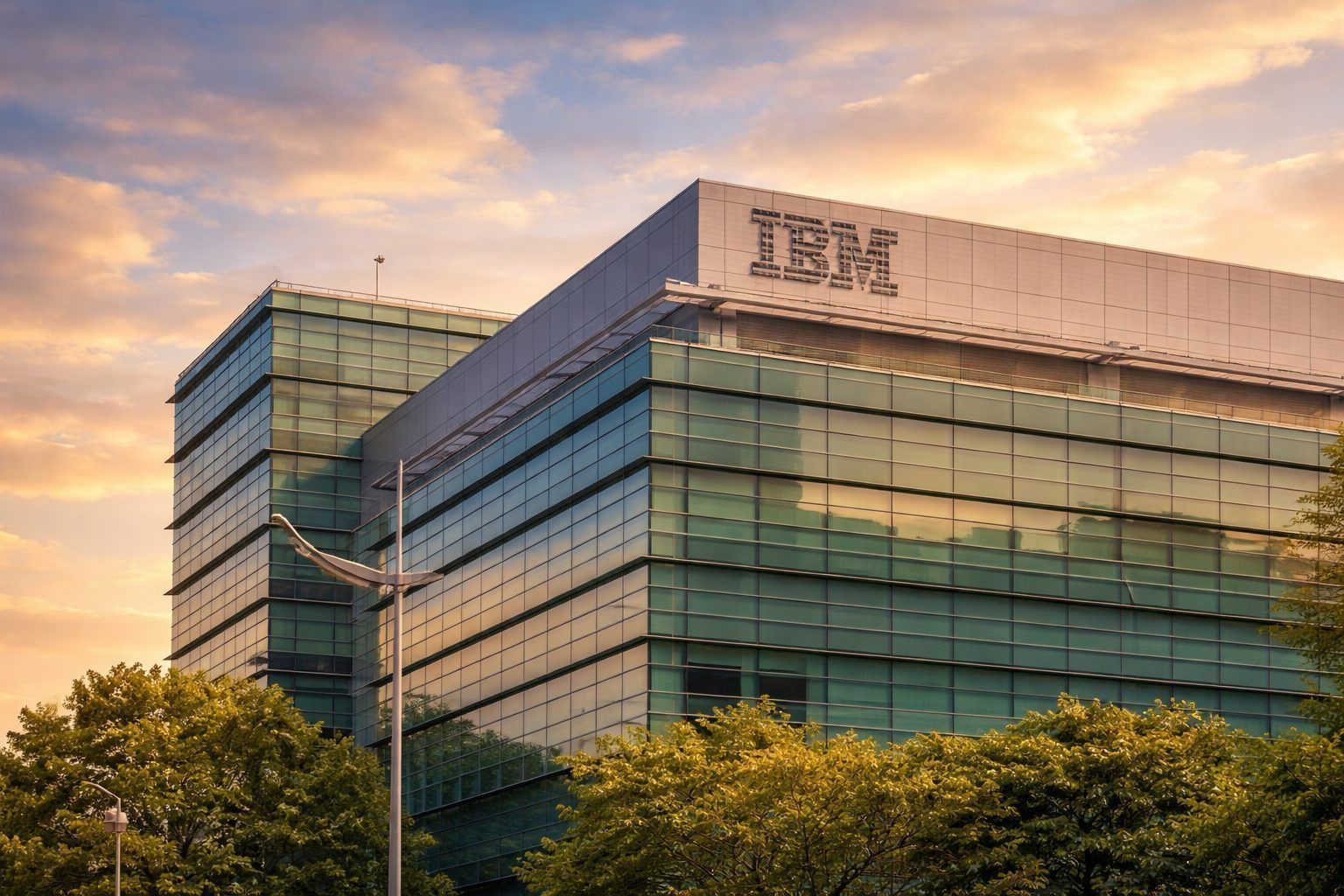

International Business Machines Corporation NYSE:IBM heads into the Dec. 22 U.S. market open with investors balancing a blockbuster acquisition headline, ongoing AI-and-hybrid-cloud momentum, and the realities of holiday-thinned trading. IBM finished the latest session at $300.98 with modest gains on the day and volume around 11.0 million shares, leaving the stock near a psychologically important $300 level as the week begins.
Below is what matters most for IBM stock before the opening bell on Dec. 22, 2025—including the biggest headlines, what Wall Street forecasts imply from here, and the events that could shape the next move.
IBM stock price check: where shares stand heading into Dec. 22
IBM is coming into Monday after a choppier stretch of late-year trading that has cooled some of the momentum from its strong 2025 run.
Key numbers to know:
- Last close:$300.98
- Recent range (last session):$299.53–$306.69
- 52-week range:$214.50–$324.90 Nasdaq
Why this matters: IBM is now trading much closer to the middle of its 52-week band than it was earlier this month, which makes the next set of catalysts—deal details, macro data, and analyst revisions—more likely to dictate direction than “pure momentum.”
The biggest IBM headlines investors are pricing in right now
1) IBM’s $11 billion Confluent acquisition is the dominant story
IBM announced it will acquire Confluent in an all-cash deal valued at $11 billion, paying $31 per share. IBM says the transaction will be funded with cash on hand and is expected to close by mid-2026, subject to shareholder and regulatory approvals.
What’s especially noteworthy for IBM shareholders:
- IBM frames Confluent as a foundational piece of a “smart data platform” for enterprise generative AI, essentially improving how data moves in real time across hybrid environments. IBM Newsroom+1
- Confluent’s largest shareholders (representing about 62% of voting power) agreed to support the transaction, which reduces one layer of execution risk.
- Reuters reported the deal is expected to boost IBM’s adjusted core earnings within the first full year after closing and add to free cash flow in year two—important because IBM’s investor base is unusually sensitive to cash generation and capital returns.
Market reaction has been measured on IBM’s side. In early trading after the announcement, Confluent jumped sharply while IBM was only marginally lower/flat depending on the moment—consistent with how large-cap acquirers often trade when the market is still debating “strategic fit vs. price paid.” AP News+1
What to watch next: Any details that clarify how IBM plans to integrate Confluent into IBM Software (leadership reporting lines, cross-sell motion, and margin targets) could matter as much as near-term price action. Reuters noted Confluent CEO Jay Kreps is expected to join IBM Software and report to IBM executive Rob Thomas.
2) A fresh IBM partnership underscores “AI in the enterprise” positioning
On Dec. 11, IBM and Pearson announced a global partnership to build AI-powered learning tools, using watsonx Orchestrate and watsonx Governance, and to explore tools that help verify AI agent capabilities.
This matters for IBM stock because:
- It reinforces IBM’s strategy of selling “the full stack” to enterprises—software, governance, consulting workflow, and industry solutions—rather than competing purely as an infrastructure vendor.
- It’s also a signal that IBM intends to keep pushing watsonx beyond pilots into operational deployments tied to productivity and workforce transformation.
3) Workforce actions remain part of the margin story
IBM said it will cut roles in Q4, impacting a low single-digit percentage of its global workforce, as it continues shifting emphasis toward higher-margin software. Reuters also reported IBM employed about 270,000 workers as of the end of 2024.
For investors, this isn’t just about headcount; it’s about whether IBM can keep expanding margins while sustaining software growth—especially as it digests multiple acquisitions.
Fundamentals: the metrics investors keep returning to
Even with December headlines, IBM’s “core debate” hasn’t changed: can it keep growing software (especially Red Hat/hybrid cloud), monetize enterprise AI, and maintain durable cash generation?
What IBM’s latest results revealed
In its most recent quarterly reporting cycle (Q3 2025), Reuters highlighted several datapoints that still shape the bull/bear cases today:
- Red Hat (hybrid cloud) growth slowed to 14% (from 16% in the prior quarter), which raised concerns about whether IBM is capturing enough of the broader cloud wave.
- IBM’s Q3 revenue was $16.33 billion, above the analyst estimate of $16.09 billion (LSEG data via Reuters).
- The infrastructure segment (including mainframe) saw revenue rise 17% to $3.56 billion, supported by an AI-driven mainframe cycle.
- IBM’s “AI book of business” rose to $9.5 billion, up $2 billion from Q2. Reuters
- IBM raised its outlook to expect revenue to grow more than 5% at constant currency.
Why it matters for Dec. 22 trading: The Confluent deal slots directly into the same narrative: AI adoption drives demand, but AI only scales if data pipelines, governance, and hybrid-cloud operations work end-to-end. IBM is betting that it can own more of that workflow.
Wall Street forecasts: what price targets say about IBM from here
The consensus view implies IBM is near “fair value”—but dispersion is wide
MarketWatch data shows:
- Average price target:$294.24
- Median target:$300.00
- High target:$360.00
- Low target:$198.00 MarketWatch
With IBM around $301, that mix tells you something important: many analysts see IBM as closer to fully valued, but there’s a meaningful bullish camp that believes the market still underestimates IBM’s software pivot and AI monetization.
A notable bullish call: Oppenheimer initiates with a $360 target
Investing.com reported that Oppenheimer began coverage with an Outperform rating and a $360 12–18 month target, arguing IBM’s software portfolio can deliver sustained growth—driven by Automation (including HashiCorp) and improving Red Hat growth—and that IBM has upside from building and managing AI applications.
How to interpret this: When a large, mature company like IBM shows a wide target range, it usually means analysts disagree on how durable the growth is—and what valuation multiple that growth deserves.
Dividend and capital returns: a core part of IBM’s stock profile
IBM remains one of the more income-oriented mega-cap tech names, and that still matters heading into year-end.
What’s relevant now:
- IBM increased its regular quarterly dividend to $1.68 per share in 2025 (IBM noted this as the 30th consecutive year of increases at the time).
- IBM’s trailing twelve-month dividend payout is shown as $6.72, and dividend yield around ~2.23% as of Dec. 19, 2025 (based on widely-circulated market data).
- IBM’s dividends are normally paid on the 10th of March, June, September, and December, which helps set expectations for income-focused investors.
- Dividend trackers list IBM’s most recent payment date as Dec. 10, 2025.
Why dividend investors care about the Confluent deal: IBM says the acquisition will be funded with cash on hand. IBM Newsroom That doesn’t automatically threaten the dividend, but it does increase sensitivity to free cash flow execution—especially if IBM wants to keep optionality for buybacks, future deals, or debt reduction.
Calendar: the next catalysts before IBM’s next earnings
The market week itself is unusual
Liquidity and volatility can change quickly in holiday weeks. The NYSE schedule shows markets will close early at 1:00 p.m. ET on Wednesday, Dec. 24, 2025.
Nasdaq’s trader calendar also lists Dec. 24, 2025 as an early close (1:00 p.m.), with Christmas Day closed.
Additionally, Reuters reported that major U.S. exchanges will remain open on Dec. 24 and Dec. 26 as originally scheduled (early close on the 24th, full day on the 26th).
Implication for IBM: For a Dow component like IBM, thinner liquidity can amplify moves around headlines—especially M&A-related chatter, analyst notes, and macro surprises.
Macro data can sway “value tech” sentiment
Investopedia flagged that the holiday-shortened week still includes market-moving U.S. data (including GDP-related reporting timing and other releases), which can influence rate expectations and equity positioning.
Next earnings date to keep on your radar
IBM Investor Relations lists IBM 4Q 2025 earnings on Jan. 28, 2026 (preliminary date).
That earnings call is likely to be the next major “truth serum” moment for:
- Updated guidance and free-cash-flow expectations
- Red Hat growth trajectory entering 2026
- Early integration commentary around Confluent (even if closing is mid-2026)
- Capital allocation priorities (dividend, buybacks, debt)
What to watch right at the open on Dec. 22
If you’re tracking IBM into the opening bell, these are the pressure points most likely to matter in the first part of Monday’s session:
- Deal framing and credit/financing commentary
IBM has emphasized cash-on-hand funding and a mid-2026 close timeline. IBM Newsroom Any new commentary from ratings agencies or sell-side desks can impact how investors price “strategic win vs. balance-sheet cost.” (Fitch, for example, commented on IBM’s rating in relation to the deal.) Fitch Ratings - $300 as a “line in the sand”
IBM is sitting right around that round-number level (and near its recent trading midpoint), which can become self-reinforcing for short-term traders and options positioning. - Holiday liquidity effects
With early closes and a shortened week ahead, price moves can be sharper than usual—particularly if broader markets swing on macro headlines. - Follow-through from analyst targets
With the median target around $300 and the average target below spot, incremental “target hikes” may matter more than usual—especially if they come with clearer margin/free cash flow reasoning. MarketWatch
Bottom line: the IBM setup into Dec. 22, 2025
IBM enters Dec. 22 near $301 with the market laser-focused on whether its aggressive build-out of an enterprise AI + hybrid-cloud software stack can keep producing the growth and cash flow that justify the stock’s strong 2025 performance. The Confluent acquisition is a big strategic bet on real-time data infrastructure for AI—and the bull case is that it deepens IBM’s moat in regulated, complex enterprise environments. The bear case is that IBM is paying up late in the cycle and increasing execution and leverage sensitivity.
Either way, for the immediate “before the bell” view, the story drivers are clear: M&A integration credibility, Red Hat/software growth confidence, and cash-flow discipline—set against a holiday week where market structure can amplify moves.
Related articles: NYSE:IBM