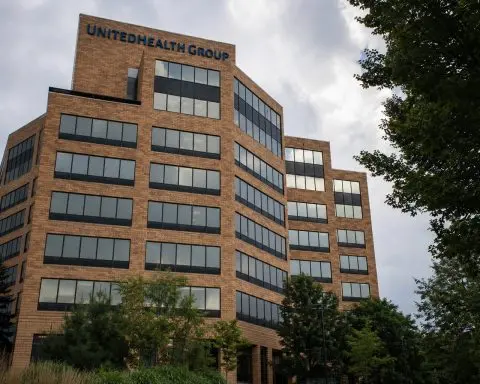

December 22, 2025 — UnitedHealth Group Incorporated NYSE:UNH is ending the year with investors focused less on “normal” quarterly momentum and more on a three-part storyline that could shape how the market values the healthcare giant in 2026: (1) management’s operational overhaul after independent reviews, (2) a heavy regulatory and legal backdrop, and (3) the next earnings call—when the company will finally lay out full-year 2026 guidance.
As of Dec. 22, UNH shares were trading around $325 in U.S. trading, leaving the stock well below its highs and keeping UnitedHealth near the top of the list of “show-me” large caps for 2026.
UnitedHealth stock today: where UNH is trading on Dec. 22, 2025
UnitedHealth stock (UNH) was last indicated around $325.48, down modestly versus the prior close ($327.25). The session range was roughly $322.15 to $329.86, with volume near 2.0 million shares at the time of the quote.
That price level matters because it sits at the intersection of two competing narratives:
- A recovery case built on operational fixes, improved transparency, and a path back toward steadier earnings growth.
- A risk case defined by regulatory scrutiny (including Department of Justice investigations), elevated medical-cost pressures, and headline risk around Optum and Medicare Advantage.
The biggest UNH story right now: independent reviews and a promised operational reset
What happened
UnitedHealth recently released the initial results of outside assessments covering:
- Medicare Advantage risk assessment operations
- UnitedHealthcare care services management (including care quality review)
- Optum Rx manufacturer discount processes (PBM-related)
The reviews were conducted by FTI Consulting and Analysis Group, with CEO Stephen Hemsley positioning them as part of a “new standard of transparency” and a practical blueprint for tightening controls and governance. UnitedHealth Group+1
What the independent assessors found (in plain English)
Across the three areas, the company says the assessors viewed policies and practices as broadly sound—but flagged opportunities to improve consistency, documentation, governance, and audit/monitoring rigor.
Reuters reported that these audits are expected to trigger changes including greater automation and standardized internal processes, and highlighted that the work was initiated after UnitedHealth missed profit expectations for the first time since 2008.
The action plan roadmap investors are keying on
UnitedHealth says its board-directed internal audit function created 23 action plans tied to the recommendations. The company’s independent-review program summary states it expects to complete:
- 65% of actions by the end of 2025
- 100% by the end of Q1 2026 UnitedHealth Group
The action items described include:
- Annual policy review and approval requirements and centralized policy repositories
- Stronger tracking of internal/external/regulatory findings to prevent repeat issues
- More formal governance for risk assessment and coding standards, including a second-line compliance review function
- Streamlined PBM manufacturer discount administration, escalation, and automation for high-volume workflows UnitedHealth Group
This isn’t just corporate housekeeping: for a company the size of UnitedHealth, credibility around operational controls can influence everything from regulatory exposure to valuation multiples.
Two near-term “tell me” moments: HouseCalls and medical policy processes
The independent review program explicitly tees up two upcoming disclosures investors will watch closely:
- In Q1 2026: results of a medical-record review of diagnosis codes identified during in-home HouseCalls visits
- By mid-2026: a report on processes used to craft evidence-based medical policy UnitedHealth Group+1
Healthcare Dive also noted that the company is linking the reviews to reforms across Medicare Advantage risk adjustment, utilization management/care services management, and PBM discount administration.
DOJ investigations remain a central overhang for UnitedHealth stock
One reason the market is treating these reviews as more than PR: UnitedHealth has acknowledged it is responding to Department of Justice requests connected to aspects of its Medicare participation.
In a July 2025 statement, the company said it proactively contacted DOJ after media reports, and that it has begun complying with formal criminal and civil requests—while stating it has confidence in its practices and cannot predict the outcome of investigations.
Reuters’ reporting on the external audits also pointed to DOJ scrutiny around Medicare Advantage billing practices, and emphasized that the outside reviewers were not engaged to evaluate legal compliance.
For investors, the point is not just legal risk—it’s uncertainty. Regulatory outcomes can affect reimbursement, business practices, and headline-driven sentiment for long stretches, even before any resolution.
Antitrust spotlight: DOJ settlement tied to Amedisys acquisition
UnitedHealth’s deal activity is also in the regulatory frame.
The U.S. Department of Justice announced a settlement related to UnitedHealth Group’s acquisition of Amedisys, stating a proposed final judgment would require divestitures of at least 164 home health and hospice locations across 19 states to preserve competition.
UnitedHealth’s own Q3 2025 press release noted its debt-to-capital ratio reflected the impact of closing the Amedisys transaction on Aug. 14, 2025.
Why it matters for UNH stock: it reinforces that consolidation efforts—especially in home health and care delivery—remain politically and regulatorily sensitive.
Earnings and guidance backdrop: what UnitedHealth has said (and what it still needs to prove)
Q3 2025 results: solid numbers, but the market wants the 2026 plan
UnitedHealth reported Q3 2025 revenue of $113.2 billion (+12% YoY) and adjusted EPS of $2.92, and raised its full-year 2025 outlook to:
- At least $14.90 net earnings per share (GAAP)
- At least $16.25 adjusted earnings per share UnitedHealth Group+1
The company also disclosed a medical care ratio of 89.9% for the quarter.
Reuters’ Oct. 28 coverage added context that management was aiming for a return to growth in 2026 (and acceleration in 2027), while flagging continued pressure in the Medicaid business due to payment rate/cost mismatches.
Next major catalyst: January 27, 2026 earnings and 2026 guidance
UnitedHealth has set Tuesday, Jan. 27, 2026 (before the market opens) to report full-year 2025 results and provide full-year 2026 guidance, followed by an 8:00 a.m. ET investor call.
That date is shaping up as a “decision point” for many investors because the company’s narrative needs to shift from:
- “We identified what went wrong and created action plans,” to
- “Here is what’s fixed, here’s what’s still pressured, and here’s the earnings power in 2026.”
The “why it fell” context still matters
In July 2025, Reuters reported UnitedHealth reset expectations dramatically, citing higher-than-expected medical costs and forecasting adjusted EPS of at least $16 at that time—after suspending earlier guidance. Reuters also reported medical cost trends in Medicare Advantage were projected to run higher than prior expectations.
This history is part of why the market is cautious: investors want proof that pricing discipline, utilization management, and Optum execution are stabilizing—not just quarter-to-quarter, but structurally.
Analyst forecasts for UNH stock: what Wall Street expects heading into 2026
Forecasts vary by provider, but one widely followed snapshot comes from MarketBeat (updated 12/22/2025), which shows:
- Consensus rating: Hold (based on 29 analyst ratings)
- Average 12‑month price target:$385.54
- Implied upside from the cited price level: ~18%
- Price target range:$198 (low) to $540 (high) MarketBeat
Reuters also reported that analysts on average expected 2026 profit of $17.59 per share (as of its Oct. 28 reporting), giving investors a reference point for what “normalized” earnings could look like if the recovery narrative holds. Reuters
How to interpret this for an SEO-savvy reader tracking “UnitedHealth stock forecast”: the Street isn’t uniformly bearish. But the rating mix suggests many analysts see upside potential that depends on execution—rather than a straightforward “set it and forget it” compounding story.
Optum and PBM pressure: reforms aimed at transparency and pharmacy economics
Regulatory and client scrutiny of PBMs hasn’t gone away, and Optum Rx is trying to show it’s adapting.
UnitedHealth’s independent review materials describe Analysis Group’s conclusion that Optum Rx has a robust governance framework and controls for manufacturer discounts, while also recommending further efficiency and oversight improvements.
Separately, UnitedHealth/Optum has highlighted longer-term commitments that intersect with today’s PBM debate:
- Optum Rx has said it will pass through 100% of negotiated drug rebate discounts to clients by 2028 (building on current pass-through rates) UnitedHealth Group
- Optum Rx also announced efforts to modernize pharmacy payment models with full implementation targeted by January 2028, tying the move to manufacturer pricing dynamics.
- Healthcare Dive reported Optum Rx said 100% of community pharmacies in its network have transitioned to cost-based contracts, with additional agreements representing more than 17,000 community pharmacies, as PBMs face pressure to make reimbursement more predictable.
For UNH stock, the Optum story is crucial: Optum is not just a growth engine; it’s also a source of policy scrutiny and business-model debate.
Medicare Advantage positioning: scale remains a strength, but it’s under the microscope
UnitedHealthcare remains a dominant player in Medicare Advantage. In an October 2025 release about 2026 Medicare Advantage offerings, UnitedHealthcare said its plans would be available to 94% of Medicare-eligible individuals, emphasizing $0 premium options and benefit designs intended to preserve affordability.
The bull case sees Medicare Advantage scale as a durable advantage. The bear case points to the reality that Medicare Advantage is also one of the most scrutinized areas in U.S. healthcare—financially and politically.
Broader sentiment check: policy uncertainty is hitting the whole healthcare complex
UnitedHealth’s company-specific issues are unfolding alongside a wider policy and positioning shift.
A Reuters “Hedge Flow” piece published Dec. 22 said hedge funds were net sellers of U.S. healthcare stocks after 14 weeks of net buying, citing the debate around Affordable Care Act subsidy expiration at year-end and rising healthcare costs. Reuters
Time also reported on Dec. 22 that Congress was ending the year without a deal to extend ACA subsidies and that expiration could push premiums sharply higher for many consumers.
Even for investors who view UnitedHealth primarily through Medicare Advantage and employer plans, shifting subsidy policy and political pressure can affect sector sentiment—and risk premiums—around large insurers.
Risks investors are weighing in UNH stock right now
For a Google News/Discover audience searching “Is UnitedHealth stock a buy?” the highest-signal risks being priced include:
- Regulatory and legal uncertainty
DOJ investigations into Medicare billing practices create headline and outcome risk. - Medical cost trend and margin volatility
Even as guidance improved later in 2025, the year featured significant cost surprises—especially in Medicare Advantage and parts of Optum. - Execution risk inside Optum
Optum’s PBM reforms and pharmacy reimbursement changes may reduce friction, but they also change economics and require careful rollout. - Antitrust and deal constraints
The DOJ’s Amedisys-related settlement underscores that UnitedHealth’s M&A strategy will remain under intense scrutiny. - Reputation and litigation headlines
The Guardian published an investigative report describing wrongful death claims and whistleblower allegations tied to Optum’s involvement in nursing home care—claims UnitedHealth disputes.
What could drive upside in UnitedHealth stock in 2026
If you’re tracking “UnitedHealth stock forecast 2026,” the most obvious upside catalysts are tied to measurable milestones:
- Clear, credible 2026 guidance on Jan. 27, including how management expects to rebuild margins and stabilize cost trends.
- Execution against the 23 action plans (especially those linked to governance, documentation, audit trails, and compliance).
- More transparency around HouseCalls diagnosis coding review results in Q1 2026, reducing uncertainty around Medicare Advantage risk adjustment practices.
- Optum Rx modernization delivering a defensible answer to PBM scrutiny while keeping client retention strong.
- Normalization of sector sentiment if policy risks (like ACA subsidy uncertainty) stabilize.
Related articles: NYSE:UNH