
Meta Platforms, Inc. NASDAQ:META stock is heading into the final stretch of 2025 with a familiar tug-of-war: strong advertising momentum and new AI-driven product bets on one side, and intensifying infrastructure spending (and the accounting, regulatory, and legal scrutiny that comes with it) on the other.
In early trading on Tuesday, December 23, 2025, Meta shares hovered around $661—a level that keeps the stock in the spotlight as investors weigh the company’s accelerating AI buildout and what it could mean for margins and free cash flow in 2026.
Below is a comprehensive, publication-ready roundup of today’s META stock headlines, the latest forecasts, and the most important analyses shaping sentiment as the market looks toward 2026.
META stock price today: where Meta shares stand on Dec. 23, 2025
Meta stock traded around the $660–$662 area in the premarket/early session, with market data sources showing quotes near $661.
At these levels, Meta remains one of the market’s mega-cap bellwethers, with a market capitalization around $1.8 trillion based on real-time pricing feeds.
The key context for investors: META is no longer “cheap,” but it’s also not priced like a hypergrowth startup—so the stock’s next major move may hinge on whether AI spending translates into durable revenue acceleration (and not just bigger depreciation bills). Nasdaq+1
Today’s top Meta stock news: what’s moving the narrative on Dec. 23, 2025
1) Baird trims Meta price target (still bullish): the “2026 bull/bear debate” is heating up
One of the most direct META stock headlines on Dec. 23: Baird analyst Colin Sebastian lowered the firm’s price target to $815 from $820 while keeping an Outperform rating, explicitly framing the bull/bear debate heading into 2026.
Why it matters: even a small target tweak is being read as a signal that the Street is actively recalibrating models around AI infrastructure costs, depreciation, and the path to monetization—not just ad demand.
2) Dividend day: Meta’s quarterly cash dividend is payable today
Meta’s board declared a $0.525 per share quarterly cash dividend payable on December 23, 2025, to shareholders of record as of December 15, 2025.
With four quarterly payments, the annualized dividend is $2.10 per share, which is a modest yield at current prices—but it continues Meta’s post-2024 shift toward a more explicit capital-return posture.
3) Reuters: a “hidden risk” for Big Tech in 2026—depreciation schedules
A major macro-style market piece published today flags an issue that’s becoming increasingly relevant for mega-cap AI builders: depreciation assumptions.
Reuters notes that multiple large tech companies—including Meta—have been extending assumed useful lives of certain major assets since 2020 as capex has surged. That can reduce annual depreciation expense and lift reported earnings, even though it doesn’t change cash flow.
For META investors, this matters because capex is the story heading into 2026. As depreciation grows, accounting choices can increasingly influence reported margins and valuation narratives.
4) New AI copyright lawsuit names Meta (and other AI leaders)
In a fresh legal headline tied to AI training data, Reuters reports that New York Times reporter and author John Carreyrou and other writers sued xAI, Anthropic, Google, OpenAI, Meta, and Perplexity, alleging their copyrighted books were used without permission to train AI systems.
This is part of a broader wave of AI copyright litigation—important not only for potential damages, but for what it may imply about future data licensing costs and product-development friction across the sector.
The core driver behind META stock heading into 2026: AI spending is accelerating
Meta’s own guidance: capex up, expenses up—AI infrastructure is the reason
Meta has already told investors that 2025 capital expenditures (including principal payments on finance leases) are expected to be $70–$72 billion, and management expects capex dollar growth to be “notably larger” in 2026 than in 2025. Meta
Meta also guided to 2025 total expenses of $116–$118 billion and said it anticipates expenses will grow at a significantly faster percentage rate in 2026, driven primarily by infrastructure costs such as cloud expenses and depreciation, with employee compensation (including AI talent) also contributing.
This is the investment cycle at the heart of nearly every current META bull/bear model:
- Bull view: AI infrastructure becomes a moat and expands Meta’s ad targeting, creative tools, recommendations, and messaging monetization.
- Bear view: Meta “overbuilds,” free cash flow compresses, and returns arrive slower than the market expects.
Analyst commentary published this week has echoed the same tension.
What Meta’s latest financial performance says about the bull case
Meta’s most recent quarterly results (Q3 2025) show why many analysts remain constructive even as spending ramps:
- Revenue:$51.24 billion, up 26% year-over-year (25% on a constant-currency basis).
- Advertising engine: Ad impressions increased 14% YoY, and average price per ad increased 10% YoY.
- Scale: Family Daily Active People (DAP) averaged 3.54 billion in September 2025, up 8% YoY.
- Operating margin:40% for the quarter (reported).
- Capex in Q3 alone:$19.37 billion (including principal payments on finance leases).
- Capital returns (Q3):$3.16 billion of share repurchases and $1.33 billion in dividend/dividend equivalent payments.
Meta’s reported Q3 net income was heavily affected by a one-time non-cash tax item: the company disclosed a $15.93 billion one-time, non-cash income tax charge embedded in its Q3 provision, with reported net income $2.71 billion and an “excluding” view implying net income would have been $18.64 billion without that charge. Meta
Company outlook: Q4 revenue guidance points to continued growth
Meta guided for Q4 2025 total revenue of $56–$59 billion, with expectations of continued strong ad revenue growth partly offset by lower year-over-year Reality Labs revenue.
Meta’s AI infrastructure strategy: data centers, financing, and bonds
Hyperion data center: a massive AI buildout with external financing
Meta’s AI infrastructure plans aren’t abstract—they’re increasingly tied to specific projects and deal structures.
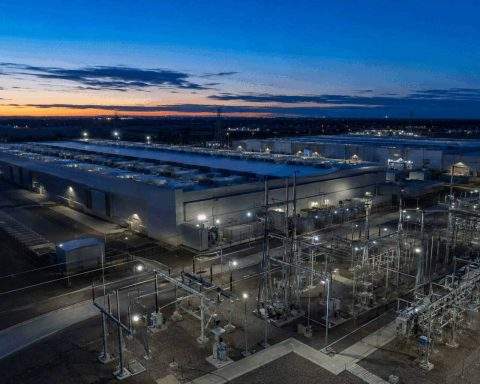
Reuters reported Meta struck a $27 billion financing deal with Blue Owl Capital for its Hyperion data center project in Louisiana, with Meta retaining about a 20% equity stake and Blue Owl funds owning the majority. The planned facility is projected to deliver more than 2 gigawatts of compute capacity to support training large language models.
Meta’s own release describes the joint venture structure, the approximate total development costs, and the ownership split (80% Blue Owl funds / 20% Meta), along with details on leases and residual value guarantees.
Meta’s bond plans: funding the AI arms race
Separately, Reuters reported Meta planned to raise money through bond offerings worth up to $30 billion, a sign of how even cash-rich Big Tech companies are considering diversified funding routes as AI infrastructure costs rise.
Product and platform catalysts: AI personalization, Instagram video strategy, and next-gen models
AI personalization: Meta is using AI chats to refine content and ads
Reuters reported Meta began using the content of users’ conversations with its AI chatbot to personalize what people see across Facebook, Instagram, and Threads, starting December 16 (with certain geographic limitations noted).
For investors, the significance is straightforward: better personalization can improve engagement and ad performance, but it also increases the importance of privacy controls and regulatory compliance.
Instagram expands beyond the phone: Reels on Amazon Fire TV
Meta has been testing an Instagram Reels experience for Amazon Fire TV in the U.S., an attempt to push short-form video into the living room and broaden engagement formats.
Instagram’s next pivot: premium longform video under consideration
Semafor reporting this week (as echoed by market-news services today) indicates Instagram head Adam Mosseri has discussed the possibility that Instagram may explore premium longform video and more user-controlled feeds—ideas that could open additional monetization pathways beyond standard ad load.
New AI models for 2026: “Mango” and “Avocado”
TechCrunch reports that Meta is working on new AI models—an image/video model (“Mango”) and a text model (“Avocado”)—with a roadmap pointing to release in the first half of 2026, citing a Wall Street Journal report and internal discussions. TechCrunch
Regulation and legal risk: a major overhang—and sometimes a relief valve
EU ad targeting: Austria’s top court ruling raises the bar for Meta
Reuters reported Austria’s Supreme Court ruled Meta’s personalized ad model unlawful and ordered changes tied to user data access and handling of sensitive data—setting a precedent enforceable across the EU, according to the report. Meta said it is reviewing the decision and argued the case relates to older practices.
Meta’s own CFO has already warned investors that EU regulatory headwinds—including possible further changes to its “Less Personalized Ads” offering—could have a significant negative impact on European revenue, potentially as early as the current quarter. Meta
U.S. antitrust: Meta defeats FTC case over Instagram and WhatsApp acquisitions
A meaningful tail-risk reducer: Reuters reported in November that Meta defeated a U.S. antitrust case challenging its acquisitions of Instagram and WhatsApp.
Copyright litigation continues
Beyond the new author lawsuit naming multiple AI developers (including Meta) today, Reuters has also covered other copyright actions involving Meta and AI training—underscoring that AI legal risk is not a one-off headline, but a continuing theme investors are tracking into 2026.
META stock forecast: what analysts are projecting heading into 2026
Consensus price targets cluster around the low $800s (with a wide range)
Across major analyst-tracking services, the current consensus picture looks roughly like this:
- MarketBeat shows a consensus price target of about $820.22, implying roughly ~24% upside from prices around $661, with targets ranging from about $605 to $1,117.
- StockAnalysis shows a similar view: consensus “Strong Buy” with an average target around $819 and a high target $1,117 (with the low target in the mid-$600s). StockAnalysis
- Today’s Baird note sits near the consensus band with an $815 target and Outperform rating.
What’s behind the forecasts
The dominant variables in published forecasts and commentary are:
- Advertising durability (impressions, pricing, Reels monetization) Meta+1
- AI capex trajectory (2025 already $70–$72B; 2026 expected to be higher) Meta+1
- Free cash flow direction as depreciation and infrastructure costs rise Nasdaq+1
- Regulatory outcomes, particularly in Europe Reuters+1
Bull case vs. bear case for Meta stock heading into 2026
The bull case for META
- Ad machine still accelerating: Q3 results show strong revenue growth, rising ad impressions, and higher average price per ad.
- AI as an engagement + ad ROI flywheel: Meta is pushing AI deeper into ranking, recommendations, and ad performance, including new personalization approaches.
- New monetization surfaces: evolving Instagram video strategy and potential premium formats expand optionality.
- Shareholder returns are now part of the story: dividends plus continued buybacks.
The bear case for META
- Infrastructure costs may outrun revenue gains in the near term: Meta’s own outlook points to higher capex and faster expense growth in 2026.
- Regulatory tightening in Europe: court and regulator actions could constrain targeting and raise compliance costs.
- AI legal risk persists: copyright disputes remain active and could influence long-term data usage practices and licensing economics.
- Accounting optics risk: as depreciation grows, the market may become more sensitive to how Big Tech accounts for asset lives and profitability.
What to watch next for Meta stock investors
1) Next earnings: late January to early February (estimates vary)
Market calendars and data providers list late January to early February 2026 as the expected window for Meta’s next earnings release, though the exact date can vary by source and may not be finalized publicly yet.
2) The two numbers that may matter most: 2026 capex trajectory and ad growth rate
Meta has clearly guided that 2026 spending growth will increase; the market’s job is to decide whether:
- higher spend is a temporary margin dip that funds a stronger moat, or
- a longer, riskier payback cycle that deserves a lower multiple.
3) Europe: “less personalized ads” and court-driven data requirements
Investors should track how Meta adapts to EU legal requirements and whether changes materially affect pricing, measurement, or advertiser ROI in Europe.
Bottom line on Dec. 23, 2025: META stock is a 2026 “execution vs. spending” trade
Meta stock today is sitting at the intersection of two powerful forces:
- A proven ad business that’s still growing strongly, with AI increasingly improving engagement and ad performance; and
- A massive AI infrastructure investment cycle that could reshape Meta’s competitive position—but also pressure free cash flow, raise depreciation sensitivity, and invite more scrutiny from regulators and courts.
That’s why even on a relatively quiet holiday-week trading day, META remains one of the market’s most closely watched “what happens next?” stories—especially as analysts refine price targets and investors try to model how expensive (and how rewarding) Meta’s AI future will be. TipRanks+2Meta+2
This article is for informational purposes only and does not constitute investment advice.
Related articles: NASDAQ:META



![US Stock Market Today 08/25/2026 [UPDATE: 00:06 EDT] [Micron and Sandisk Turn Green as QQQ Gains Overnight]](https://ts2.tech/wp-content/uploads/2026/08/US-market-dashboard-2026-08-25-0002-480x384.jpg "US Stock Market Today 08/25/2026 [UPDATE: 00:06 EDT] [Micron and Sandisk Turn Green as QQQ Gains Overnight]")