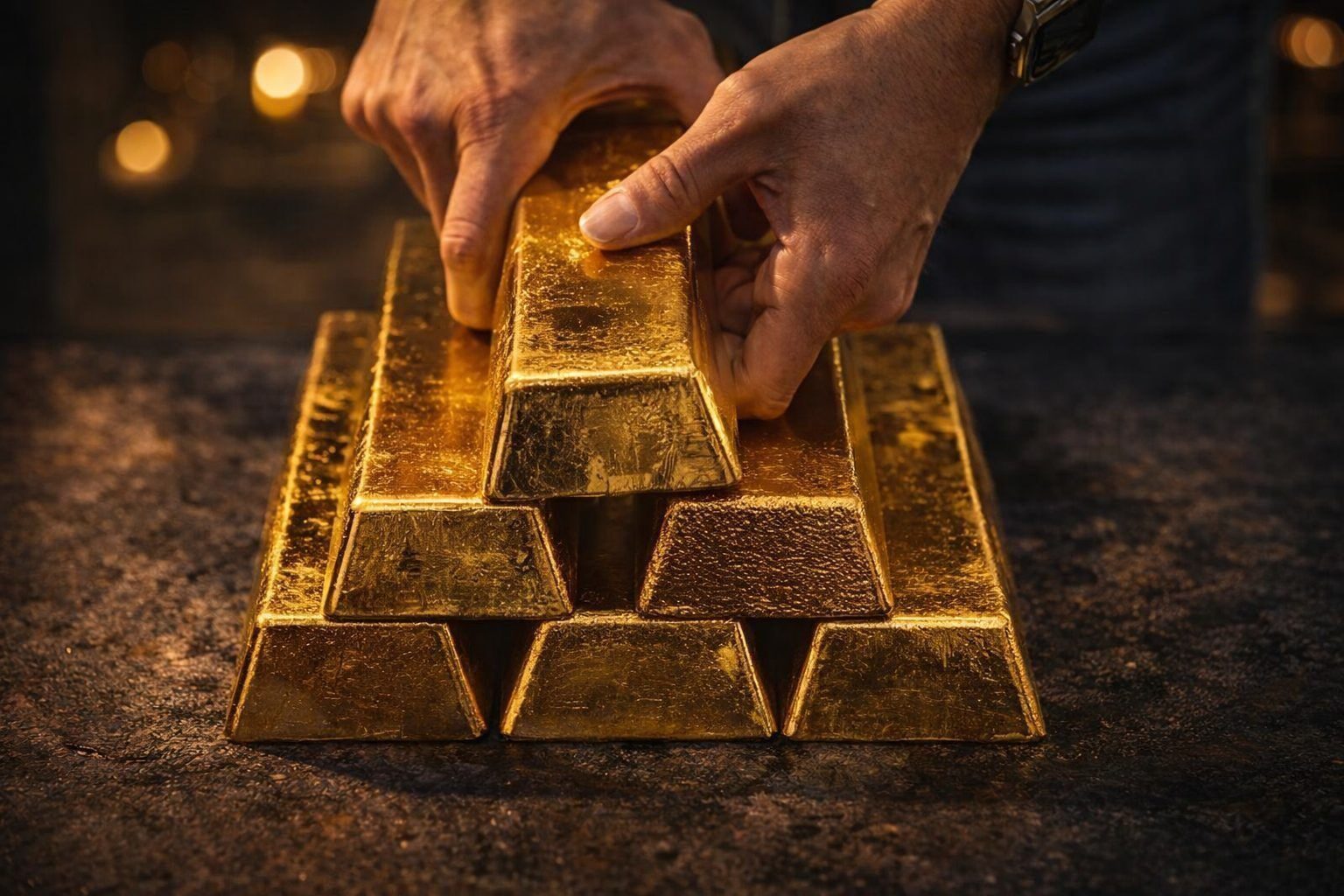
Gold price today is making history on December 24, 2025. Spot gold pushed through the psychologically important $4,500-per-ounce level for the first time, setting a new all-time high before easing back as traders navigated thin Christmas Eve liquidity and a year-end rush into “hard” assets. Reuters
By early Wednesday trading, spot gold hit a record $4,525.19 per ounce and later traded around $4,481.90 (as of 08:03 GMT in Reuters’ report), while U.S. gold futures (February) hovered near $4,509.20.
The rally isn’t happening in isolation. Silver, platinum, and even palladium are joining what one major report described as a broad precious-metals frenzy—an end-of-year stampede powered by geopolitics, rate-cut expectations, and a weakening U.S. dollar.
Gold price today: the key levels investors are watching
Gold’s “headline” move is the break above $4,500, but the intraday details show how intense (and volatile) today’s trade has been:
- Spot gold (record): $4,525.19/oz (new all-time high)
- Spot gold (after the peak): about $4,481.90/oz in the same session snapshot
- U.S. gold futures (Feb): about $4,509.20/oz
- Day range (XAU/USD): roughly $4,471.46–$4,525.96, underscoring the size of today’s swings
That wide trading range matters. Breakouts during holiday-thinned sessions can travel farther than usual because fewer large participants are around to absorb sudden flows—meaning today’s record can be both a momentum signal and a reminder that pullbacks can be sharp.
Why is gold up today? 5 drivers behind the $4,500 breakthrough
Today’s gold surge is being attributed to a rare alignment of macro and geopolitical forces—plus the year-end market structure that can amplify moves.
1) Safe-haven demand is back in control
Investors have been piling into precious metals as hedges against a mix of geopolitical and trade risks. Reuters tied gold’s record run directly to hedging behavior amid these uncertainties.
2) The market is pricing in more U.S. rate cuts in 2026
Gold is a non-yielding asset, so it often benefits when interest rates (or expected rates) fall—reducing the “opportunity cost” of holding bullion.
On Dec. 24 coverage, Reuters reported that traders were pricing in roughly two more Fed cuts in 2026, a theme that has helped support gold’s leap.
3) The U.S. dollar is having a historically weak year
A softer dollar can mechanically support dollar-priced commodities like gold by making them cheaper for non-U.S. buyers.
Reuters noted the dollar is on track for its worst year since 2003, down about 9.9% against a basket of currencies in 2025.
4) Central bank buying and “de-dollarization” narratives are still fueling the bid
One of the most powerful structural themes of 2025 has been the steady appetite for gold as a reserve asset and hedge against currency uncertainty.
Reuters explicitly pointed to robust central-bank buying and de-dollarization trends as major forces behind gold’s more-than-70% year-to-date surge.
5) Thin year-end liquidity is exaggerating price moves
Christmas Eve trading conditions are famously quirky: fewer desks are staffed, fewer orders sit in the market, and headline-driven moves can jump farther than they would in a “normal” week.
Reuters and Investing.com both flagged thin/holiday liquidity as an amplifier of the latest breakout—helping explain why today’s record-setting run is also arriving with outsized intraday swings.
It’s not just gold: silver and platinum are also hitting records
Gold may be stealing the spotlight, but today’s news flow shows this is a broader metals move, not a solo performance.
According to Reuters’ Dec. 24 report:
- Silver hit an all-time peak of $72.70/oz (later around $71.95)
- Platinum touched a record $2,377.50/oz (later around $2,323.95)
- Palladium climbed to about $1,919.17, its highest in three years
Reuters also emphasized the scale of 2025’s run: gold up over 70% year-to-date (biggest annual gain since 1979), silver up over 150%, with platinum and palladium also posting extraordinary annual gains.
Meanwhile, broader market coverage from Reuters on Dec. 24 underscored that gold and silver have become standout movers as the year closes, with spot gold around $4,524 and silver near $72.27 in early Asian trade.
What analysts are saying about what comes next
Forecasting gold is a dangerous sport—humbling, like meteorology, but with more spreadsheets. Still, several Dec. 24 reports put concrete numbers on the table:
- Reuters quoted strategist commentary suggesting thin liquidity has exaggerated moves, but the broader theme could endure—with gold targeting $5,000 within 6–12 months and silver potentially heading toward $80 if momentum persists.
- Business Insider’s Dec. 24 analysis framed gold’s strength as potentially structural, tied to “policy uncertainty,” central-bank demand, and a dollar that “no longer dominates as it once did,” while noting major banks see gold in the $4,500–$4,700 range next year with possible upside toward $5,000 under supportive macro conditions. Business Insider
- The same Business Insider piece cited Goldman Sachs projecting gold could reach about $4,900 by December 2026.
The important nuance: many bullish outlooks are not based on a single shock event. They’re based on a world where debt burdens, geopolitical fragmentation, and real-rate uncertainty remain persistent background conditions—less “panic bid,” more “strategic allocation.”
Why today’s record matters for investors (even if you don’t trade gold)
Gold crossing $4,500 is more than a headline. It also affects:
Inflation and currency expectations:
Gold tends to rise when investors worry about purchasing power, currency stability, or policy credibility. Today’s move is arriving alongside notable dollar weakness.
Portfolio hedging behavior:
The scale of this year’s rally suggests gold is being treated less like a niche “crisis hedge” and more like a core macro asset again—especially with central bank demand in the narrative. Reuters
Volatility into year-end:
Holiday liquidity can produce outsized moves both ways. Even strongly bullish stories often warn that thin markets can snap back quickly once liquidity returns.
Gold price in India today (Dec. 24, 2025): latest rates and MCX futures
Gold’s global surge is also showing up in major consumer markets—especially India—though local pricing is influenced by the rupee, taxes, import costs, and city-level premiums.
On December 24, 2025, Goodreturns reported:
- 24K gold: ₹13,893 per gram
- 22K gold: ₹12,735 per gram
- 18K gold: ₹10,420 per gram
On the futures side, Moneycontrol reported MCX gold futures around ₹1,38,325 per 10 grams for 24-carat purity on Wednesday, slightly lower versus the prior close, after a recent peak the day before.
City-level variation remains meaningful. A separate India-focused update noted 24-carat gold around ₹1,38,560 per 10 grams, with differences across metros such as Mumbai, Delhi, and Chennai reflecting local conditions.
The bottom line on gold price today
Gold price today is being driven by a rare combination of record-breaking momentum and structural macro tailwinds: safe-haven demand tied to geopolitical and trade risks, expectations for further Fed easing in 2026, and a U.S. dollar on pace for its weakest year in more than two decades.
With spot gold printing above $4,525 before easing back, the market is also sending a clear message about conditions into the Christmas break: thin liquidity can supercharge breakouts—and just as easily magnify reversals.