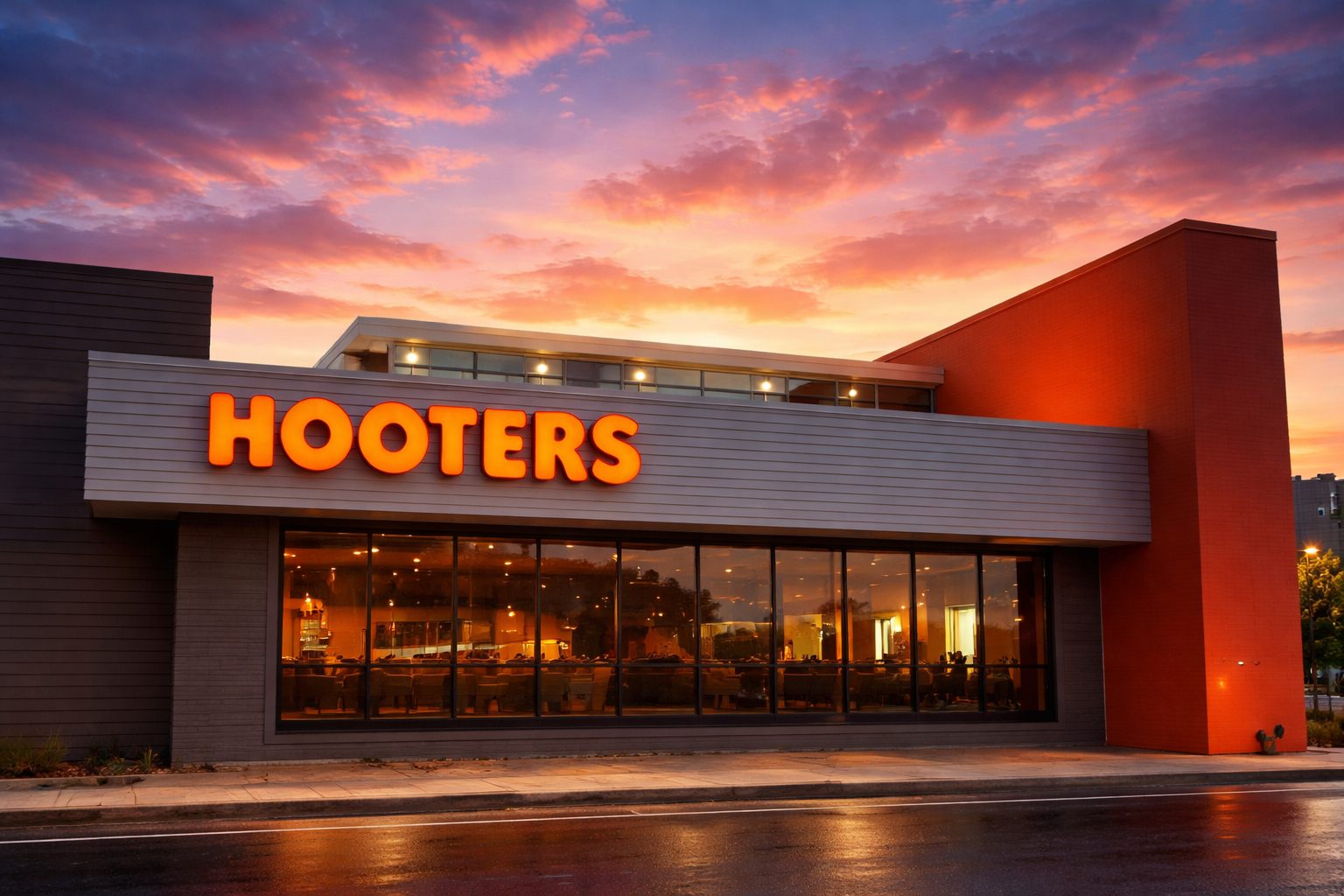

December 25, 2025 — Hooters is back in the spotlight this Christmas Day as fresh coverage revives one of the most surprising details to emerge from the brand’s post-bankruptcy overhaul: the chain’s leadership says many customers were eating wings that didn’t taste like Hooters for years—because many locations were using a “substitute” sauce instead of the original recipe. Red94
The revelation is more than a quirky food story. It has become a symbol of what the company’s new owner-operators say went wrong during years of fragmentation—and what they believe will fix it: a back-to-basics “re-Hooterization” strategy focused on consistent food execution, simplified operations, and a brand repositioning designed to welcome families as well as longtime fans. Fox News
What’s new on December 25: renewed attention on the “wrong wing sauce” problem
Today (December 25), a new report recapped the Hooters turnaround and put the sauce issue at the center of the comeback narrative, arguing that inconsistent execution across locations weakened customer trust and the chain’s core identity.
That recap follows a widely circulated interview earlier this week in which CEO Neil Kiefer said that after the founder-led group took over a large batch of restaurants, leadership discovered that many of those acquired stores had not been using the original wing sauce for roughly two decades.
The key claim: “110 stores… haven’t had the original sauce on them in 20 years”
In the Fox News interview, Kiefer described a sweeping operational inconsistency: “of those 110 stores we’ve taken over,” he said, those locations hadn’t used the original sauce in 20 years. He said the restaurants had been serving a substitute sauce rather than the signature formula customers associated with Hooters. Fox News
To fix it, Kiefer said the new leadership had to clear inherited inventory that did not meet specifications before restoring recipes to their original “taste profiles.” Fox News
If this sounds like a small change, that’s the point. For a wing chain, sauce consistency is the brand.
Why sauce consistency matters for a national restaurant chain
In casual dining, customers don’t just buy wings—they buy familiarity. If the same order tastes different in different cities, the product stops being a chain experience and starts feeling like a gamble.
Kiefer framed the original sauce as a “craveable” differentiator and suggested the substitute version undercut what made the food special in the first place. Fox News
From an operational standpoint, sauce consistency also affects:
- Training and kitchen execution (how wings are finished, tossed, and held)
- Supplier standards and purchasing (what’s approved vs. what’s substituted)
- Menu planning (what items depend on one core sauce)
Those are exactly the areas Hooters says it is standardizing as part of its broader comeback.
The turnaround plan: “re-Hooterization” through food, standards, and franchise input
Kiefer describes the reboot as “re-Hooterization,” a strategy meant to roll back years of operational drift and rebuild trust location by location. Fox News
One of the most significant internal changes: a new food task committee that includes franchisees who, Kiefer said, previously had little or no input into menu decisions.
The menu approach he described is built around three tiers:
- Mandatory items (must be available everywhere)
- Optional items (available where they make sense operationally)
- Regional items (to reflect local tastes without breaking brand consistency)
The goal is to avoid a repeat of the “same brand, different product” problem—starting with wings and sauce. Fox News
Post-bankruptcy context: how Hooters got here
Hooters’ reset is happening after a major financial restructuring that began in early 2025.
On March 31, 2025, Hooters of America announced it had entered a Restructuring Support Agreement with broad stakeholder backing and filed for Chapter 11 in the U.S. Bankruptcy Court for the Northern District of Texas, aiming to facilitate a sale of company-owned locations and move toward a pure franchise model.
That filing came as the company faced heavy debt pressure—reported at $376 million—amid the broader strain hitting casual dining, where rising costs and softer consumer spending have pushed multiple well-known brands into bankruptcy processes in recent years.
Hooters also sought debtor-in-possession financing totaling $40 million, including $35 million of new capital, to keep operations running through the restructuring.
The ownership shift: founders regain control and claim a “return to roots”
By fall 2025, the founder-led group was positioning itself as the brand’s long-term steward rather than a short-term owner.
In a November 3, 2025 company release, Hooters said the “Original Hooters” founding group had finalized its acquisition of Hooters of America, with the transaction closing October 31, 2025. The statement said Original Hooters and partner Hoot Owl Restaurants would own approximately 140 of the 198 domestic U.S. restaurants, alongside 60 international locations, representing about $700 million in systemwide sales. Hooters
The same release laid out “immediate updates” that map directly to the sauce story: a streamlined menu, upgraded equipment, and wing sauces using Grade AA butter, with a renewed emphasis on “freshness” and fan favorites. Hooters
Uniforms and brand tone: moving away from “little boys’ club” perceptions
The comeback is not only about food.
In the Fox News interview, Kiefer said some reacquired restaurants had drifted into what he called “little boys’ club” environments, where the experience leaned too far into sexualization. He framed the new direction as a correction—without abandoning the brand’s identity. Fox News
A visible part of that shift is uniforms. Kiefer said prior leadership pushed skimpier shorts that sparked employee backlash, and he characterized some staff as feeling embarrassed by the lack of choice. The new leadership, he said, moved to an “athletic look” modeled after the original dolphin shorts—“sporty in nature.” Fox News
Earlier reporting also pointed to the same changes: a return to the classic 1980s athletic style, plus discontinuing weekly bikini nights as the company tries to broaden appeal.
Kiefer also indicated that while in-restaurant bikini contests are no longer part of the plan, the swimsuit calendar remains.
Who Hooters is chasing now: families—and a surprisingly powerful over-60 audience
A notable detail in the Fox News interview: Kiefer said one of the chain’s most dependable customer groups today is adults over 60, arguing they have time, discretionary income, and a stronger preference for dining out than staying home.
He also described Hooters as a place meant to feel comfortable and casual—good for watching a game while grandchildren can tag along.
That positioning aligns with the broader messaging in Hooters’ own acquisition announcement, which emphasized family, community events, and returning to a neighborhood “beach-themed hangout” vibe. Hooters
The Villages effect: a new Florida location becomes a “six-figure weekly store”
Among the clearest signals the company is watching: store-level performance in the right market.
Kiefer said a newer Hooters in The Villages, Florida (a major retirement community) became a six-figure weekly store since opening in June, underscoring how the brand can still perform when the concept fits the audience and execution is consistent.
Expansion isn’t the priority—stabilization is
Even with the attention and the internal changes, Kiefer emphasized that growth-for-growth’s-sake is not the play right now.
He said leadership wants to stabilize operations and rebuild trust before reopening in markets that previously had Hooters or signing up new franchisees simply to bring in fees.
That’s a meaningful stance in franchising, where brands often face pressure to sell units. Hooters’ current message is the opposite: fix the product, fix the experience, then consider growth.
The bigger lesson: brands don’t always lose because they’re unpopular—sometimes they lose because they’re inconsistent
Hooters’ sauce story resonates because it feels like a metaphor for the entire post-bankruptcy rebuild:
- A famous brand with built-in awareness
- A product people remember
- Operational drift that quietly breaks the promise
- A reset that starts with basics—recipe, standards, and consistency
Whether Hooters’ founder-led comeback becomes a durable turnaround will hinge on execution across a complex footprint. But as of December 25, the company’s strategy is clear: reclaim the “original” taste and feel, make the customer experience predictable again, and prove the chain can compete on food and hospitality—not just nostalgia. Red94
Related articles: Restaurant Industry