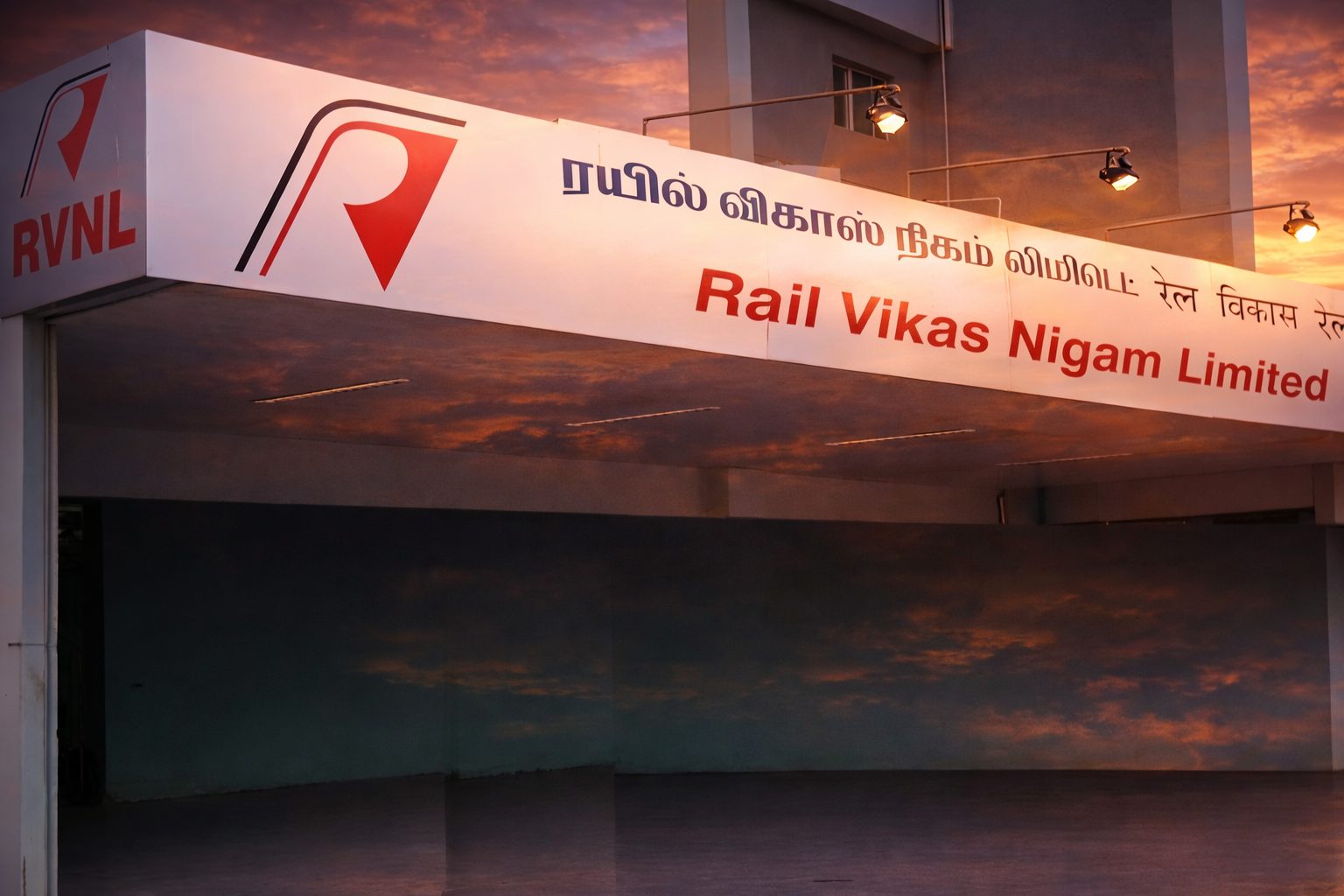

Rail Vikas Nigam Ltd (RVNL) stock jumped sharply in Friday’s session (December 26, 2025), with multiple market trackers reporting a double-digit move and heavy trading volumes. The rally put RVNL at the front of the “railway pack” as investors reacted to Indian Railways’ fare rationalisation taking effect today and renewed pre-Union Budget positioning in infrastructure names. Press Information Bureau
RVNL share price today: what the market is reacting to
By mid-session, RVNL was being reported as up roughly 10–13% intraday, with the stock touching the upper circuit at one point in early trade on some platforms. Business Standard noted RVNL hitting the upper circuit around mid-morning, while other reports pegged the day’s move closer to the 12–13% range as trading progressed.
Several outlets also highlighted a volume spike—often a tell that the move isn’t just a sleepy drift but a crowded trade. Capital Market reported RVNL as the top gainer in the BSE “A” group during the session, with trading volumes far above the recent one-month average. Capital Market
The big catalyst: Indian Railways fare rationalisation begins today
The dominant macro trigger behind the railway-sector rally is the passenger fare rationalisation that has come into effect from December 26, 2025.
In an official release, the Press Information Bureau (PIB) said Railways has rationalised the passenger fare structure effective today, emphasising that:
- the increase is modest (headline framing includes 1 paise per km for certain ordinary classes and 2 paise per km for Mail/Express categories),
- no change has been made to reservation fees or superfast charges,
- the revised fares apply only to tickets booked from December 26, 2025, with no impact on earlier bookings even if the travel date is later.
Market narratives are treating this as supportive for the broader rail ecosystem because better Railways finances can translate—indirectly—into capex continuity and faster project execution (the “more money + more willingness to spend” story). Moneycontrol, for instance, noted investor focus on the fare move partly because Railways had indicated the revision could help generate additional revenue (often cited around ₹600 crore in reports). Moneycontrol
Why RVNL is moving more than some peers: it’s a “capex beta” name
RVNL’s business model makes it especially sensitive to railway capex cycles. Unlike financing-focused railway PSUs, RVNL is widely framed as a higher-beta play on project execution: order wins, execution pace, and project margins can swing sentiment quickly.
India Today captured this positioning directly, describing RVNL as a higher-beta railway capex proxy whose earnings are more responsive to order wins, execution and margins—making it particularly reactive to policy and Budget expectations.
That framing helps explain why RVNL can out-run the pack on bullish days—and underperform just as enthusiastically when the market starts worrying about margins or order flow.
“Budget 2026 trade” is back in railway stocks—and RVNL is in the front row
Beyond fares, a second theme is unmistakable in today’s coverage: pre-Union Budget 2026 positioning.
The Economic Times reported RVNL had rallied strongly over the last five sessions and linked the move to optimism ahead of the Union Budget 2026.
LiveMint also pointed to a mix of pre-Budget positioning, policy optimism, and sector rotation driving Friday’s railway stock rally, with RVNL among the biggest gainers in that trade.
The fundamental reality check: RVNL’s recent earnings and margins have been under pressure
Here’s the part investors often ignore during a hot theme-rally: RVNL’s near-term profitability and cash flow have been a concern in recent quarters, and multiple analysts have flagged project mix and cost pressures.
A detailed IDBI Capital research note (Q2 FY26 result review, dated November 13, 2025) said RVNL posted a disappointing quarter on profitability despite modest revenue growth. The report highlighted:
- Revenue from operations up about 1% YoY to ₹49.3 billion (₹4,930 crore),
- EBITDA margin around 7.9%, down year-on-year as cost pressures persisted and lower-margin EPC work formed a larger share,
- Profit after tax down 35% YoY to about ₹1.9 billion (₹190 crore),
- A maintained HOLD rating with a revised target price of ₹334.
This is a key reason why “RVNL enthusiasm” in the market tends to come in waves: the story (order book + national rail buildout) is long-duration, but the quarterly execution/margin profile can be bumpy.
RVNL order book and guidance: the long runway the bulls keep pointing to
The bullish structural argument is still about visibility.
IDBI Capital pegged RVNL’s order book at roughly ₹900 billion (₹90,000 crore) as of Q2 FY26, suggesting 3–4 years of revenue visibility, with a split between legacy railway work and competitively bid contracts. The same note also said management reaffirmed FY26 revenue guidance and discussed a large bidding pipeline.
Put simply: if execution improves and margins stabilise, the backlog can power steady top-line momentum. But if margins stay compressed, revenue alone may not excite the market for long.
Analyst forecasts and RVNL share price targets: a wide spread (and that matters)
Today’s rally doesn’t mean analysts are unanimously cheering. In fact, the target-price spread being cited is unusually wide—one of the most useful signals that the stock is still controversial at these levels.
Consensus view: “Sell” bias in some aggregators
Investing.com’s consensus snapshot shows:
- consensus rating: Sell
- average 12‑month target: ₹269
- high estimate: ₹334
- low estimate: ₹204
Trendlyne similarly shows an average target around ₹334, implying downside from prices around the day’s elevated levels.
The “₹204 target” on a busy news day
Goodreturns reported that an Antique Stock Broking report dated December 26 carried a ‘Sell’ call with a target price of ₹204.
Whether investors agree or not, it’s notable because it places a fundamentally bearish anchor into a session dominated by bullish headlines.
Derivatives and technical chatter: signs of aggressive positioning
Alongside cash-market buying, derivatives indicators have also been in focus in the past few sessions.
MarketsMojo reported a rise in RVNL derivatives open interest alongside heavy trading volumes, and separately highlighted call option activity around late-December expiries—often interpreted as traders positioning for further upside (or hedging into volatility).
This kind of positioning can amplify moves both ways: when momentum persists, derivatives flows can add fuel; when sentiment turns, the unwind can be fast.
Corporate developments investors are tracking: tax demand notices and compliance updates
While today’s price action is being driven by sector headlines, RVNL has also made recent regulatory disclosures that investors should be aware of.
GST/Tax demand notices (FY 2021–22)
RVNL disclosed receipt of a DRC‑07 demand notice from the Assistant Commissioner (Ahmedabad) with a total demand of ₹5.56 crore, stating there is no material impact on the company’s financial/operational activities and that necessary appeals have been filed/are being filed.
A similar disclosure referenced a demand notice from the Senior Joint Commissioner (Kolkata) showing a total demand of ₹16.30 crore, again stating no material impact and that appeals are being filed.
Moneycontrol’s corporate notices feed also lists multiple demand-notice related disclosures around late December (alongside other compliance items), indicating the company has been actively updating exchanges on these matters.
Trading window closure ahead of Q3 (Dec quarter) results
RVNL also informed exchanges that the trading window for designated persons/insiders and their immediate relatives will remain closed from January 1, 2026 until 48 hours after the declaration of financial results for the quarter ended December 31, 2025.
This is standard compliance, but it’s relevant because it highlights the market’s next major company-specific catalyst: Q3 FY26 results.
Valuation check: why the stock can still feel “expensive” even after a correction
Even after a significant pullback from its peak, RVNL can screen as richly valued compared with some infrastructure peers—one reason brokerage targets are cautious.
LiveMint’s market stats page, for example, showed RVNL trading at a TTM P/E around the low 60s and noted the average broker rating skewing negative, alongside a still-modest dividend yield.
When a stock carries a high multiple, the market typically demands one (or more) of the following:
- accelerating earnings,
- improving margins,
- or highly reliable order inflows and execution.
Without that, rallies can become headline-driven rather than fundamentals-driven—and those are famously moody.
What matters next for RVNL stock after December 26’s surge
The market has handed RVNL a momentum baton today. Whether it keeps it depends on a few concrete checkpoints:
- Union Budget 2026 messaging on rail/infrastructure capex (and whether allocations or policy measures exceed expectations).
- Order inflow pace versus guidance and pipeline commentary (watch for “big-ticket” wins, not just incremental contracts). IDBI Capital
- Execution quality and margin trajectory—especially given recent analyst notes about cost pressures and contract mix.
- Q3 FY26 results (Dec quarter): investors will likely look for cash-flow and margin stability, not just revenue.
- Regulatory/tax matters: while RVNL has stated no material impact on recent demand notices, repeated disclosures can still influence sentiment until resolved.
Bottom line
RVNL’s December 26 move is a classic mix of macro headline catalyst (fare rationalisation) plus a pre-Budget infrastructure trade, with RVNL behaving like the high-beta rail capex proxy it’s often described as.
But the unusually wide range of analyst targets (including bearish calls even on a strong day) is a reminder that the next leg likely depends less on headlines and more on execution, margins, and order flow.
Related articles: Stock Market