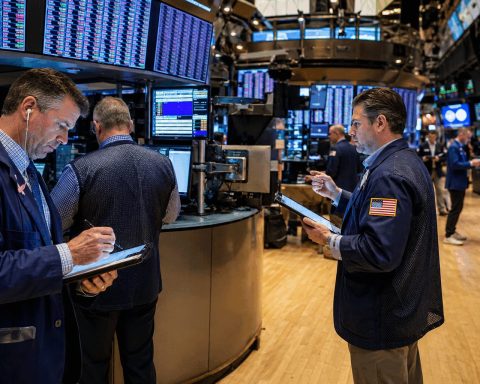

NEW YORK, Dec. 27, 2025, 12:00 p.m. ET — Market closed (U.S. stocks; crypto trading open).
Bitcoin (BTC) traded around $87,453 on Saturday midday in New York, with a $86,812–$87,699 intraday range, as weekend liquidity kept price action contained even while broader cross‑asset themes—year‑end portfolio moves, ETF flows, and a major options reset—continued to dominate traders’ short‑term playbook.
With U.S. equity markets shut until Monday, crypto markets are effectively taking their cues from what happened in Friday’s thin, post‑holiday stock session and what investors may do next as year‑end deadlines approach.
Bitcoin’s weekend trade: steady price, uneasy positioning
In the last 24–48 hours, the defining feature for BTC has been compression—a market that’s not collapsing, but also struggling to regain the psychological $90,000 handle that many traders view as the near‑term “line in the sand.” Commentary from Investing.com has framed Bitcoin as stuck below $90,000 amid thin liquidity and risk‑off sentiment, with flows and derivatives positioning amplifying moves around the mid‑$80,000s to high‑$80,000s. Investing.com
That “pinned” behavior matters because the final week of December often mixes low volume with high incentives: institutions finish rebalancing, some investors harvest losses for tax purposes, and derivatives dealers adjust hedges around large expirations.
Spot Bitcoin ETF flows: outflows continue into the final week
One of the most closely watched drivers for BTC into year‑end has been the direction of U.S. spot Bitcoin ETF flows—a channel many investors see as the “institutional rail” that supported much of 2025’s earlier strength.
Data tracked by Farside Investors shows net outflows of about $83.3 million on Dec. 26, with the table indicating FBTC at -$74.4 million and GBTC at -$8.9 million, while most other funds were flat and IBIT displayed as “—” on the tracker for that date. Farside
The same dataset shows prior outflow days including roughly -$175.3 million on Dec. 24 and -$188.6 million on Dec. 23, underscoring a late‑December stretch where net redemptions have repeatedly outweighed creations.
Analysts at Investing.com have argued that end‑of‑year ETF outflows can reflect tactical de‑risking and seasonal rebalancing rather than a clean break in longer‑term institutional adoption—yet, tactically, persistent outflows can still remove marginal demand and cap rallies.
Derivatives: the year-end options reset and why volatility risk hasn’t disappeared
Another major force behind Bitcoin’s late‑December “stuck” feeling has been derivatives positioning.
A Yahoo Finance report highlighted that more than $27 billion in Bitcoin and Ethereum options were set to expire on Deribit, one of the most important crypto options venues—an event large enough to reshape dealer hedging and near‑term volatility dynamics.
Investing.com analysis over the past two days has also emphasized that options strikes clustered in the $85,000–$90,000 band can create a “pinning” effect as dealers hedge gamma exposure—potentially suppressing volatility until positioning rolls off, and then allowing sharper moves once that constraint fades. Investing.com
The practical takeaway for investors: even if BTC looks calm on a Saturday, the market can still be “coiled,” particularly in thin holiday conditions where relatively modest spot flows can have an outsized impact.
Tax-loss harvesting: why Bitcoin’s drawdown matters more at year-end
A key narrative emerging late this week is tax-driven trading—especially for investors who hold both equities and crypto.
Bloomberg reported that Bitcoin’s roughly 30% slide from its all‑time high has created conditions that financial advisers say are likely driving more tax‑loss harvesting in digital assets than in prior years. Bloomberg also pointed to a stark divergence: Bitcoin down about 5% year‑to‑date versus the S&P 500 up roughly 18%, increasing incentives for investors to sell underwater crypto to offset gains elsewhere before Dec. 31.
This matters for price because tax‑motivated selling can be “mechanical”—it doesn’t always reflect a fundamental view on Bitcoin’s long‑term prospects, but it can still pressure spot markets (and ETF flows) in the final sessions of the year.
The stock-market backdrop: near record highs, “Santa Claus rally” watch, and surging precious metals
While Bitcoin trades 24/7, U.S. stock market tone still shapes broad risk appetite—especially for institutions that allocate across asset classes.
On Friday, Wall Street closed nearly flat in a quiet, post‑Christmas session. The S&P 500 finished at 6,929.94, the Dow at 48,710.97, and the Nasdaq at 23,593.10, with all three slightly lower on the day but still logging weekly gains.
Reuters quoted Ryan Detrick, chief market strategist at Carson Group, describing the post‑holiday pause as the market “catching our breath” after a strong run, with investors still watching whether the traditional “Santa Claus rally” period ends positively. Reuters
Meanwhile, precious metals have been stealing attention. Reuters reported silver hitting an all‑time high around $77.4/oz and gold reaching record levels near $4,549/oz, helped by safe‑haven demand, a weaker dollar, and expectations around the path of Fed policy. Reuters Reuters also cited Soojin Kim, a commodities analyst at MUFG, noting the gold rally could continue amid strong physical demand and persistent geopolitical and monetary uncertainty.
For Bitcoin investors, the “risk-on stocks / risk-off crypto” split isn’t a rule—but it has been a feature of this part of the cycle. When gold is making fresh highs and stocks are hovering near records, Bitcoin bulls typically want to see ETF flows stabilize and macro stress ease before expecting a sustained rebound.
Forecasts and technical levels: what analysts are watching next
With year-end catalysts in play, near‑term forecasts have leaned toward scenario-based levels rather than bold directional calls.
In an Investing.com outlook published Friday, author Günay Caymaz argued that Bitcoin’s near‑term direction “depends” on whether it can reclaim $91,000; the analysis flagged $85,000 as key support, with resistance near $91,000 and a more significant zone around $94,700, and listed higher targets only if those resistance levels break decisively. Investing.com South Africa
A separate Investing.com analysis by Itai Smidt described Bitcoin as pivoting around the $87,000 area in thin liquidity, with ETF outflows and derivatives positioning acting as near‑term headwinds—while warning that post‑expiry conditions can lead to a sharper move once the “pin” loosens. Investing.com
Taken together, the dominant “forecast” theme isn’t a single price target—it’s fragile stability: a market that may hold together above mid‑$80,000s, but could swing quickly if liquidity thins further or if flows worsen when traditional markets reopen.
If the stock exchange is closed: what investors should know before Monday’s next session
With U.S. equity markets closed for the weekend, Bitcoin traders are effectively preparing for two openings: Sunday evening futures (for macro sentiment) and Monday’s cash session (for ETF flows and cross‑asset positioning).
Here are the highest‑impact items to watch before the next U.S. session:
- Spot Bitcoin ETF flow prints when U.S. markets reopen
Late‑December outflows have been a key talking point; any stabilization (or renewed outflows) can quickly change BTC’s tone. - Year-end tax positioning into Dec. 31
Bloomberg’s reporting suggests tax-loss harvesting in crypto is becoming a bigger late‑December factor as investors weigh stock gains against crypto losses. - Thin liquidity = bigger moves from smaller catalysts
Friday’s equity session was notably quiet, which is typical in the last week of the year—but it also means price can gap faster when real volume returns. - Key economic data on Monday morning
The National Association of Realtors says Pending Home Sales for November are scheduled for 10:00 a.m. Eastern on Monday, Dec. 29—one of the first notable U.S. releases of the week that can nudge rates and the dollar, and indirectly influence risk assets. - Holiday week market hours into New Year’s
Investopedia reports a full trading day on New Year’s Eve (Wed., Dec. 31), with markets closed on New Year’s Day (Thu., Jan. 1, 2026)—useful context for anyone planning around liquidity and settlement timing.
Bottom line
Bitcoin’s price near $87,000 isn’t just “a quiet weekend.” It’s a market balancing ETF outflows, a major derivatives reset, and year-end tax and rebalancing incentives, while U.S. stocks sit near record highs and precious metals surge. With Monday’s reopening likely to restore institutional flows and cross‑asset activity, traders are watching whether BTC can hold the mid‑$80,000s support zone—and whether renewed buying can push the market back toward the $90,000–$91,000 resistance area that multiple analysts have flagged as pivotal. Investing.com South Africa+1