
NEW YORK, Dec. 28, 2025, 4:40 p.m. ET — Market closed (weekend).
Lam Research Corporation NASDAQ:LRCX is heading into the final trading week of 2025 near record territory after a strong late-December run that has put semiconductor equipment stocks back in the spotlight. With U.S. equity markets closed for the weekend, investors are now looking ahead to Monday’s open (and a holiday-shortened week) to see whether momentum continues—or whether thin, year-end liquidity triggers sharper swings.
Where Lam Research stock stands heading into Monday
Lam Research shares last closed at $178.07 after Friday’s session, with after-hours trading last recorded around $178.19. The stock’s Friday range touched the high-$179 area, keeping LRCX close to fresh highs as investors position for 2026 expectations in AI infrastructure, advanced packaging, and memory spending.
On standard U.S. trading days, the market’s core session runs 9:30 a.m. to 4:00 p.m. ET, with extended hours from 4:00 p.m. to 8:00 p.m. ET. Monday’s action will begin to matter most in premarket positioning and opening liquidity—especially in a holiday week when price discovery can be jumpy.
The past 48 hours: what’s new in the headlines
Even with the calendar turning and news flow naturally slowing, several LRCX-related headlines and research notes have shaped weekend sentiment:
- Market movers coverage (Dec. 26): Barron’s flagged Lam Research among notable stock movers as U.S. markets reopened after Christmas in light volume, noting LRCX was pushing toward record levels.
- “New highs” watch (Dec. 26): Barron’s also included Lam Research in a roundup of stocks hitting new highs alongside other large-cap tech and semiconductor names, reinforcing the “leadership” narrative in the tape. Barron’s
- Fresh sell-side research compilation (Dec. 26): A Zacks Research Daily recap on Nasdaq highlighted Lam Research as one of the day’s featured research reports, citing drivers such as 3D DRAM, advanced packaging, and HBM-related demand—while also calling out risks tied to weaker “mature node” spending and U.S.–China trade/tariff tensions. Nasdaq
- Comparative fundamental angle (Dec. 27): Trefis published a side-by-side framing of Lam Research versus Teradyne, pointing to stronger recent growth and profitability metrics for LRCX in its comparison.
- Institutional/filing-driven headlines (Dec. 28): MarketBeat posted multiple items focused on 13F-style position changes involving Lam Research, including reports on new or increased stakes by specific advisory firms. (These are typically not market-moving on their own, but they can add color on ownership trends.
Analyst targets: $200 is becoming a common “next stop”
A key reason Lam Research remains a “top of mind” semiconductor name into year-end is that multiple firms have recently lifted targets, often clustering around the $200 level.
- Mizuho: Analyst Vijay Rakesh raised Mizuho’s price target on Lam Research to $200 from $170 and kept an Outperform rating, citing expected upside to 2026 wafer fab equipment (WFE) estimates and an improving WFE outlook.
- UBS: UBS raised its price target to $200 from $175 and reiterated a Buy rating (as carried by TheFly/TipRanks distribution).
For investors trying to reconcile bullish targets with a stock already near highs, it’s worth noting that published consensus snapshots can look mixed depending on timing and methodology. For example, a Nasdaq/Fintel summary dated Dec. 23 cited an average one-year price target of $173.27 (as of Dec. 21), with a wide range from $117.48 to $220.50—and it also noted a put/call ratio of 1.33, a data point some traders interpret as more cautious positioning.
Industry backdrop: AI-driven capex and the WFE cycle matter more than ever
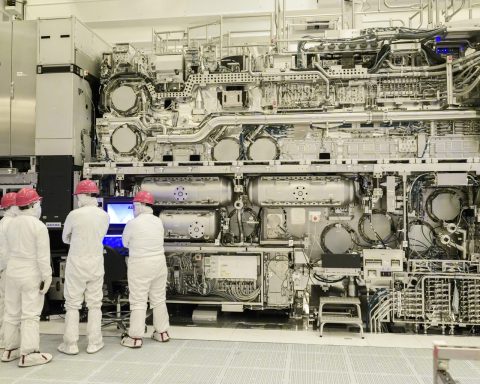
Lam Research sits in the center of the semiconductor “picks-and-shovels” trade—etch and deposition equipment that becomes more critical as chip architectures get more complex (3D NAND layers, advanced DRAM, leading-edge logic, and packaging).
Two macro/industry forecasts are frequently cited in recent coverage:
- SEMI (via Reuters): Industry group SEMI forecast equipment sales used to make chip wafers would rise about 9% to $126 billion in 2026, with further growth projected for 2027—attributing the expansion to capacity build-outs for logic and memory chips used in AI. Lam Research is listed among key global suppliers in that ecosystem.
- Bank of America (via TheStreet): BofA analysts wrote that they expect nearly double-digit WFE sales growth and highlighted semicap equipment as an area they “continue to like,” pointing to drivers such as high-bandwidth memory, higher-layer NAND, leading-edge logic, and advanced packaging. TheStreet
This is the real debate investors are carrying into Monday: Is LRCX’s move mainly a year-end momentum trade, or the market pulling forward a multi-year equipment upcycle tied to AI and memory? The answer will likely be shaped by capex commentary from major chipmakers over the next several quarters—not just Lam’s own results.
What Lam Research last told investors: growth, margins, and a China-heavy mix
From Lam Research’s most recent quarterly report (for the quarter ended Sept. 28, 2025), the company posted:
- Revenue: $5.32 billion
- U.S. GAAP gross margin: 50.4%
- U.S. GAAP operating income: 34.4% of revenue
- U.S. GAAP diluted EPS: $1.24 (with non-GAAP diluted EPS of $1.26) Lam Research Newsroom
Lam also disclosed a revenue mix detail that remains strategically important for risk assessment: China represented 43% of revenue in the September 2025 quarter (with Taiwan 19% and Korea 15% among other regions). That exposure can be a tailwind in strong demand periods—but it is also a headline risk when export controls or geopolitical tensions intensify.
Looking ahead, Lam’s guidance at the time called for (for the quarter ended Dec. 28, 2025) approximately:
- Revenue: $5.20 billion ± $300 million
- Non-GAAP gross margin: 48.5% ± 1%
- Net income per diluted share: $1.15 ± $0.10 Lam Research Newsroom
Insider activity: a real data point investors continue to monitor
While not a day-to-day trading driver, insider filings have also been part of the December discussion around Lam Research.
A Form 4 filing for Timothy Archer (President and CEO) shows transactions dated Dec. 17, 2025, described as planned under a Rule 10b5-1 trading plan adopted earlier in 2025.
Separately, a Reuters/Refinitiv-distributed item (carried on TradingView) summarized the Form 4 activity and labeled it as planned transactions (exercise and sale) disclosed to the SEC.
Market context: what matters this week for LRCX holders
Because it’s the last trading week of the year and New Year’s Day falls on Thursday, the broader market setup could play an outsized role in whether LRCX extends its run or pauses.
Key calendar points highlighted in weekend market previews include:
- Holiday-shortened week: Stock markets are off on Thursday (Jan. 1) for New Year’s Day; stock markets are operating a normal schedule on New Year’s Eve (Wednesday), while bond markets close early at 2 p.m. ET on Wednesday.
- Macro releases: Pending home sales (Monday), Case-Shiller home price index (Tuesday), Chicago Business Barometer (Tuesday), and FOMC meeting minutes (Tuesday), followed by weekly jobless claims (Wednesday).
For Lam Research specifically, macro data can matter indirectly through rates and risk appetite, but the more direct read-through tends to come from semiconductor and AI infrastructure sentiment—often moving in sympathy with large-cap chip names and memory leaders.
If you’re watching LRCX into Monday: a practical checklist
With markets closed today, here’s what many investors will focus on before the opening bell:
- Premarket tone in semiconductors: Watch whether strength holds across semiconductor equipment peers and memory-linked names. (In thin holiday liquidity, sympathy moves can be magnified.
- Whether “$200 target” talk keeps pulling in buyers: Multiple recent target raises have clustered around $200, which can become a psychological level traders lean on. TipRanks+1
- Any change in the WFE narrative: The bull case rests heavily on 2026 equipment demand tied to AI and memory—an outlook supported by recent SEMI forecasts and bullish sell-side commentary.
- Headline risk around trade/geopolitics: Recent research recaps continue to cite U.S.–China trade/tariff tension as a meaningful risk factor for Lam’s outlook—especially given the company’s regional revenue exposure.
- Volatility risk from the calendar: With New Year’s week historically lighter on liquidity, investors often see sharper moves—up or down—than fundamentals alone would suggest.
Bottom line
Lam Research stock enters Monday’s session with strong momentum, a stack of recent bullish target revisions, and an industry backdrop that continues to tilt toward higher equipment intensity in AI-era chips. But with U.S. markets heading into a holiday-shortened week—and with LRCX already near records—traders will be watching whether the next leg higher is driven by fresh fundamental catalysts (WFE data points and capex confidence) or simply year-end positioning that can reverse quickly when liquidity returns in early January.