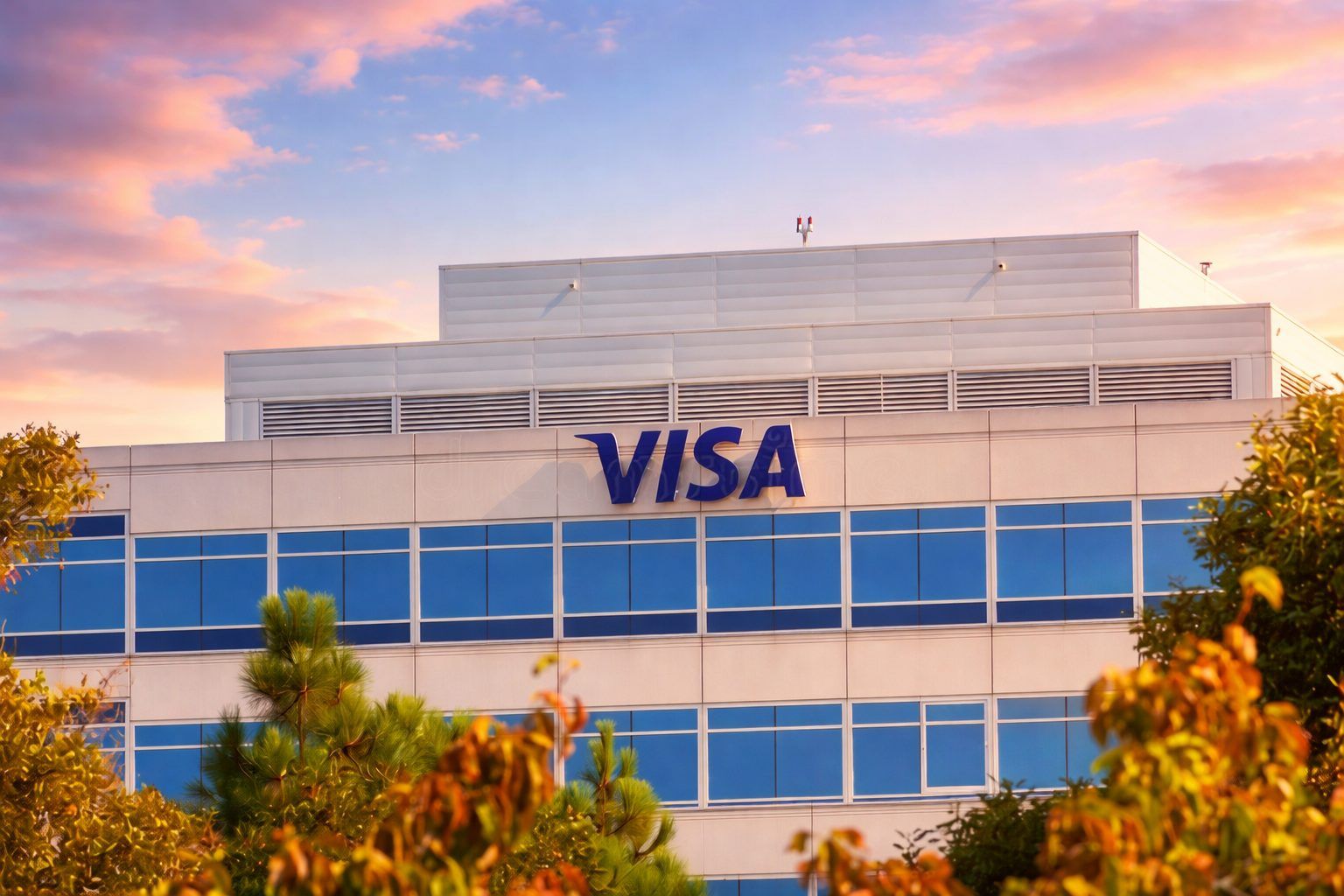
NEW YORK, January 1, 2026, 11:09 ET — Market closed
- Visa shares last traded down 0.8% at $350.71 in extended trading after closing at $353.53.
- A new SEC filing detailed updated conversion rates for Visa’s class B-1 and B-2 shares tied to its U.S. litigation escrow plan.
- Investors are looking ahead to early-January U.S. data and Visa’s late-January calendar catalysts.
Visa Inc. shares (V) were last down 0.8% at $350.71 in extended trading after the payments company disclosed an update to its class B stock conversion rates in a regulatory filing. U.S. stock markets were closed on Thursday for New Year’s Day.
The update matters because the conversion rates determine how Visa’s class B shares convert into its publicly traded class A stock. Changes can affect the share count used in earnings per share, a key metric investors track.
Visa tied the adjustment to its U.S. litigation escrow account, which is linked to legacy legal exposures under its “U.S. retrospective responsibility plan.” Investors watch litigation-related cash uses because they can shape how much capital a company returns via buybacks and dividends. SEC+1
Visa said in its Dec. 30 Form 8-K that the class B-1 conversion rate fell to 1.5491 from 1.5549 and the class B-2 conversion rate fell to 1.5108 from 1.5223, effective as of Dec. 23. The company said the adjustments reduced the as-converted class B-1 share count by about 27,782 and the class B-2 share count by about 1.38 million.
The company said the conversion-rate adjustments “have the same effect on earnings per share as repurchasing” Visa’s class A shares. Visa said it used a volume-weighted average price, which weights each trade by its size, over a three-day period from Dec. 23 through Dec. 26 to calculate the adjustment. SEC
Visa’s investor-relations materials note that class B conversion rates change with deposits into the litigation escrow account, with class B holders bearing the expense via a reduced as-converted share count.
Visa ended the last regular session of 2025 at $353.53. It last traded at $350.71 in extended trading, which refers to after-hours transactions when the main U.S. session has ended.
The broader market finished 2025’s final session lower in holiday-thinned conditions, with the S&P 500 down 0.74%, according to Reuters. “It’s perfectly fine in any bull market to have moments of cost,” Giuseppe Sette, co-founder and president of Reflexivity, told Reuters, pointing to profit-taking when liquidity was low. Reuters
Before the next session on Friday, investors in payment processors will look for fresh signals on consumer spending and travel, key drivers of transaction volumes. Visa and peers such as Mastercard can trade as read-throughs on card and digital payment activity.
The early-January U.S. data calendar is also in focus because interest-rate expectations can ripple through financial stocks. The Labor Department’s Employment Situation report for December is due on Jan. 9, followed by December consumer inflation data on Jan. 13, the agency’s schedule shows.
On the company calendar, Visa’s annual meeting is set for Jan. 27, according to its annual meeting materials. Visa has not announced a date for its next quarterly results, but Nasdaq’s earnings calendar estimates a report around Jan. 29.
On the tape, traders are watching whether the stock holds the $350 area after it traded as low as $350.71, with a near-term marker at Wednesday’s high of $355.13.
For now, the conversion-rate filing is primarily a share-structure update rather than an operating signal. Still, it underscores how litigation-related mechanics can influence share counts and per-share metrics as investors turn to the next earnings window.