NEW YORK, January 1, 2026, 14:46 ET
- NOAA issued geomagnetic storm watches for Jan. 1–3 after multiple solar eruptions.
- Forecasters expect the strongest geomagnetic activity late Friday into Saturday, which can boost northern lights visibility.
- A full “Wolf Moon” supermoon and the Quadrantid meteor shower arrive this weekend, but moonlight will wash out many meteors.
The U.S. National Oceanic and Atmospheric Administration has issued geomagnetic storm watches through Saturday after several solar eruptions, a setup that can strengthen the northern lights over parts of North America.
The timing matters because the first nights of 2026 coincide with a burst of solar activity that can ripple from the sky to critical infrastructure. Geomagnetic storms can push aurora farther from the poles and also stress systems that rely on radio and satellite links.
For the public, the payoff is a chance — not a guarantee — of seeing aurora on the northern horizon. For operators, the same solar disturbances can trigger navigation errors, radio disruptions and power-grid fluctuations.
In a three-day forecast issued on Thursday, NOAA’s Space Weather Prediction Center said the planetary Kp index — a 0-to-9 measure of geomagnetic activity — could reach 6 at times through Jan. 3, a level it classifies as a moderate (G2) geomagnetic storm. The center said G1 to G2 storming is possible late Jan. 2 into Jan. 3 as multiple coronal mass ejections arrive and interact with a coronal-hole high-speed stream.
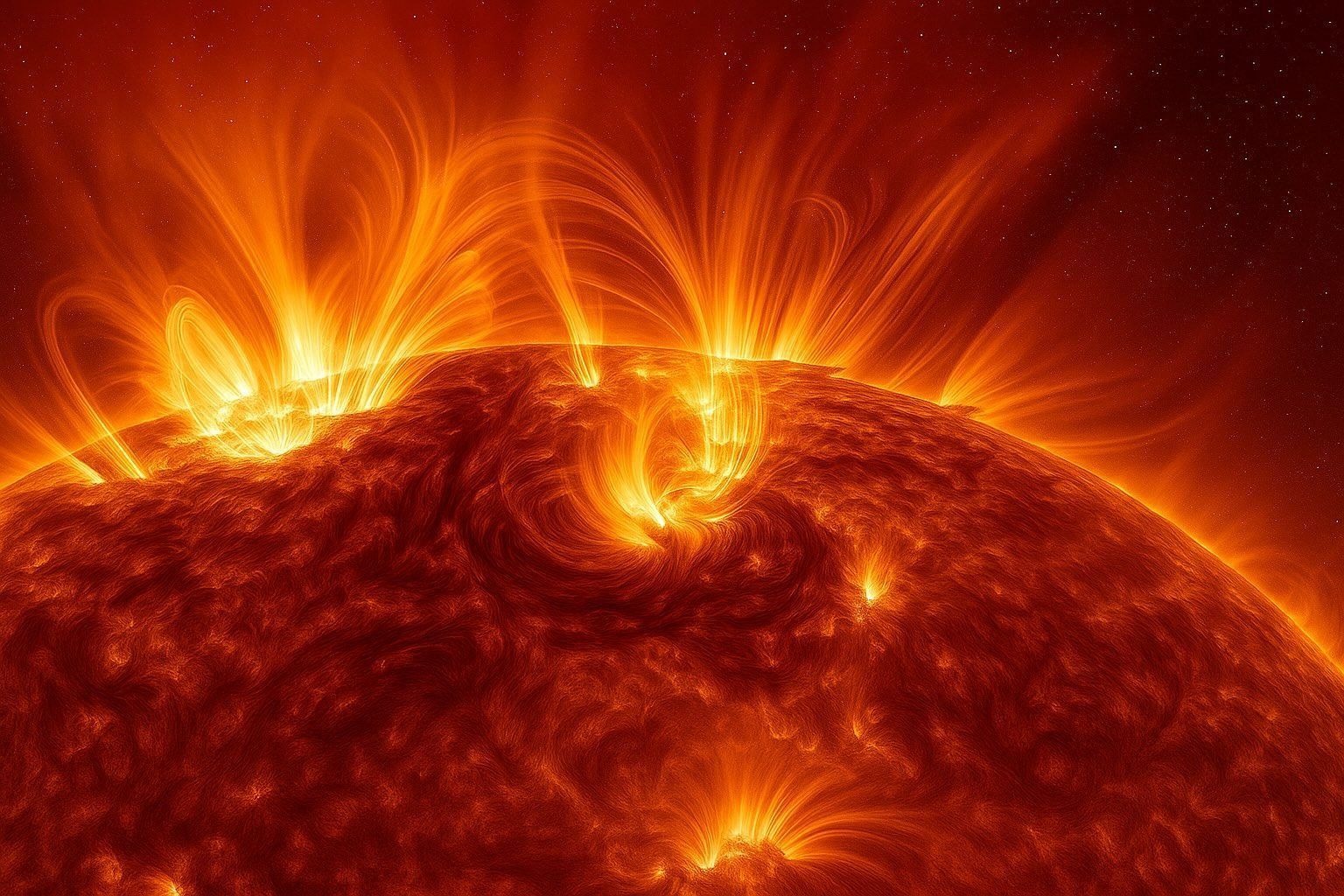
A coronal mass ejection, or CME, is a large burst of solar plasma and magnetic field that can drive strong geomagnetic storms when it hits Earth’s magnetic environment. Coronal holes are regions on the sun that can send faster solar wind toward Earth and also stir geomagnetic activity, NOAA says.
NOAA said an M7.1 solar flare triggered an R2 (moderate) radio blackout at 13:51 UTC on Dec. 31 from sunspot region 4324.
NOAA’s storm scale runs from G1 (minor) to G5 (extreme) and links each level to likely effects on power systems, satellites and radio. At the G2 level, aurora has been seen as far south as New York and Idaho, while G1 aurora is commonly visible at higher latitudes such as northern Michigan and Maine, NOAA says.
For viewers, NOAA says the best aurora window is typically within an hour or two of midnight, and darker skies away from city lights help. The agency also notes that moonlight reduces the aurora’s apparent brightness, even if it does not change the underlying activity.
NOAA’s experimental “aurora viewline” product uses the OVATION model and updates continuously, showing the southernmost areas that may see aurora on the northern horizon. A map published early Thursday placed that viewline close to the U.S.-Canada border, signaling that the best odds remain at higher latitudes as the storm setup develops. NOAA Space Weather Prediction Center
Across the Atlantic, the UK Met Office also flagged the risk of geomagnetic storms building toward Saturday, with a “minor to moderate” storm expected on Jan. 3 and a slight chance of stronger intervals. Its outlook tied the risk to an Earth-directed component of a CME associated with the Dec. 31 flare.
The weekend sky has another complication: Saturday’s full “Wolf Moon” will be a supermoon, a term used for a full moon near its closest point to Earth. At that distance, NASA says the moon can appear up to 14% larger and 30% brighter than the year’s faintest full moon, a glare that will also dull the Quadrantid meteor shower. “The biggest enemy of enjoying a meteor shower is the full moon,” said Mike Shanahan, the planetarium director at Liberty Science Center, in comments reported by the Associated Press. AP News
NOAA said aurora forecasts can shift quickly as solar wind conditions change, and it publishes frequent updates for both short-term and multi-day outlooks. For most observers, clear skies, darkness and patience will matter as much as the storm label.