
NEW YORK, April 30, 2026, 10:01 EDT
- Plug Power shares slipped, paring some of Wednesday’s gains as investors awaited first-quarter results set for May 11.
- Clear Street’s raised target combined with gains in fuel-cell stocks fueled the previous session’s advance.
- Now the spotlight shifts to Plug’s cash burn. Investors want to see improvement there, along with real movement toward positive adjusted EBITDA—a metric excluding interest, taxes, depreciation, amortization, plus a few other adjustments.
Plug Power Inc. shares slipped in early U.S. trade Thursday, giving back some of the previous session’s strong gains. Investors are weighing a bullish analyst note against the company’s ongoing heavy cash requirements.
The stock slipped roughly 7% to $3.17, after finishing at $3.41 on Wednesday. Earlier Thursday, it touched $3.53, market data show.
Plug’s timing is notable, with its first-quarter earnings announcement less than two weeks out. The company sets May 11 for results and plans a 4:30 p.m. ET call, shifting attention from sector momentum to margins, orders, and liquidity.
Plug jumped 12.54% Wednesday, snapping a four-session slide as volume spiked well past its usual levels, according to MarketWatch. Investors piled in after Bloom Energy posted strong numbers and Plug got a price-target boost, pulling in fresh interest across fuel cell and alternative power stocks.
Tim Moore at Clear Street bumped his Plug price target up to $3.50 from $3.00, sticking with a Buy rating. He pointed to “continued order wins momentum” alongside “adequate liquidity” to cover near-term cash burn, projecting the company could hit free cash flow by 2028, according to TipRanks, which referenced The Fly. Free cash flow refers to cash left after covering both operating expenses and capital spending. TipRanks
The report had some mixed messages. Clear Street lowered its revenue forecast for Plug in the first half of 2026, but bumped up estimates for the second half, according to Investing.com. The firm sees March-quarter sales rising 8% to $144 million and expects Plug’s total revenue for 2026 to climb 15% to $817 million.
Plug is drawing comparisons to Bloom Energy. In the first quarter, Bloom’s revenue surged 130.4% to $751.1 million, fueled by strong demand for its on-site power systems. The company also posted $73.6 million in operating cash flow. While Bloom builds fuel-cell systems, its business doesn’t mirror Plug’s hydrogen-driven approach.
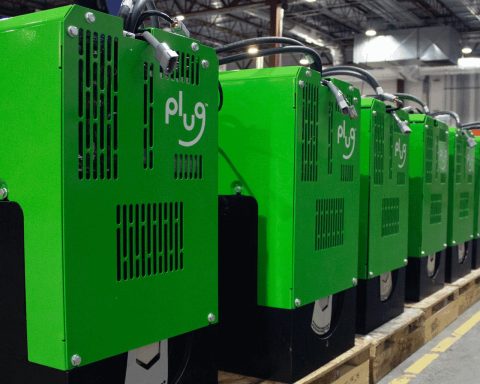
The debate partly centers on that gap. Plug’s products range from electrolyzers—these use electricity to separate water into hydrogen and oxygen—to fuel cells, storage units, fueling systems, and liquid hydrogen. The company reports more than 74,000 fuel-cell systems and 285 fueling stations now in operation.
Plug has been keen to highlight incoming business. Earlier this month, it announced selection for front-end engineering on a 275-megawatt GenEco PEM electrolyzer system for Hy2gen Canada’s Courant project in Québec—one of Plug’s biggest electrolyzer wins so far. The PEM, or proton-exchange membrane, system is designed for hydrogen production.
Yet investors want to see revenue translate into real cash flow. Plug closed out 2025 holding $368.5 million in unrestricted cash, the company reported in March. Operating cash outflows for the year came to $535.8 million, a drop of over 26.5% from 2024.
Plug pointed to over $275 million it expects from monetizing assets connected to a U.S. data-center expansion and other steps to boost liquidity. Executives said that cash, plus anticipated improvements in cash flow, will keep operations funded into 2026.
Back in March, Chief Executive Jose Luis Crespo reiterated Plug’s aim: positive adjusted EBITDA in the fourth quarter of 2026, then operating income in the black by the end of 2027, and full profitability a year after that. He pointed to ongoing cost-cutting measures and a sales pipeline topping $8 billion.
Execution is the sticking point. Plug has little room for error—delays in asset sales, weaker orders, or if those gross-margin improvements don’t hold up, and management might be forced to either tighten spending more or tap the market for cash again. Thursday’s pullback in the shares signals investors aren’t taking Wednesday’s surge as confirmation that the company’s fortunes have reversed.
Related articles: Earnings Reports