
TORRANCE, California, May 3, 2026, 15:01 PDT
- Navitas Semiconductor jumped 5.76% to finish at $17.45 on Friday, as nearly 30 million shares changed hands. Investors are looking ahead to first-quarter earnings set for Tuesday.
- The company is moving to lean harder on high-power chips used in AI data centers, grid gear, and industrial customers, following a soft fourth quarter.
- Timing remains the key risk here. Navitas cautioned that its customer pipeline and so-called “design wins” shouldn’t be mistaken for actual orders, backlog, or immediate sales. Navitas Semiconductor
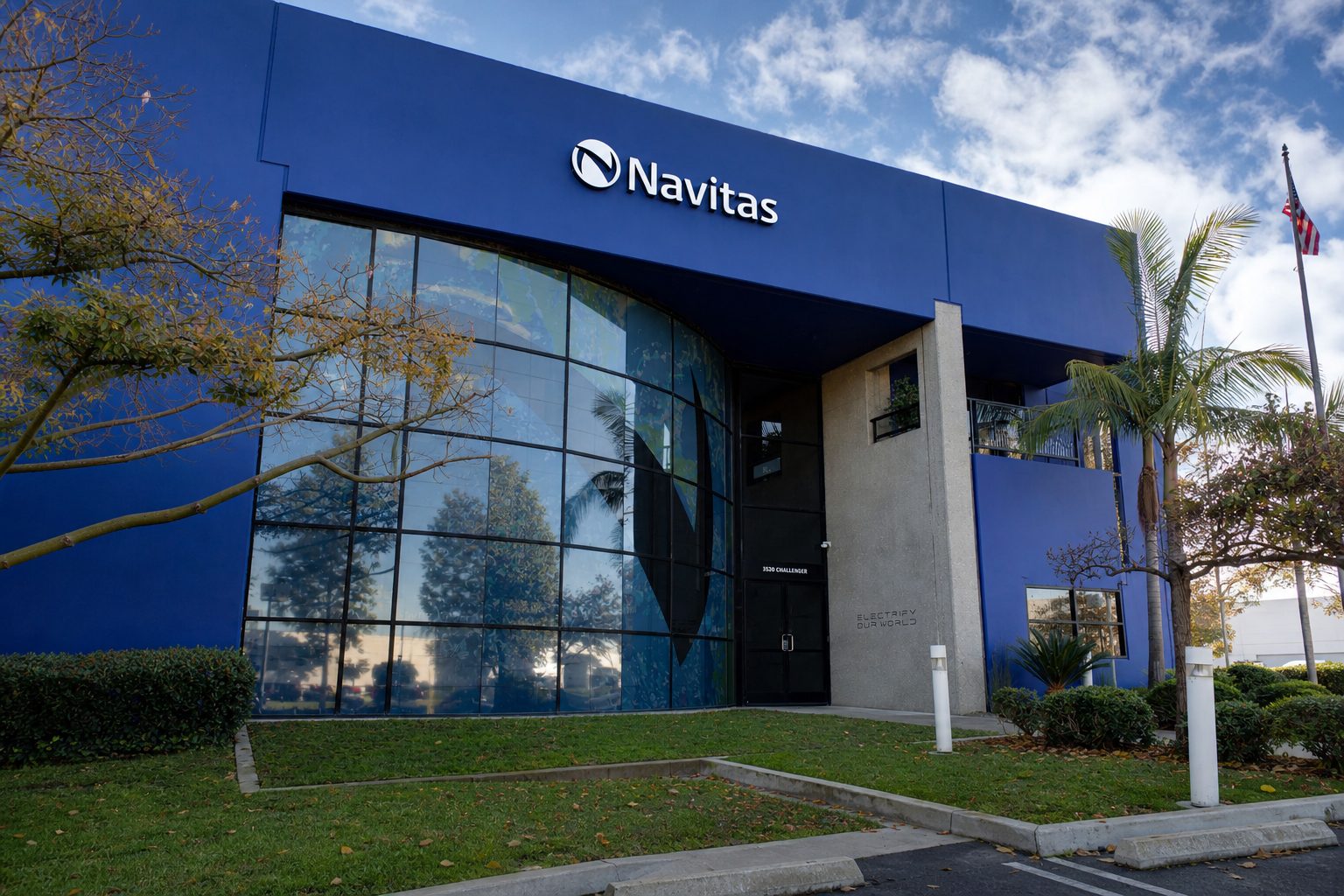
Navitas Semiconductor Corp heads into its first-quarter earnings on Tuesday afternoon with a rally that’s about to get tested. Shares, listed on the Nasdaq, wrapped up Friday at $17.45—gaining 5.76% for the session. The stock swung from $15.81 to $18.03 on robust volume.
This has become a key focus as investors shift attention past flashy graphics processors and memory, zeroing in on the overlooked components that actually power AI servers. Navitas, for its part, manufactures chips built with gallium nitride and silicon carbide. Those materials handle power delivery with less heat loss compared to traditional silicon, and lately, the company’s valuation has started to move in step with the broader AI energy supply story.
President and CEO Chris Allexandre, along with CFO Tonya Stevens, are set to review results and talk guidance during a call at 2:00 p.m. Pacific on May 5. With shares making a notable move lately, investors may be more focused on what’s ahead than on the numbers just reported.
Navitas’s revenue base remains limited. The company posted fourth-quarter sales of $7.3 million, slipping from $10.1 million in the previous quarter and $18.0 million in the same period last year. GAAP operating loss deepened, reaching $41.4 million. For the first quarter, Navitas expects revenue between $8.0 million and $8.5 million.
Management wants investors to look past the current dip. For the first time, Navitas reported that high-power markets accounted for most of its quarterly revenue. Allexandre pointed to AI as a new driver, spurring wider use of these high-power offerings.
Here’s the angle: 800-volt direct-current power. It’s a high-voltage setup designed to push electricity through tightly packed AI racks, cutting down on conversion steps. Back in March, Navitas rolled out an 800 V-to-6 V DC-DC power delivery board aimed at NVIDIA-based AI infrastructure—DC-DC refers to the process of shifting from one direct-current voltage to another.
Allexandre pointed to the design’s potential to “lower system cost and power losses.” NVIDIA’s 800 VDC data-center setup is targeting one-megawatt IT racks and larger beginning in 2027. That puts the focus on how much revenue Navitas can generate before NVIDIA’s architecture gains traction. Navitas Semiconductor
Navitas finds itself among bigger names. NVIDIA’s official 800 VDC ecosystem features heavyweight silicon suppliers—Infineon, Monolithic Power Systems, Texas Instruments—all listed right next to Navitas. The smaller player, then, is part of a crowded field, not tucked away in any niche.
Power-chip stocks have caught some notice lately. Last week, Barron’s pointed to a pivot in investor interest toward the sector, mentioning the runs in Navitas and Vicor. Analyst Rick Schafer, quoted in the piece, flagged 800-volt power as a possible growth trigger starting in 2027.
Navitas tapped Gregory M. Fischer—a Broadcom veteran with over four decades in semiconductors—for an independent director seat starting April 13. Chairman Richard Hendrix described the moment as a “pivotal time for Navitas.” The company said Fischer’s appointment adds industry know-how at the board level. Navitas Semiconductor
Not as high-profile, but still on the radar: governance. Navitas, in an early proxy filing, set a virtual annual meeting for June 25. Shareholders will be asked to greenlight a proposal to declassify the board—shifting directors to annual elections instead of the current staggered setup.
Still, things can swing the opposite direction. Navitas has flagged several risks tied to its move into high-power: operational, technical, and market uncertainties all in play. The company cautions that adoption of 800 V systems might fall short of what it’s counting on, and it’s quick to note that “design wins” don’t automatically translate to orders or a revenue pipeline. Navitas Semiconductor
Tuesday’s report faces a double challenge: it needs to deliver sequential revenue growth after that fourth-quarter slump, and also make sure the AI momentum isn’t just a distant 2027 pitch overshadowed by 2026 losses. According to MarketScreener, eight analysts carry a Hold consensus, their average target price planted at $8.15—well under Friday’s close.