
SAN DIEGO, May 9, 2026, 14:03 PDT
Kratos Defense & Security Solutions picked Odon, Indiana, for its latest hypersonic materials test facility, just two days after the defense firm bumped up its 2026 revenue guidance. The new site is set to host Project Helios—a mid-tier coupled arc jet and laser operation focused on testing materials for hypersonic systems, those vehicles built to travel at speeds topping Mach 5.
The timing here is key: Kratos wants to convert that surge in demand for drones, missile systems, and high-speed weapons testing into actual contracts, not just a bounce in its stock. After a multi-state search, the company picked Odon for its new site, which will boost aerothermal testing capacity — essentially, testing how materials withstand intense heat and fast-moving air.
KTOS shares have been drawing scrutiny lately. On Friday, the stock finished at $57.89—up 1.56%—and ticked to $58.00 in after-hours trading. U.S. markets were closed Saturday.
Kratos posted first-quarter revenue of $371.0 million, climbing 22.6% year over year. Adjusted earnings landed at 16 cents a share, with net income rising to $11.9 million from $4.5 million in the same period last year. The company raised its outlook for full-year revenue, now projecting a range of $1.70 billion to $1.76 billion. Adjusted EBITDA guidance moved up too, with Kratos now targeting $170 million to $176 million.
Orders were a highlight in the report. Kratos booked $605.2 million for the quarter, pushing its book-to-bill ratio to 1.6. As of March 29, total backlog reached roughly $2.01 billion.
Michael Johns, senior vice president at Kratos, called the Odon choice “a highly competitive process with several strong candidate locations.” According to Dave Carter, who heads the Defense and Rocket Support Services division, support from Indiana leaders and utility partners factored into Kratos’ site selection. Kratos Defense
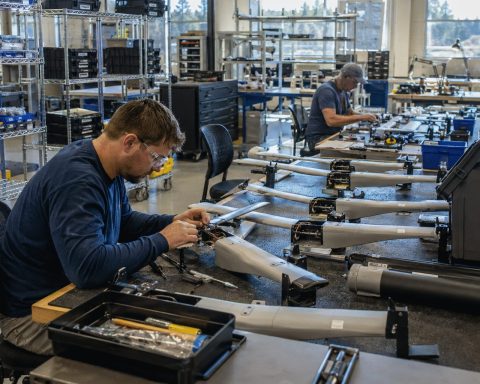
Growth came from more than just one segment. Kratos’ unmanned systems division delivered $82.6 million in revenue, powered in part by work tied to Valkyrie. Over in Kratos Government Solutions, sales climbed to $288.4 million. Inside the government business, defense rocket systems, turbine technologies, and microwave products stood out as top performers.
Chief Executive Eric DeMarco described the turbine unit as “ripping right now,” pointing to momentum in missile, drone, and space programs. Executives also talked up plans to ramp up Valkyrie aircraft production to roughly 40 per year by 2027 and into 2028, with ongoing spending on engines, hypersonics, and rocket systems. The Motley Fool
Wall Street didn’t rally behind the guidance as one. Citizens’ Trevor Walsh trimmed his Kratos target to $105 from $125 but left his buy call unchanged, StockAnalysis shows. Canaccord’s Austin Moeller pushed his target up to $130. BNP Paribas, RBC Capital, and BTIG also adjusted their numbers following the earnings.
One sticking point: the second quarter numbers weren’t as clear-cut. Kratos projected revenue between $400 million and $410 million, along with adjusted EBITDA in the $30 million to $35 million range. Consensus, according to Investing.com, was higher—$414.5 million for revenue and $39.4 million for adjusted EBITDA.
Competition isn’t standing still. Lockheed Martin launched its hypersonics integration lab in Huntsville back in December, while heavyweights like Lockheed, Northrop Grumman and RTX keep pushing deeper into hypersonic weapons and their defenses. Kratos, on the other hand, keeps its focus tighter: it’s more of a supplier, working on things like propulsion, drones, rocket systems, and test infrastructure that support the bigger players’ programs.
Execution remains the sticking point. Kratos is planning $155 million to $165 million in capital expenditures this year, with anticipated free cash flow use between $85 million and $105 million. Management cautioned that ramping up production, component supplies, staffing, and the timing of contracts could all sway those figures. DeMarco flagged hiring—and retention of skilled employees—as the company’s “number one operational challenge” during the analyst call. Kratos Defense