
HOBOKEN, New Jersey, May 12, 2026, 04:26 EDT
Quantum Computing Inc. gained roughly 14% in U.S. premarket trading Tuesday, following a big first-quarter revenue boost tied mostly to two recent acquisitions. The Hoboken-based photonics and quantum tech firm now faces questions about whether its sizable cash reserves and expanded manufacturing can be leveraged into steady commercial revenue.
The stock move is notable given Quantum Computing is still just getting started on commercialization. In the first quarter, revenue climbed to roughly $3.7 million from just $39,000 a year ago, but losses deepened: the company reported a $4.1 million net loss with operating expenses hitting $19.8 million.
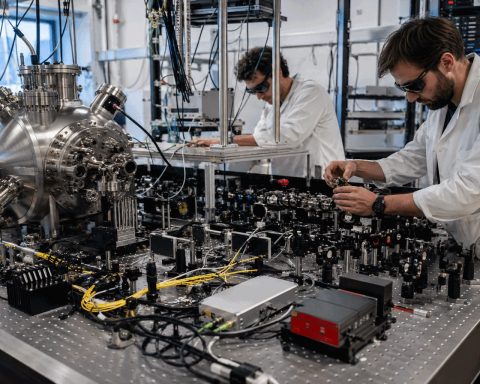
This quarter puts the company’s photonics-focused buying spree to the test. Photonics—tech that harnesses light to transmit or manipulate data, rather than relying solely on electrical signals—sits at the core of the strategy. According to QCi, most of the revenue bump was tied to February’s Luminar Semiconductor acquisition. NuCrypt, acquired in March, added a smaller slice.
On the call, Chief Executive Yuping Huang pointed to “two key transactions” wrapped up during the quarter, with integration of those businesses now underway. Huang added that Fab One, the Tempe, Arizona facility, has started small-batch production, though the site is still primarily focused on research and development. The Motley Fool
That point matters. CFO Christopher Roberts put revenue—minus Luminar Semiconductor and NuCrypt—at $204,000, largely driven by foundry bookings and an R&D subcontract with NASA. So, the top-line boost is deal-driven for now, not a sign of QCi’s core business scaling up.
QCi wrapped up March holding around $1.4 billion in cash, cash equivalents, and investments—slipping from about $1.5 billion at 2025’s close. Contract backlog landed at roughly $16 million, offering a bit of a buffer as manufacturing and integration expenses continue.
The company’s quarterly report and an 8-K landed with the U.S. Securities and Exchange Commission on May 11, just after the market closed. The 10-Q addresses performance for the quarter ending March 31. As for the 8-K, it details operating results and the firm’s financial condition.
Risks remain. Roberts pointed out to analysts that “underutilization” weighed on gross margins, since chip plants rack up expenses regardless of how much they’re making. Huang added that Fab One wasn’t meant to be the company’s top money-maker—it’s more of a lead-in to a bigger Fab Two. The Motley Fool
QCi isn’t the only one under the microscope from investors. Rigetti Computing posted first-quarter revenue of $4.4 million this week. Across the sector, shares in publicly traded quantum companies keep swinging as investors try to square ongoing technical advances with persistent losses and limited commercial traction.
D-Wave Quantum is set to release its first-quarter 2026 numbers Tuesday morning, before Wall Street gets going. Investors will be looking for any new signals on quantum computing demand, as the sector faces ongoing questions about whether its specialist hardware is gaining ground outside the lab and research pilots.
For QCi, the immediate focus shifts from debating market size to delivering results. With cash in hand, new assets, a backlog, and ambitions for a bigger foundry, the company’s next test is turning those resources into organic revenue growth—not just running up expenses. Investors are watching for that distinction.
Related articles: Quantum Computing