Intel Shares Steady in U.S. Premarket as AI-driven CPU Sales Lift Profits Expectations

Intel Shares Steady in U.S. Premarket as AI-driven CPU Sales Lift Profits Expectations

NEW YORK, July 28, 2026, 04:14 EDT — U.S. premarket trading

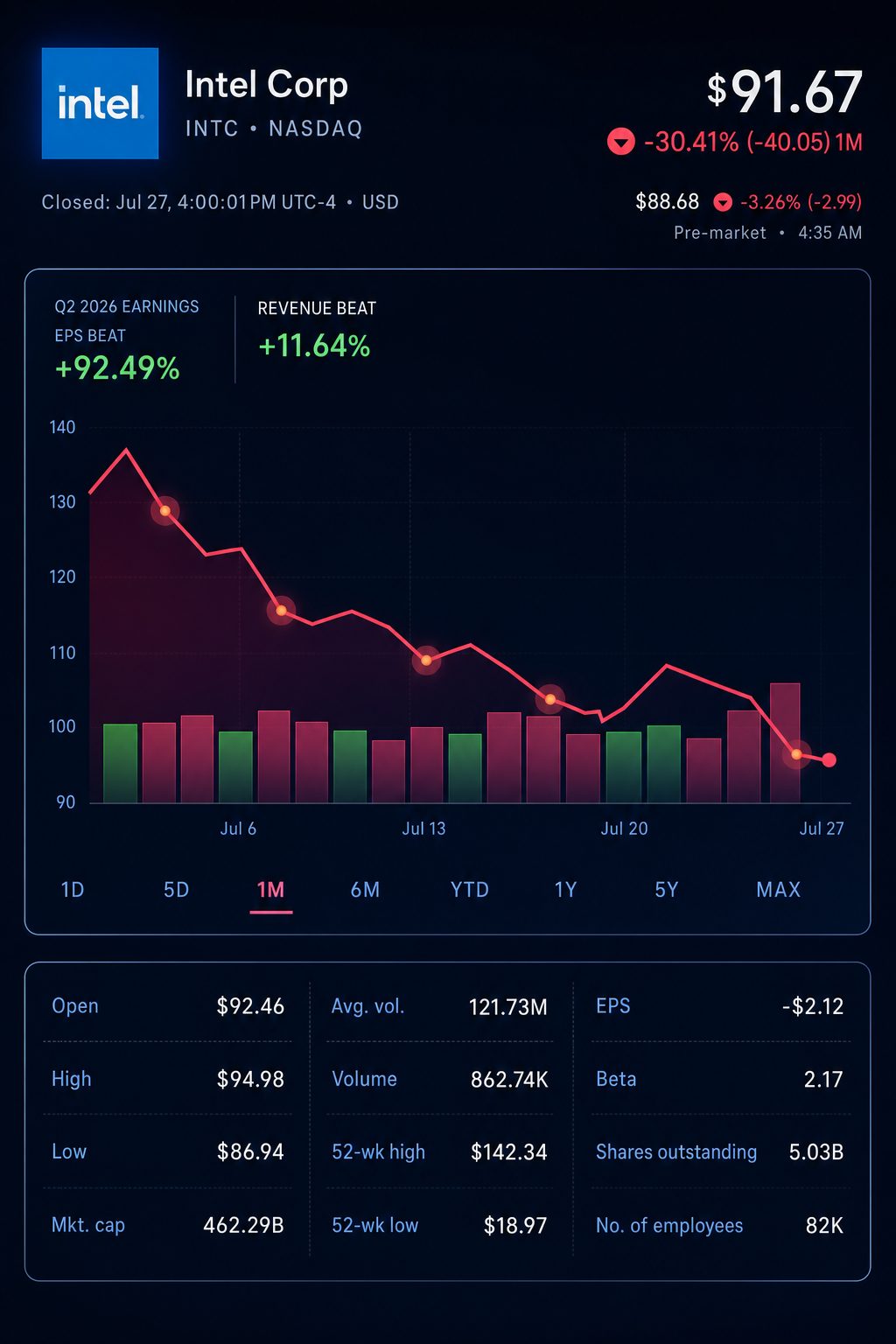
Intel Corporation ended Monday 0.7% lower at $91.67. Shares of NVIDIA Corporation and Advanced Micro Devices, Inc. both declined roughly 5%. Intel outperformed its typical move by 4.4 percentage points.

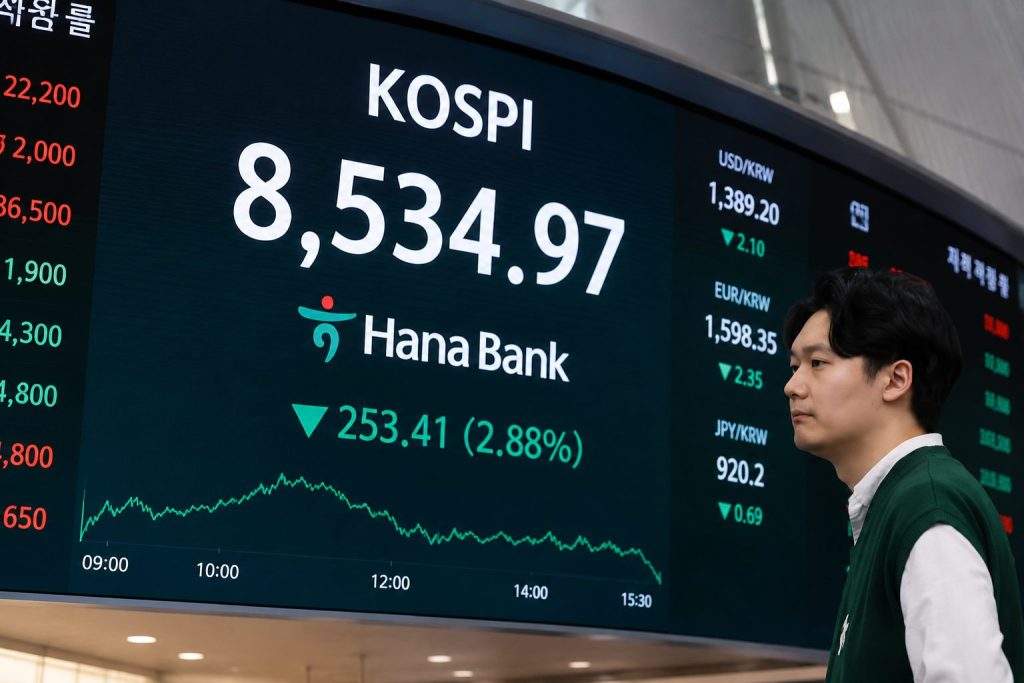
The PHLX Semiconductor Index dropped 2.2% on Monday. On Tuesday, Asian chip stocks tumbled, with Korean shares leading losses, down 10.8%.
Stock chart for NASDAQ:INTC

Intel’s narrower loss points to a different strategy. Investors seem to separate worries about CPU shortages from issues tied to funding accelerators. This conclusion is reinforced by Intel’s server backlog and Monday’s selloff driven by accelerator news.

Intel reported that its data-center and AI division posted quarterly revenue of $6.262 billion, a rise of 59% from $3.939 billion. Operating income reached $2.474 billion, close to four times higher than previously.

Based on filings, DCAI was responsible for 70% of the rise in Intel Products’ revenue and accounted for 86% of the growth in operating income. While DCAI made up 41% of product revenue, it contributed 51% of operating income.

Investor signalIntel readingComparisonDifference
Monday share change-0.7%NVIDIA/AMD average: -5.1%+4.4 percentage points
DCAI sales$6.262 billion$3.939 billion the previous year+59%
DCAI operating profit$2.474 billion$633 million the prior year+291%
Q3 revenue midpoint$16.3 billionLSEG projection: $15.1 billion+7.9%
2026 capital spending$20 billionEarlier forecast: $18 billion+11.1%

This was not primarily driven by a rebound in PC volumes. Revenue from the client segment increased 13%, while the number of PC units sold declined 8%. Average selling prices jumped 27%, supported by stronger sales of premium offerings.

Server business performance improved. Server revenue climbed by $2.0 billion, with unit volumes up 9%. Average selling prices surged 48%, primarily due to a more robust product mix.

Chief Executive Lip-Bu Tan stated, “AI is driving unprecedented demand for compute.” Total revenue increased 25% to $16.1 billion. Adjusted earnings were 42 cents per share. Intel

Intel forecast third-quarter revenue in a range of $15.8 billion to $16.8 billion, with the $16.3 billion midpoint coming in 7.9% higher than the previous LSEG consensus. The company also projected adjusted EPS of 38 cents, marking a 41% increase.

Intel continues to face demand beyond its current internal server limits. Chief Financial Officer David Zinsner stated that customer contracts extend from three to five years, with certain agreements covering both price and volume terms.

“The stock can continue revaluing,” Shay Boloor from Futurum Group said, citing ongoing data-center expansion and improved foundry economics as reasons. The impact of external customers remains important. Reuters

Foundry revenue increased 31% to $5.765 billion. The loss decreased by $1.1 billion but still stood at $2.089 billion. External revenue reached just $293 million, mostly related to Altera.

Risks are still evident. Intel increased its 2026 capital expenditure target to $20 billion, up from $18 billion. The company posted a GAAP loss of $11.0 billion. The bulk of this came from a $12.5 billion mark-to-market charge related to government escrowed shares.

The next test for the market arrives soon. Major cloud purchasers are due to report this week, coinciding with the Federal Reserve’s rate decision. Either event may alter expectations related to AI investment and funding.

Intel targets large-scale 14A output in 2028. Monday’s steady performance suggests investors expect earnings support. However, it has not yet demonstrated that the foundry will deliver adequate returns. Cash generation has become more important than exceeding expectations.

What caused Intel stock to decline despite posting strong earnings?

Intel last closed at $91.67 before Tuesday’s U.S. session began, marking a 0.7% decline on Monday and placing its valuation at about $468 billion. The company’s earnings prompted a 5.2% increase in after-hours trading. However, Friday saw shares fall 7.9% in spite of the strong results, as investors worried about an uptick in capital expenditures and the potential impact on free cash flow. Intel

By how much did Intel surpass expectations in its second-quarter earnings?

Intel posted second-quarter revenue of $16.13 billion, marking a 25.4% increase from the previous year. LSEG analysts had forecast around $14.42 billion. Adjusted earnings stood at $0.42 per share, compared to the estimated $0.21. The adjusted gross margin hit 41.8%, topping the consensus of 38.8%. The results reflect strong operational performance, rather than just an accounting effect. Intel

Does the outlook for the third quarter indicate ongoing growth?

Intel forecasts third-quarter revenue in a range of $15.8 billion to $16.8 billion. The midpoint of $16.3 billion stands about 1% above sales from the previous quarter. Before results, analysts had predicted just around $15.1 billion. Intel’s adjusted EPS guidance is $0.38, compared with the $0.27 analysts estimated. The company also sees an adjusted gross margin at approximately 42%. Intel

Are data centers seeing tangible profits from AI-driven demand?

DCAI revenue increased 59% from a year earlier to $6.262 billion. The segment reported operating income of $2.474 billion, up from $633 million. That translates to an operating margin of nearly 39.5% for the quarter. Intel secured three-to-five-year customer deals encompassing CPUs and specialized XPUs. Certain agreements outline price commitments, others specify volumes only. Because contracts are open to renegotiation, full visibility remains limited. Intel

Is Intel’s personal computer business truly bouncing back?

Intel’s CCPG segment, which focuses on PCs, posted revenue up 13% to $8.877 billion. Analysts had forecast laptop and desktop sales at around $7.89 billion. Although revenue climbed, the number of units sold decreased while average prices moved higher. Intel redirected supply toward higher-end chips, reducing the emphasis on entry-level models. The revenue gain points to improvement, but weaker unit volumes cloud the picture of a full recovery. Intel

Is Intel Foundry now proving to be a feasible business?

Intel Foundry reported a 31% year-on-year increase in revenue to $5.765 billion. The unit reduced its operating loss to $2.089 billion from $3.168 billion. External revenue accounted for only $293 million, about 5% of total foundry sales. Most of the external revenue growth came as Altera became a newly separate customer. Intel is now aiming for 14A high-volume production during 2028. The filing lists potential major customers, without disclosing specific production commitments. Intel

What led to Intel recording an $11 billion GAAP loss?

Intel posted a GAAP net loss of $11.033 billion for the second quarter, largely driven by a $12.529 billion mark-to-market charge. This charge was mainly due to government escrowed shares increasing in value along with Intel’s stock, and it did not impact operating cash flow for the period. On a non-GAAP basis, net income reached $2.197 billion, or $0.42 per share. At the end of the quarter, Intel reported 143 million escrow shares still on hold. Intel

Is Intel able to support greater capital expenditures without selling new equity?

Intel increased its 2026 capital expenditure target to $20 billion, up from $18 billion. The company held $29.727 billion in cash and short-term investments, while its debt stood at $50.537 billion. Second-quarter operating cash flow amounted to $7.006 billion. Adjusted free cash flow for the quarter registered negative $8.419 billion, largely driven by a net partner outflow of $12.216 billion. Intel spent $14.2 billion to buy back Apollo’s Ireland stake. Management currently does not have a defined equity plan but has not ruled one out. Reuters

How stretched is Intel’s present valuation?

Intel’s current share price of $91.67 is up around 148% compared to its year-end close at $36.90, but still trades about 35% under the $140.94 all-time closing high reached on June 22. The company’s market cap is close to $468 billion. With trailing GAAP profits still negative, the standard P/E ratio is not meaningful. As a result, expectations for AI growth and foundry performance account for the bulk of its valuation. Intel

What factors might influence Intel’s stock price in the coming week?

The Federal Reserve will wrap up its two-day session on Wednesday, July 29, with its policy statement set for release at 2 p.m. Eastern time. Meta is scheduled to deliver an update on its $125–145 billion capital expenditure plans after trading ends on Wednesday. AMD will report results following the U.S. market close on Tuesday, August 4, with its server and PC commentary expected to provide a direct comparison to Intel’s demand outlook. These events may sustain volatility in Intel shares up to next Tuesday. Federal Reserve

Jerzy Lewandowski is a senior markets editor at TS2.tech covering stocks, artificial intelligence, semiconductors and global financial markets. He studied economics at the University of Warsaw and previously worked in investment analysis before moving into financial journalism. His daily coverage focuses on the trends and events that matter most to investors worldwide. Follow Jerzy Lewandowski on Google News.

Stock Market Today

  • Micron Shares Pricey at $920; AI Memory ETF Offers Broad Exposure
    July 28, 2026, 6:28 AM EDT. Micron Technology (NASDAQ: MU) jumped 671% last year and now trades at 17.3 times operating cash flow, leaving shares at a premium price. The Roundhill Memory ETF (NYSEMKT: DRAM), which started trading in April 2026 near $50 a share, provides exposure to top memory sector names, with Micron making up 26.7% of the fund. Memory is key to AI expansion, with the sector forecast to grow from $190B in 2026 to $448B by 2034.
KOSPI Sheds 10.8% as Chip Sector Focus and China Concerns Knock AI Stocks
Previous Story

KOSPI Sheds 10.8% as Chip Sector Focus and China Concerns Knock AI Stocks

D-Wave Quantum Shares Surge 20% Following AT&T Agreement, Boosting Market Cap by $1.2 Billion
Next Story

D-Wave Quantum Shares Surge 20% Following AT&T Agreement, Boosting Market Cap by $1.2 Billion