NEW YORK, July 28, 2026, 05:01 EDT — U.S. cash markets remained shut, but premarket activity continued.
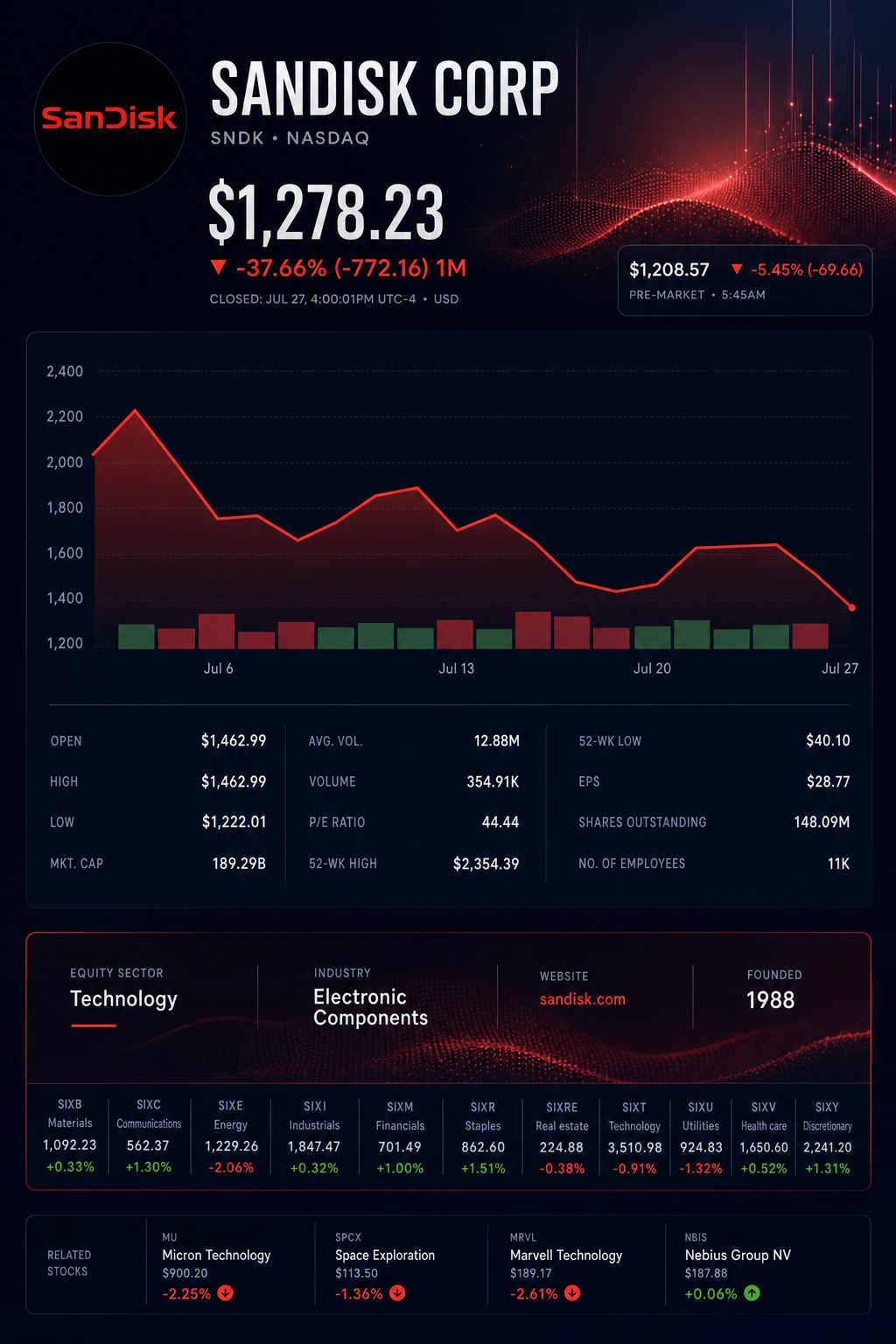
Sandisk ended Monday’s session at $1,278.23, sliding 11.0%. Pre-market quotes on Tuesday pointed to a further fall of about 5%.
Initial calculations show that the two-day decline wiped out approximately $49.2 billion in market capitalization.
Sandisk is scheduled to release its fiscal fourth-quarter results on August 5. The company’s midpoint forecast indicates $8 billion in revenue and adjusted earnings per share of $31.50.
Sandisk Corporation NASDAQ:SNDK ended Monday’s session at $1,278.23, falling 11.0%. The company was among the top decliners in a broader chip downturn linked to China’s growth in the memory industry.
Quotes early Tuesday suggested a further drop of about 5%. U.S. regular trading was yet to begin.
The decline over two sessions totaled 20.6% from Thursday’s closing price. Initial calculation: this wiped out roughly $49.2 billion, based on 148.09 million shares outstanding. The amount is more than eightfold Sandisk’s $6 billion share repurchase authorization.
The trigger was not direct. CXMT Corp SHA:688825 of China produces DRAM, whereas Sandisk specializes in NAND flash. Investors seem to be anticipating broader financing support for China’s semiconductor sector, which may also benefit unlisted NAND competitor YMTC.
Sandisk dropped roughly five times more than both Micron and the chip index, highlighting heightened sensitivity regarding NAND supply and valuation.
That concern is significant given Sandisk’s revenue composition. Datacenter revenue reached $1.47 billion last quarter, accounting for 24.7% of the overall total. Edge products brought in $3.66 billion, representing 61.6% of total revenue.
AI-driven demand is genuine. However, the majority of present revenue—about three-quarters—still comes from outside the datacenter segment.
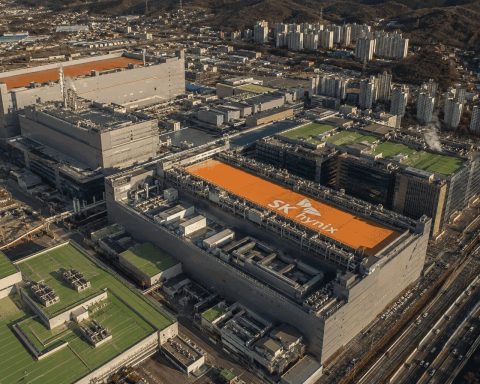
YMTC accounted for 11.8% of the worldwide NAND market last year, Reuters reported. This figure was on par with Sandisk’s share. Projections indicated YMTC would surpass 14% by early 2027, and its planned new facilities could boost capacity by over twofold.
Sandisk maintains robust near-term operating guidance, forecasting fourth-quarter revenue in the range of $7.75 billion to $8.25 billion. The midpoint reflects sequential growth of 34%.
The company projects adjusted earnings per share in the range of $30 to $33. Adjusted gross margin is forecast at 79% to 81%.
Initial illustrative calculation: The closing price on Monday represents 10.1 times projected annual earnings at the midpoint of the guidance. This is not a prediction. Memory sector earnings can swiftly change if supply aligns with demand.
Chief Executive David Goeckeler has sought to lessen that cyclical volatility. Sandisk secured five extended customer deals, with three involving minimum commitments of $42 billion each. “We want consistent, predictable economics,” Goeckeler told Reuters in May. Reuters
Asian markets reflected ongoing investor skepticism in early trade. Shares of Kioxia Holdings TYO:285A, which collaborates with Sandisk on NAND technology, dropped 18.3% on Tuesday.
“Investor focus is not so much on CXMT’s present profits but on its ability to ramp up capacity more quickly,” analyst Kim Seok-hwan said. Information about the performance of Chinese equipment and schedule for production is still scarce. Reuters
Sandisk rose nearly 6% over the last week, but a 10.8% drop on Friday wiped out a large portion of its midweek rebound. The decline continued into Monday.
The company’s next test is set for August 5, with Investor Day scheduled for August 13. Investors seek more specific data on fiscal 2027 NAND pricing, contracted sales, and the datacenter share.
Risks: Increased production at YMTC or declining NAND pricing may put pressure on Sandisk’s elevated margins. Conversely, constrained supply, effective price minimums, or additional datacenter contracts could imply the share decline has been overdone.
What caused the sharp drop in Sandisk shares, and what is the current position of the stock?
Sandisk ended trading on Monday, July 27, at $1,278.23, falling 11.02%. Early Tuesday premarket levels suggested a further 4.61% drop to $1,219.29. The decline mirrored a widespread selloff among chipmakers amid concerns over Chinese competitors. Shares of CXMT surged 466% at its Shanghai debut, and reports on Chinese lithography technology intensified market pressure. Sandisk's close was 45.7% lower than its $2,354.39 high over the past year.
What does Sandisk need to achieve in its August 5 earnings report?
Sandisk’s earnings call is set for August 5 at 4:30 p.m. EDT. The company projects revenue between $7.75 billion and $8.25 billion. It forecasts non-GAAP EPS of $30 to $33 and expects gross margin in the 79%-81% range. Published EPS estimates from various providers range from $33.38 to $34.52. Google Finance lists revenue at $8.39 billion, topping management’s outlook, increasing expectations.
What level of operating momentum did Sandisk display in the most recent quarter?
Revenue for the fiscal third quarter totaled $5.95 billion, a 97% increase from the previous period. Non-GAAP earnings per share stood at $23.41, up from $6.20 the prior quarter. Non-GAAP gross margin improved by 27.3 percentage points to 78.4%. Datacenter revenue jumped 233% sequentially to $1.47 billion. Consumer revenue declined 10% from the prior quarter to $820 million.
Are gross margins approaching 80% sustainable throughout the NAND cycle?
Management projects fourth-quarter non-GAAP gross margin in the 79% to 81% range, after reporting 78.4% in the prior quarter and 51.1% two quarters ago. Revenue for the third quarter was primarily driven by a 248% surge in pricing per gigabyte, while total exabytes sold matched the previous year’s level. Today’s profits are therefore heavily dependent on stronger pricing. While long-term contracts could provide stability, margins near 80% have little historical precedent.
What portion of revenue can be attributed to long-term agreements with customers?
Sandisk disclosed $41.6 billion in remaining performance obligations as of April 3, with just 15% projected to be recognized as revenue within the next twelve months. An additional $41.2 billion remained unbilled, indicating that these funds are not immediately available. At that point, Sandisk had three agreements in place and added two more later. The company’s top-ten customers accounted for 46% of its quarterly revenue. While visibility is considerable, the timing and concentration of revenue remain key factors.
Does China’s CXMT pose a direct challenge to Sandisk’s NAND operations?
Not directly. CXMT focuses mainly on DRAM production, whereas Sandisk is largely involved in NAND flash. In 2025, CXMT controlled around 7.7% of the global DRAM market. YMTC is a closer competitor to Sandisk in NAND, holding 11.8% of the worldwide market. Reuters reported that this share was on par with Sandisk, and three new plants could potentially double output, though the schedule for these projects is not determined.
Does Sandisk remain pricey following the latest selloff?
At the close on Monday, Sandisk traded at 44.44 times its trailing earnings. Another method factors in reported adjusted EPS along with guidance for the fourth quarter, resulting in an estimated $60.83-$63.83 for full-year adjusted EPS. Based on this, the closing share price is about 20-21 times that estimate. This figure is approximate. Analyst price targets compiled by Google Finance range from $1,000 to $3,050.
What level of downside protection is provided by holding cash and conducting share buybacks?
On April 3, Sandisk reported $3.74 billion in cash holdings. The company listed no short-term or long-term debt on its balance sheet. Operating cash flow for the third quarter was $3.04 billion. On April 30, the board approved a $6 billion share buyback plan, representing roughly 3.2% of Sandisk's $189.29 billion market capitalization as of Monday. The authorization does not obligate Sandisk to buy back shares, and the program can be paused or discontinued by management.
Which key topics should investors pay attention to during the August 13 Investor Day?
Sandisk will hold its Investor Day on August 13, starting at 9:00 a.m. EDT, just eight days after releasing its fiscal-year earnings. BiCS10 technology is expected to be a highlight, as it is still being sampled by customers. The 332-layer BiCS10 architecture provides 59% higher density compared to BiCS8. The interface speed climbs by 33%, up to 4.8 gigabits per second. Investors will look for details on production schedules, yield rates, capital requirements, and long-term margin expectations.
Marcin Frąckiewicz is the founder and CEO of TS2 Space, a satellite communications company working with customers worldwide. His experience spans satellite communications, telecommunications and technology ventures. He graduated from the Warsaw School of Economics (SGH) and writes about space technology, artificial intelligence, stocks and the technology companies and industries he follows. Follow Marcin Frąckiewicz on Google News, Facebook or LinkedIn.
A figure above or below the 12.0 consensus could impact Treasury yields, the dollar, and cyclical stocks by influencing short-term growth outlooks.
#2
NAHB Housing Sentiment
A reading above or below 33 will influence expectations for housing demand, mortgage rate trends, and homebuilder stocks.
#3
Fabrinet After the Close
Investors are focusing on revenue, margins, and comments on datacom as key factors for companies involved in optical networking and AI infrastructure supply chains.