
MILPITAS, California, August 17, 2026, 10:01 PDT — Trading has commenced in the U.S. cash markets.
- Sandisk shares climbed nearly 9%, pushing their five-session rally to approximately 35%.
- Nearly two-thirds of projected NAND production for 2028 is secured by long-term contracts.
- Recent targets on Wall Street range from $1,600 up to $2,250.
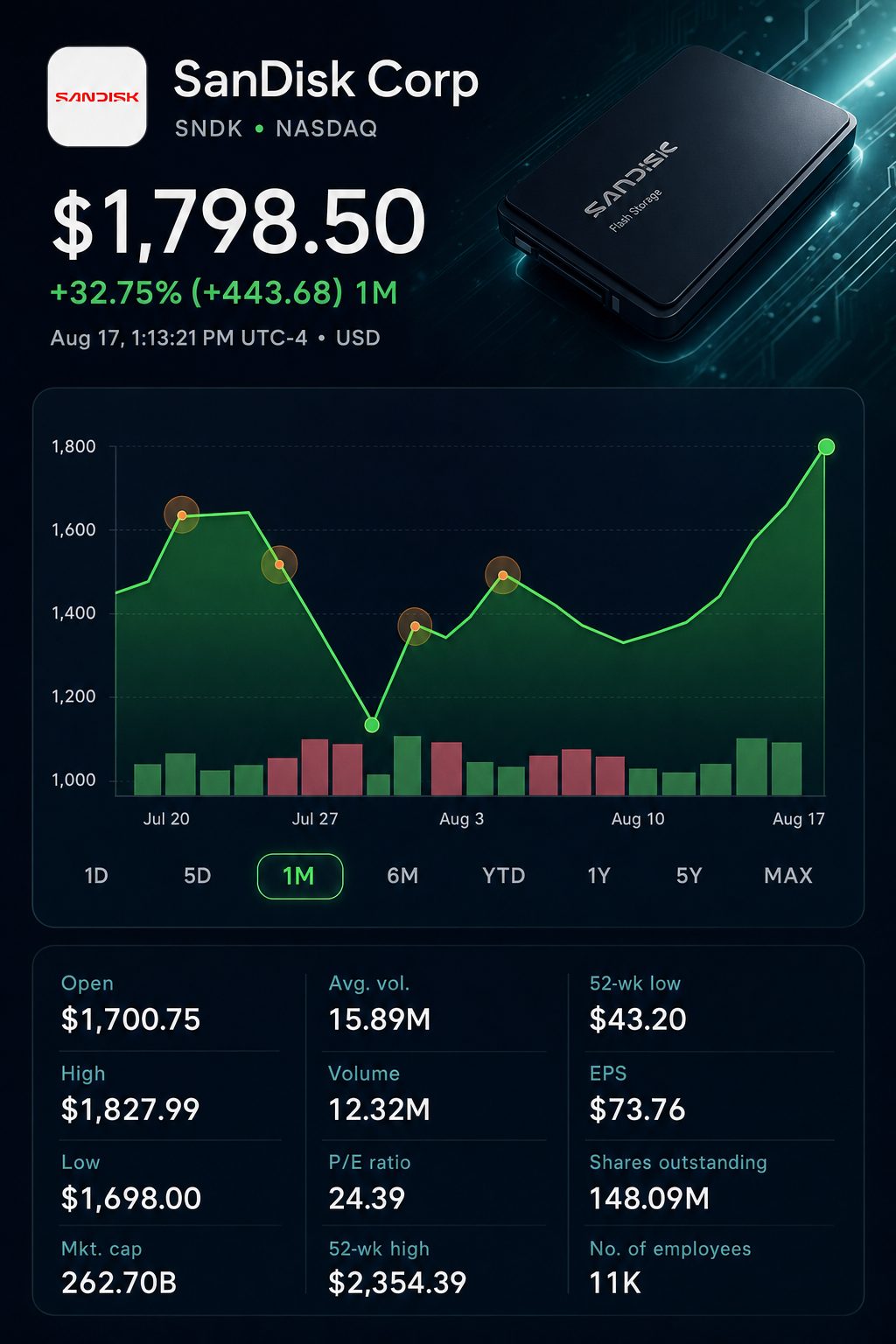
Shares of Sandisk Corporation NASDAQ:SNDK surged nearly 9% on Monday, pushing its five-day advance to around 35%. The stock gained as the company announced bold long-term goals and received new backing from analysts following its recent investor day.
The main issue is shifting away from immediate NAND price fluctuations. Investors are evaluating if long-term customer contracts can help stabilize the industry’s typical cycle of rapid expansions and contractions.
The differentiation is significant following an unusual reset in earnings. Sandisk posted fiscal third-quarter revenue of $5.95 billion, representing a 97% increase from the previous quarter. Datacenter revenue climbed 233% to $1.47 billion.
Memory stocks climbed as well, with Sandisk outperforming its peers. Micron Technology NASDAQ:MU, Western Digital NASDAQ:WDC, and Seagate Technology NASDAQ:STX also saw gains, driven by increased AI-related demand.
| Company | Approx. Monday move | Primary driver |
|---|---|---|
| Sandisk (SNDK) | +9.3% | Investor-day guidance, backing from analysts |
| Micron (MU) | +5.9% | Focus on memory pricing, U.S. supply emphasis |
| Western Digital (WDC) | About +6% | Storage sector momentum |
| Seagate (STX) | About +2% | Rising AI-related storage needs |
Sandisk supports its durability case with contracts and product mix. The company said it has agreements in place for roughly two-thirds of its intended 2028 capacity. It projected annual revenue growth in the mid-to-high teens between fiscal 2028 and 2030.
| Metric | Verified level | Investor significance |
|---|---|---|
| Fiscal Q3 2026 revenue | $5.95 billion | Rises 97% quarter-over-quarter |
| Fiscal Q4 revenue outlook | $7.75-$8.25 billion | Midpoint points to 34% quarterly increase |
| Fiscal Q4 adjusted gross-margin outlook | 79%-81% | Measures how robust supply tightness is |
| 2028 capacity under agreements | About two-thirds | Lowers reliance on spot pricing |
| 2028-2030 revenue growth target | Mid-to-high teens annually | Builds growth narrative past current constraints |
| Long-term adjusted free-cash-flow margin | About 50% | Enables possible capital distributions |
The share was around $1,782 in midday trading. J.P. Morgan’s price target of $2,250 indicates an implied upside of approximately 26%, whereas Argus’ $1,600 target is below the current level. This gap highlights the degree to which forecasts hinge on how long the cycle lasts.
| Firm | Recommendation | Price target | Approx. upside/downside at $1,782 |
|---|---|---|---|
| J.P. Morgan | Overweight | $2,250 | +26% |
| Citi | Buy | $2,100 | +18% |
| Wedbush | Outperform | Not stated | Not applicable |
| Argus Research | Buy | $1,600 | -10% |
Technology underpins the margin assertion. Sandisk says its BiCS10 NAND achieves a 59% increase in bit density and interfaces that are up to 33% faster than those in BiCS8. The company also reports a 34% reduction in output power consumption.
Chief Executive David Goeckeler stated in April that “This quarter marks a fundamental inflection point for Sandisk.” Goeckeler attributed the change to increased demand in higher-value segments, particularly driven by datacenter needs. Sandisk
A U.S. sourcing debate intensified on Monday. Reports said Commerce Secretary Howard Lutnick urged Apple NASDAQ:AAPL not to use memory from China. The impact for Sandisk is not yet clear.
Significant risks persist. NAND supply may increase, leading to price declines, and contract floors might not safeguard higher margins. A 35% rise over five days also heightens the stakes for any missed guidance.
Currently, the market values transparency. The upcoming challenge will be to see if agreed volumes translate into cash flow without triggering a return of surplus capacity in the industry.
Related articles: NASDAQ:SNDK