
MENLO PARK, California, August 17, 2026, 09:55 PDT — Trading has begun in U.S. cash markets.
- Meta states that potential damages in the case brought by 29 states could total up to $1.4 trillion.
- The number represents 15.5 times the amount of Meta’s cash and investments at the end of the quarter.
- Legal charges in the second quarter accounted for 15.1% of net income for the quarter.
Meta Platforms Inc. NASDAQ:META began its most extensive youth-safety trial on Monday. The firm states that hypothetical penalties may total as much as $1.4 trillion. This figure is close to Meta’s full equity valuation, but the states have yet to reveal what they will seek.
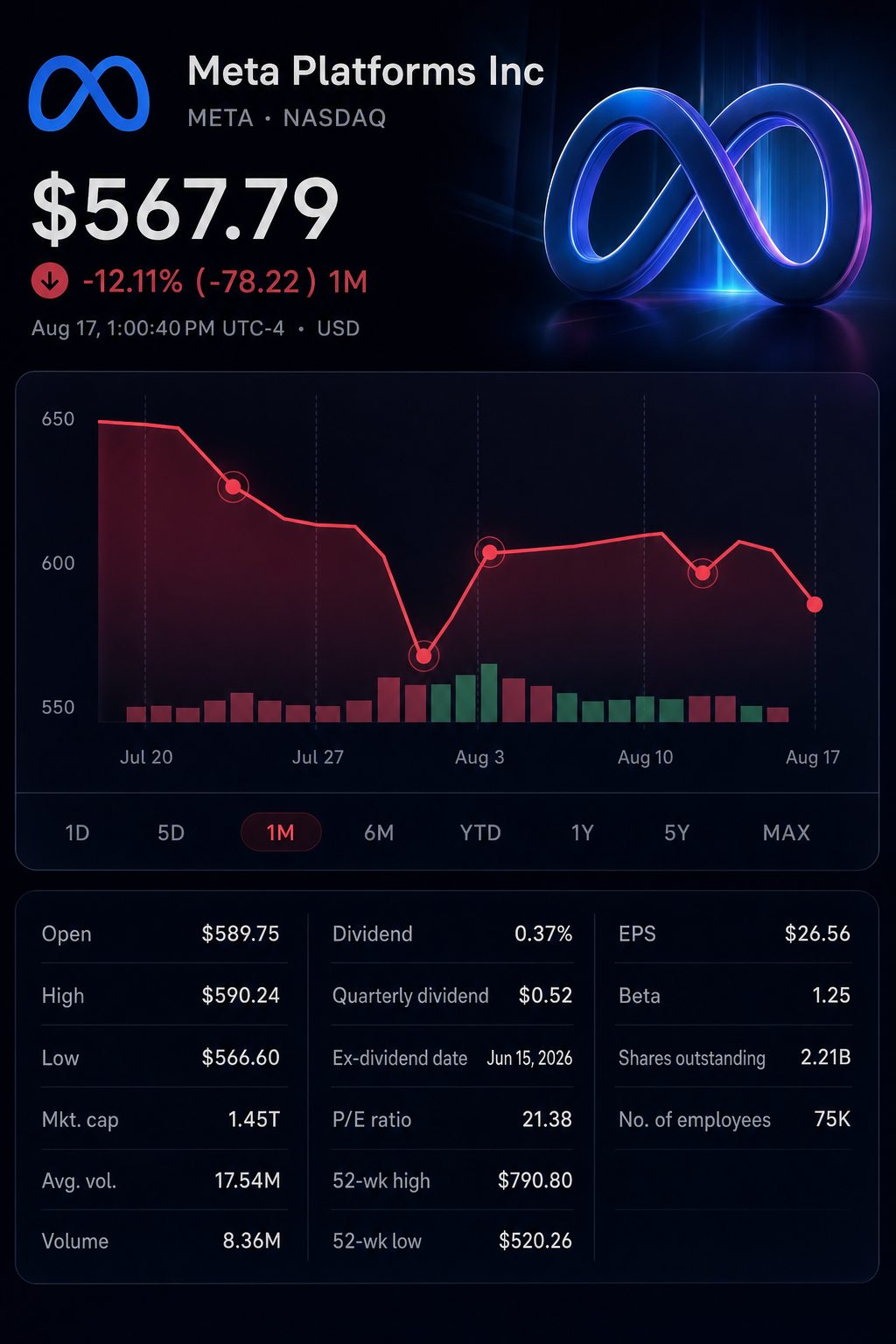
The headline figure is not expected to represent the ultimate payment. However, the lawsuit introduces legal expenses as another significant spending factor alongside artificial intelligence. Meta closed June holding $90.26 billion in cash and marketable securities.
| Legal and financial scale | Amount | Investor context |
|---|---|---|
| Theoretical Oakland penalties | Up to $1.4 trillion | Meta figure, not based on official request |
| New Mexico total liability | $942 million | Two parts; company will appeal |
| Q2 legal charges | $2.40 billion | Reflected in this period’s results |
| Cash and marketable securities | $90.26 billion | As of June 30 |
| Q2 free cash flow | $784 million | Significantly decreased post capital investment |
The federal lawsuit involves 29 state attorneys general, with four states taking the lead in the ongoing Oakland trial. They accuse Meta of unlawfully gathering data from children and creating Facebook and Instagram features intended to capture minors’ attention. Meta denies these claims.
The jury, made up of eight people, is advisory only. Its decision will not be binding on U.S. District Judge Yvonne Gonzalez Rogers, who will issue the final ruling following a trial anticipated to run for six weeks.
This setup reduces the impact of each individual jury signal but does not eliminate the risk tied to precedent. Legal experts told Reuters that judges frequently follow recommendations from advisory juries, though comprehensive data on outcomes is sparse.
| Claim scale comparison | Calculated ratio | Meaning |
|---|---|---|
| $1.4 trillion / liquidity | 15.5 times | Significantly surpasses existing cash on hand |
| $1.4 trillion / Q2 net income | 88.3 quarters | Potential maximum is extremely high |
| Q2 legal charge / Q2 net income | 15.1% | Meaningful effect on current profits |
| New Mexico liability / Q2 net income | 5.9% | Can be handled by itself, could grow if repeated |
| New Mexico liability / Q2 free cash flow | 1.2 times | Outpaces a full quarter’s free cash generation |
New Mexico highlights the potential for repetition. In March, a jury awarded $375 million. This month, a judge added $567 million and mandated youth-safety reforms for five years. Meta now faces $942 million in total liability in the state. The company intends to challenge the decision.
New Mexico’s attorney general is preparing two new bills. The proposed legislation would expand consumer protections and cover issues related to social media, AI, and chatbots. The approach could be followed by other states and local plaintiffs.
Meta states its platforms enforce rigorous child-exploitation policies and offer a wide range of safety features. “We have strict, longstanding rules against child exploitation and have invested billions to fight it,” a spokesperson said. The company pointed to features for teen accounts as well as proactive detection systems. Source
| Meta Q2 operating measure | 2026 result | Year-on-year change |
|---|---|---|
| Revenue | $60.80 billion | up 28% |
| Advertising revenue | $59.36 billion | increase of 27% |
| Costs and expenses | $42.03 billion | rose 55% |
| Operating income | $18.78 billion | down 8% |
| Operating margin | 31% | was 43% the prior year |
| Capital expenditure | $31.08 billion | Extensive AI investment |
Meta’s core ad business continued to perform well, with second-quarter revenue climbing 28% to $60.80 billion. The company saw a 14% rise in ad impressions and a 12% increase in average ad price. Daily active users across Meta’s apps reached 3.60 billion.
Costs increased at a quicker pace. Expenses surged by 55% to $42.03 billion, factoring in $2.40 billion in legal costs and $1.18 billion in severance payouts. Operating margin decreased to 31%, down from 43%.
AI investments are driving tighter cash conditions. Capital expenditure hit $31.08 billion in the quarter. Free cash flow dropped to $784 million. Meta forecasts capital spending between $130 billion and $145 billion for the year.
Chief Executive Mark Zuckerberg stated that AI is advancing Meta’s main business while also creating new enterprise prospects. “The results are already showing,” he commented in the earnings release. Investors are now tasked with balancing these benefits with legal and infrastructure challenges.
| Analyst | Date | Recommendation | New target | Previous target |
|---|---|---|---|---|
| Evercore ISI | July 30 | Outperform | $820 | $930 |
| Barclays | July 30 | Overweight | $780 | $830 |
| TD Cowen | July 30 | Buy | $750 | $800 |
| UBS | July 30 | Buy | $715 | $766 |
| JPMorgan | July 30 | Hold | $640 | $725 |
Analysts remained largely optimistic following earnings, though the majority lowered their price targets. The most recent consensus showed 55 buy recommendations, seven holds, and zero sell ratings. The mean price target stood at $822.05. Legal issues continue to pose a distinct risk.
Risks: The $1.4 trillion figure is notional, and legal specialists describe it as very improbable. Penalties may be postponed by appeals. On the other hand, ongoing expenses from product limits or similar lawsuits in other states could surpass any headline-grabbing judgment.
The investor test takes cumulative effects into account. Meta is able to withstand a single penalty the size of New Mexico. However, successive fines, compulsory redesigns, and continued AI expenditures would make greater demands on its cash reserves.
Related articles: NASDAQ:META