
BEAVERTON, Oregon, August 17, 2026, 07:34 PDT —
- Nike dropped 3.1% to $39.47, hitting a fresh 52-week low
- The annual dividend represents 78% of reported earnings per share for the fiscal year
- Revenue from Greater China declined 13% when excluding currency effects
Nike, Inc. NYSE:NKE dropped 3.1% to $39.47 on Monday morning, hitting a fresh 52-week low at $39.42. The U.S. cash market was open. Nike had not released any new operating statements to account for the decline, leaving no single new catalyst apparent for the move.
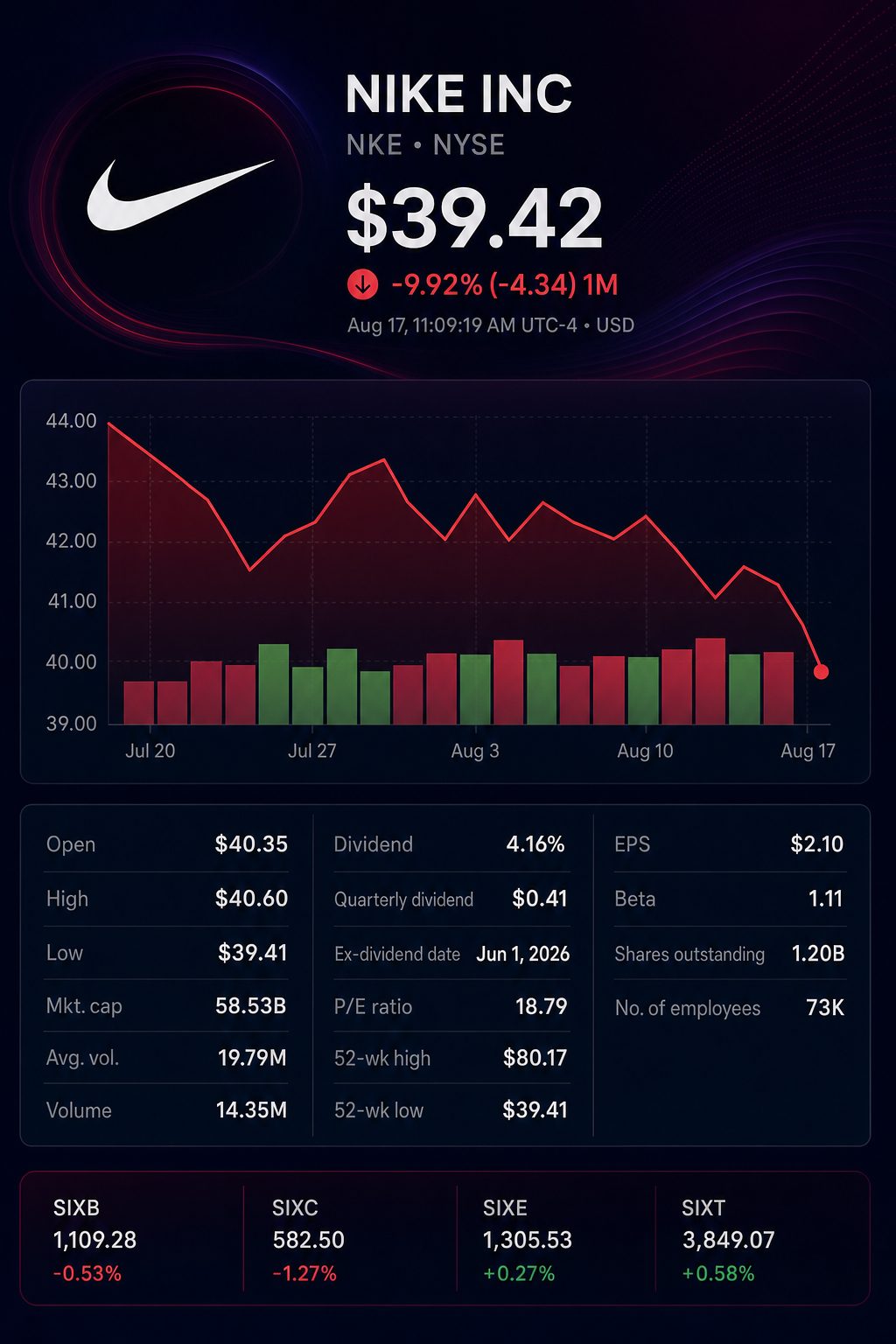
The stock is currently down 50.8% from its 52-week high of $80.16. Other apparel companies also declined, but Nike underperformed the small peer group by roughly 0.4 percentage point. This suggests pressure across the sector as well as unique doubts about the company, without clear evidence pointing solely to one or the other.
| Apparel and footwear stock | Price | Intraday move | Snapshot |
|---|---|---|---|
| Nike NYSE:NKE | $39.47 | -3.07% | 10:34 EDT |
| Lululemon Athletica NASDAQ:LULU | $116.54 | -2.52% | 10:06 EDT |
| Under Armour NYSE:UAA | $5.21 | -2.80% | 10:30 EDT |
| Deckers Outdoor NYSE:DECK | $90.51 | -2.77% | 10:42 EDT |
The yield appears steeper than implied by the share price. Nike pays a $0.41 quarterly dividend, totaling $1.64 annually. Based on reported fiscal-2026 EPS of $2.10, that results in a payout ratio of 78.1%.
A more rigorous test excludes the previously disclosed $0.52 fourth-quarter gain tied to anticipated tariff recoveries. This adjustment results in a sample EPS of $1.58. With an annualized dividend of $1.64, that represents 103.8% of the calculation. This serves as a stress scenario, not Nike-adjusted guidance.
| Dividend coverage check | Formula | Outcome |
|---|---|---|
| Annual dividend value | $0.41 × 4 | $1.64 |
| Yield based on $39.47 | $1.64 ÷ $39.47 | 4.16% |
| Declared payout ratio | $1.64 ÷ $2.10 EPS | 78.1% |
| Example EPS without tariff impact | $2.10 – $0.52 | $1.58 |
| Example payout in stressed scenario | $1.64 ÷ $1.58 | 103.8% |
Most of Nike’s reported margin increase in the fourth quarter was also attributed to the tariff recovery. Gross margin climbed 890 basis points to reach 49.2%, with the anticipated recovery accounting for around 900 basis points. Excluding this effect, the underlying margin was nearly unchanged.
Nike’s Chief Financial Officer Matthew Friend stated the company was “improving the health of our business” as it worked to manage products and costs. Friend added that sell-through continued to face challenges. Nike fiscal-2026 results
| Fiscal-2026 measure | Result | Year-on-year change |
|---|---|---|
| Total revenue | $46.40 billion | No change reported; down 2% on a currency-neutral basis |
| Nike Brand wholesale | $27.45 billion | Reported increase of 6% |
| Nike Direct | $17.72 billion | Reported decrease of 6% |
| Nike Brand Digital | Not disclosed individually | Down 12% |
| Converse revenue | $1.17 billion | Fell 31% |
| Inventory | $7.5 billion | No change |
The channel breakdown is uneven. Retailers are restocking Nike gear, driving wholesale gains. However, direct revenue and digital traffic continue to lag. This puts greater emphasis on profitable wholesale expansion and stronger consumer appetite for the turnaround.
China represents the most evident geographic challenge. Greater China generated $5.85 billion, accounting for 12.6% of the company’s revenue. Reported sales declined by 11%, or by 13% when excluding currency fluctuations. Direct digital sales in the region slipped 29%.
| Nike Brand geography | Fiscal-2026 revenue | Reported change | Currency-neutral change |
|---|---|---|---|
| North America | $20.51 billion | up 5% | up 5% |
| Europe, Middle East and Africa | $12.57 billion | up 3% | down 3% |
| Greater China | $5.85 billion | down 11% | down 13% |
| Asia Pacific and Latin America | $6.24 billion | unchanged | down 1% |
China reported a 20% decrease in earnings before interest and tax to $1.28 billion. While the margin stayed elevated, profit declined as sales slipped. Footwear unit sales in the region dropped 14%, an indication of weakness beyond the effects of currency translation.
The range of valuations is particularly broad. Shares of Nike are priced at 18.8 times trailing earnings and roughly 1.26 times projected fiscal-2026 revenue. The consensus analyst price target stands at $50.29, suggesting potential gains of 27.4%, while the lowest forecast points to just 1.3% upside.
| Analyst | Recommendation | Target | Date |
|---|---|---|---|
| JPMorgan Chase NYSE:JPM | Sell | $40 | Aug. 4 |
| Wells Fargo NYSE:WFC | Hold | $40 | July 24 |
| Citigroup NYSE:C | Hold | $45 | July 22 |
| Barclays LON:BARC | Buy | $52 | July 1 |
| Jefferies Financial Group NYSE:JEF | Buy | $75 | July 1 |
| Goldman Sachs NYSE:GS | Hold | $42 | June 30 |
| 25-analyst consensus | 9 Buy / 14 Hold / 2 Sell | $50.29 average | Past three months |
JPMorgan most recently downgraded the stock to Sell on August 4, setting a $40 price target. That figure is nearly identical to Monday’s closing price. For a positive outlook, stronger earnings are necessary in addition to any gains from a higher multiple.
Risks: Demand in China may stay subdued, while ongoing digital softness might necessitate deeper promotional activity, putting pressure on gross margins and dividend coverage. On the other hand, improved wholesale sell-through or continued growth in North America could suggest the current low valuation is overly conservative.
The next assessment is underway. Investors require stronger China sales, better digital engagement, and gross margin figures not factoring in tariff impacts. Until all of these metrics progress simultaneously, the 4.15% yield reflects compensation for a recovery that is still in progress.