
SAN JOSE, California, August 17, 2026, 07:32 PDT — U.S. cash markets are open.
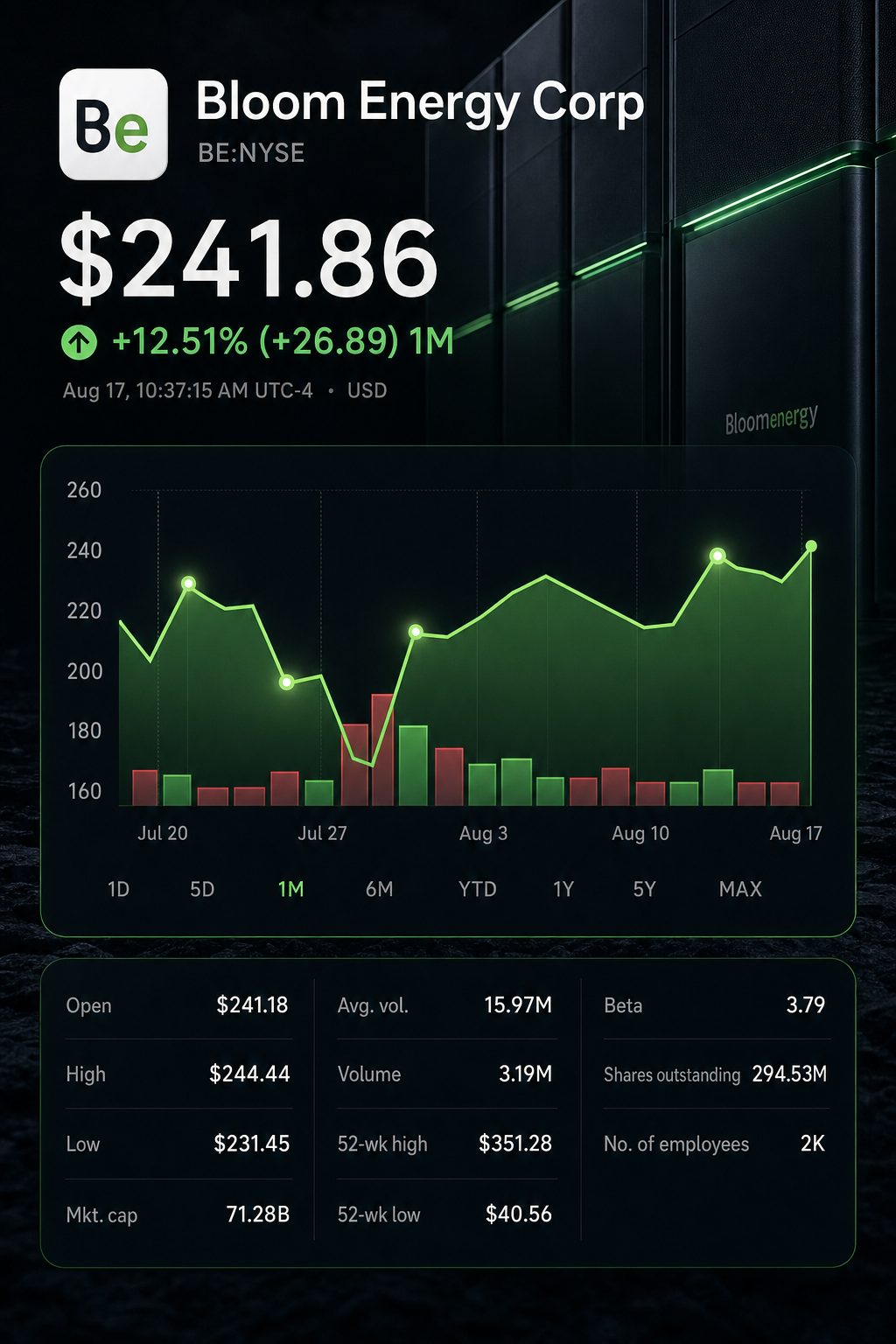
- Bloom Energy rose 5.1% to $241.72 at 10:29 EDT.
- The Nebius agreement covers 328 MW and up to $2.6 billion in fees.
- Bloom trades near 16.7 times its 2026 sales-guidance midpoint.
Bloom Energy Corporation NYSE:BE shares climbed 5.1% on Monday as investors revisited its role in Nebius Group N.V.’s NASDAQ:NBIS rapid AI expansion. The stock traded at $241.72 at 10:29 EDT, adding $11.78.
The rally puts contract quality ahead of headline size. Nebius may pay Bloom up to $2.6 billion, but the capacity comes in three phases with 10-year supply terms.
A simple annualized estimate equals $260 million. That is only 6.4% of Bloom’s $4.05 billion revenue-guidance midpoint. The estimate is illustrative, not company guidance.
| Market measure | August 17 reading | Investor context |
|---|---|---|
| Share price | $241.72 | Up 5.1% |
| Previous close | $229.94 | Monday gain: $11.78 |
| Intraday range | $231.45-$244.44 | Wide 5.6% range |
| Market value | $67.72 billion | About 16.7× guidance midpoint |
| Year-to-date return | +178.2% | High expectations already embedded |
The contract still matters strategically. Bloom will install, operate and maintain systems providing 250 MW of guaranteed capacity. Installed capacity is expected to reach 328 MW.
| Nebius agreement measure | Verified term | Calculated comparison |
|---|---|---|
| Aggregate service fees | Up to $2.6 billion | About $260 million annually over 10 years |
| Guaranteed capacity | About 250 MW | 76% of installed capacity |
| Installed capacity | About 328 MW | 6.6% of Nebius’s 5 GW target |
| Deployment | Three phases | Each phase has a 10-year supply term |
| Illustrative annual fees | $260 million | 6.4% of Bloom guidance midpoint |
Nebius increased its 2026 contracted-power target to 5 GW last week. Its second-quarter revenue rose to $582.3 million, beating estimates. Four new AI cloud contracts averaged more than $1 billion each.
That demand supports Bloom’s speed-to-power pitch. The fuel cells generate electricity onsite and reduce dependence on new transmission. Nebius expects the first 328 MW project to operate this year.
Bloom’s latest results provide the financial proof. Second-quarter revenue reached $1.065 billion, up 165.5%. Gross margin expanded 668 basis points to 33.4%.
| Bloom measure | Q2 2026 | Q2 2025 | Change |
|---|---|---|---|
| Revenue | $1.065 billion | $401.2 million | +165.5% |
| Product revenue | $935.4 million | $296.6 million | +215.4% |
| Gross margin | 33.4% | 26.7% | +668 basis points |
| Operating income | $182.2 million | -$3.5 million | +$185.7 million |
| Operating cash flow | $226.4 million | -$213.1 million | +$439.5 million |
The company raised 2026 revenue guidance to $3.9 billion-$4.2 billion. It expects roughly 34% non-GAAP gross margin and $800 million-$900 million of non-GAAP operating income. Chief Executive KR Sridhar said, “Bloom is now a standard for AI onsite power.” Bloom Energy results
Analysts remain divided despite a Buy consensus. Ten of 19 recent ratings are Buys and nine are Holds. The average target of $271.58 implies about 12% upside from Monday’s quote.
| Analyst | Recommendation | Target | Date |
|---|---|---|---|
| J.P. Morgan | Buy | $314 | August 3, 2026 |
| Barclays | Hold | $276 | July 31, 2026 |
| Mizuho | Buy | $242 | July 30, 2026 |
| Jefferies | Hold | $188 | July 30, 2026 |
| RBC Capital | Buy | $335 | July 28, 2026 |
| Recent consensus | Buy: 10; Hold: 9; Sell: 0 | $271.58 average | August 17, 2026 |
The dispersion is the message. Targets range from $176 to $350, reflecting uncertainty around deployment timing, margins and valuation. A $2.6 billion headline does not arrive as immediate revenue.
Risks: Project conditions, local permits and phased commissioning could delay revenue. Customer concentration also matters. At 16.7 times guided sales, even modest execution slippage could produce sharp volatility.
The next test is physical delivery. Investors need evidence that 328 MW reaches service on schedule and that higher volume preserves margins. Until then, the Nebius boost validates demand more clearly than valuation.
Related articles: NYSE:BE