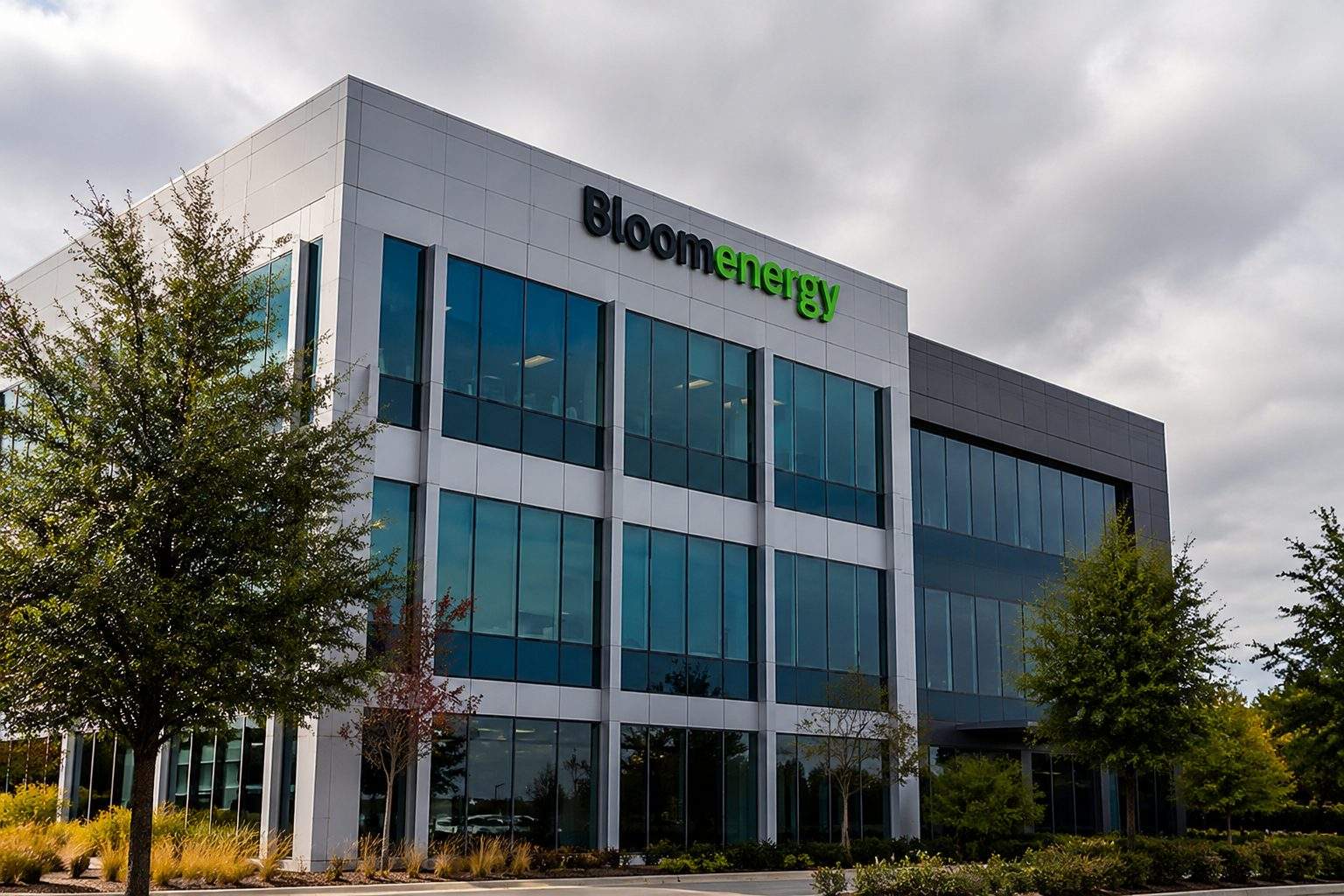
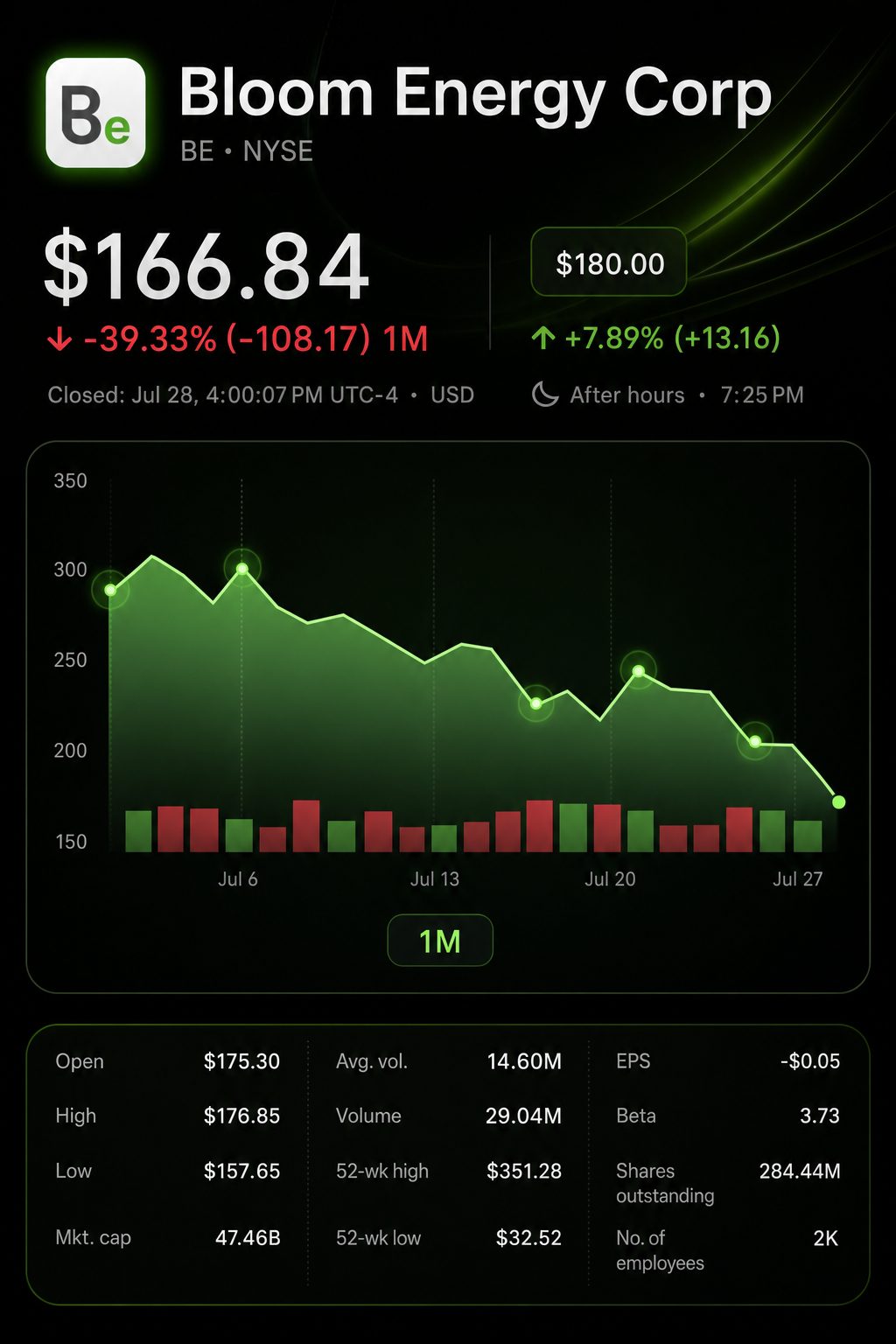
Shares of Bloom Energy rose roughly 10.6% in after-hours trading to $184.44, following an 11.3% drop to $166.84 at the close.
Bloom Energy reported second-quarter revenue of $1.065 billion. Adjusted earnings came in at 78 cents per share, surpassing Wall Street expectations.
The midpoint of the outlook implies that average quarterly revenue in the second half would need to be just 4.8% higher than in the second quarter.
Shares of Bloom Energy Corporation NYSE:BE surged in after-hours trade on Tuesday following record revenue and a further raise to its 2026 forecast. The gain almost fully offset losses earlier in the regular session. After-hours pricing is still provisional.
The guidance calculations hold the key signal for investors.
Bloom’s revenue midpoint forecast of $4.05 billion suggests $2.234 billion for the last six months, or $1.117 billion each quarter. This marks an increase of 4.8% compared to the second quarter.
The adjusted operating income target is even less demanding. Meeting the midpoint means roughly $240.3 million is needed each quarter in the second half. In the second quarter, Bloom achieved $239.6 million.
Measure
Q2 2026 actual
Implied H2 quarterly average
Required change
Revenue
$1.065 billion
$1.117 billion
+4.8%
Non-GAAP operating income
$239.6 million
$240.3 million
+0.3%
First-half results and midpoint values from company guidance form the basis for calculations. Figures based on guidance are estimates.
This reduces the necessity for a significant new surge in demand. The main challenge will be whether Bloom can replicate results as it scales up production capacity.
Revenue for the second quarter jumped 165.5% compared to the same period last year. Product revenue surged 215.4% to reach $935.4 million. FactSet analysts had forecast total revenue around $826 million.
Bloom reported adjusted earnings of 78 cents per share, compared with the FactSet consensus of 41 cents. GAAP net income totaled $196.3 million, reversing a loss of $42.6 million in the same period a year earlier.
Operating cash flow climbed to $226.4 million, marking an improvement in cash generation. In the same period a year earlier, Bloom used $213.1 million.
Margins improved alongside higher volume. GAAP gross margin stood at 33.4%, up from 30.0% in the prior quarter and 26.7% in the same period last year.
Non-GAAP gross margin reached 34.3%. If the annual margin is precisely 34%, the midpoint suggests about 34.7% in the second half. Bloom must sustain the recent efficiency improvements to maintain this level.
KR Sridhar, Chief Executive, stated that Bloom’s systems had received approval from all major U.S. hyperscalers. He also referenced over a dozen neoclouds, AI labs and colocation providers. “Bloom is now a standard for AI onsite power,” Sridhar said. Bloom Energy
Chief Financial Officer Simon Edwards said the performance was the result of disciplined execution. He also highlighted investment in increased capacity and improved operating capability.
Oracle Corporation NYSE:ORCL is featured in the demand scenario. The company has entered into a contract for an initial 1.2 gigawatts as part of a deal that could reach 2.8 gigawatts. Projects are currently being rolled out in the United States.
Brookfield Asset Management Ltd. NYSE:BAM increased its Bloom financing structure to $25 billion in June. This initiative is aimed at supporting power projects that supply AI infrastructure.
Expectations continue to fluctuate. Bloom closed Tuesday’s regular session down 23.6% over five days. Shares were off 42.4% for the past month, but still up 92% for 2026.
Despite the late session rebound, shares remained roughly 15% lower than they were five sessions ago. The difference highlights how much growth expectation was priced into the stock.
Risks: Bloom is required to turn significant deals into reported revenue as it seeks to grow production. Any setbacks involving delayed data centres, dependence on a small number of customers, issues with interconnection, or limited supply may negatively affect the run-rate. The forecast depends on non-GAAP figures and the company’s management assumptions.
Upcoming sessions provide new insights into demand. Microsoft Corporation NASDAQ:MSFT and Meta Platforms, Inc. NASDAQ:META are set to report on Wednesday, followed by Amazon.com, Inc. NASDAQ:AMZN on Thursday. Their plans for capital expenditures may influence sentiment for suppliers powering AI.
The Federal Reserve is set to announce its policy verdict on Wednesday. An increase in rates would boost the discount rate imposed on growth stocks with long durations.
Bloom met the latest earnings expectations. The 2026 midpoint now requires the company to maintain its Q2 performance rather than exceed it.
What caused Bloom Energy stock to swing sharply following its earnings release?
BE shares finished July 28 at $166.84, a decline of 11.3% for the day. By 7:00 p.m. Eastern, they recovered to $180.69, rising 8.3% in after-hours trading. The turnaround came after the company reported record quarterly revenue and raised its full-year financial forecast. Earlier losses were driven by a broader decline in AI stocks and ongoing short-seller worries. The stock’s intraday range swung widely from $157.70 to $191.00 on Tuesday.
What was the margin by which second-quarter earnings surpassed expectations?
Bloom reported a second-quarter revenue of $1.065 billion, up 165.5% from the prior year. FactSet consensus was $826.1 million, putting the revenue ahead by around 29%. Adjusted EPS came in at $0.78, nearly twice the $0.41 anticipated. GAAP net income totaled $196.3 million, compared to a $42.6 million loss in the same quarter last year. GAAP gross margin expanded by 6.7 percentage points to 33.4%.
What is necessary in the second half to achieve the increased 2026 guidance?
The company raised its revenue forecast to $3.9–$4.2 billion, up from its earlier $3.4–$3.8 billion estimate. Revenue for the first half reached $1.816 billion, following two quarters of record performance. To hit the updated target, Bloom needs to generate $2.084–$2.384 billion in revenue over the next two quarters. Meeting the midpoint of the guidance involves around $1.117 billion per quarter for the rest of the year, which is 4.8% above the revenue reported in the second quarter. Delivery timetables for major campuses may still shift reported revenue between quarters.
Is there now a sustainable improvement in margins and cash flow?
GAAP gross margin for the second quarter was 33.4%, up 6.7 percentage points from a year earlier. Non-GAAP operating margin increased to 22.5%, compared to 7.1% the previous year. Operating cash flow totaled $226.4 million, and free cash flow amounted to $175 million. Non-GAAP operating income for the full year is now projected between $800 and $900 million. Bloom is unable at this time to reconcile this full-year forecast with GAAP figures quantitatively.
To what extent is Bloom’s revenue growth from AI sources concentrated?
Product revenue totaled $935.4 million, making up nearly 88% of sales for the quarter. Management reports that all leading U.S. hyperscalers have given approval to Bloom’s power systems. Over a dozen U.S.-based neocloud companies, AI laboratories, and colocation providers have also granted approval. According to management, the backlog spans multiple customer segments and project types. Still, one or two customers could represent a significant share of revenue in any given quarter. No specific backlog figure or second-quarter customer concentration details were disclosed in the release.
What commitments are provided through Brookfield’s $25 billion financing framework?
The framework does not secure $25 billion in Bloom revenue. It funds AI power initiatives and represents a fivefold increase from the earlier $5 billion figure. The majority of clients pay through installments, while financiers acquire Bloom’s in-use energy equipment. Revenue remains reliant on contracted locations, financial agreements, project readiness, and the timeline for equipment delivery. In a separate move, IDF and Oaktree revealed a $1.7 billion program for Nebius. Although a large financing pool is positive, it does not count as booked sales.
Is manufacturing capacity and scandium availability sufficient to sustain the expansion strategy?
Management reports that factory capacity and supply chains are not currently restricting company expansion. Bloom is increasing domestic manufacturing capacity using repeatable production increments. The company also states it has scandium access supporting 25 gigawatts in annual fuel-cell output and says its scandium supply chain is not reliant on China. A short-seller challenges that assertion, but Bloom does not disclose its supplier information. This results in a real gap in external verification.
Has there been a resolution to the short-seller claims?
The disagreement remains unresolved. Hunterbrook accused Bloom of exaggerating its $20 billion backlog and misrepresenting its exposure in China. Bloom dismissed the allegations in an SEC filing, calling them false and misleading. The short-seller revealed a bet that profits from further drops in Bloom's share price. Bloom’s strong revenue and cash flow in the second quarter support its ongoing business case, but do not address historical backlog or accounting matters. More detailed backlog figures would help clarify the situation.
Is the current balance sheet sufficient for further growth without significant dilution?
Bloom reported cash and cash equivalents of $2.667 billion at the end of June. Recourse debt totaled close to $2.475 billion as of the same quarter's close. Free cash flow for the second quarter increased by about $175 million. The number of shares outstanding climbed 4.8% since the end of the prior year, reaching roughly 293.4 million. Quarterly expenses for stock-based compensation were $56.4 million, up from $30.2 million the year before. Liquidity remains strong, but the continued rise in share count is notable for investors.
Does Bloom Energy’s valuation remain elevated following the earnings beat?
At the close of regular trading, the shares traded at approximately 62 times the midpoint of adjusted EPS guidance. By 7:00 p.m. Eastern, the after-hours move pushed that figure close to 67 times. The midpoint for 2026 guidance stands at $2.70 per diluted share. This outlook is on a non-GAAP basis, and no quantitative reconciliation to GAAP was provided. The company’s adjusted results for the second quarter did not include $56.4 million in stock-based compensation costs. Expectations remain elevated.
Leokadia Głogulska is a financial and technology journalist at TS2.tech. Her coverage ranges from stocks and artificial intelligence to space technology and developments across global markets. She graduated from Wrocław University of Economics and Business and worked in financial analysis before becoming a business journalist.