
CUPERTINO, California, August 18, 2026, 02:15 PDT — U.S. cash markets were closed. Premarket trading was under way.
Apple Inc. NASDAQ:AAPL faces an estimated 13-point device-margin squeeze if it holds the iPhone 18 Pro at $1,099. That hardware risk now sits against a fresh $400 AI bull case.
The trade-off matters because iPhone produced almost half of Apple’s latest quarterly revenue. A price increase could defend profit per phone. It could also weaken demand before a critical product cycle.
TechInsights estimates the iPhone Pro bill of materials could rise from $582 to $726. That is a 24.7% increase, not the nearly 40% figure circulating in trend summaries. The estimates are preliminary, and Apple has not confirmed pricing.
| Estimated device economics | Retail price | Estimated BOM | Gross profit | Device margin |
|---|---|---|---|---|
| iPhone 17 Pro baseline | $1,099 | $582 | $517 | 47.0% |
| iPhone 18 Pro, no price change | $1,099 | $726 | $373 | 33.9% |
| iPhone 18 Pro, $200 increase | $1,299 | $726 | $573 | 44.1% |
| iPhone 18 Pro, $300 increase | $1,399 | $726 | $673 | 48.1% |
The table shows Apple can recover most of the pressure with a $200 increase. A $300 rise would slightly exceed the estimated current device margin. Neither outcome is guaranteed.
Apple enters that decision from a position of strength. June-quarter revenue rose 16% to $109.4 billion. iPhone revenue climbed to $54.3 billion, while reported company gross margin reached 50.1%.
| Fiscal Q3 revenue mix | Revenue | Share of total | Year-on-year signal |
|---|---|---|---|
| iPhone | $54.3 billion | 49.6% | June-quarter record |
| Services | $30.7 billion | 28.1% | June-quarter record |
| Other products | $24.4 billion | 22.3% | Mixed by category |
| Total | $109.4 billion | 100% | +16% |
Chief Executive Tim Cook called it Apple’s “strongest June quarter ever.” However, tariff refunds added about two points to reported gross margin. The underlying figure was therefore near 48.1%. Apple
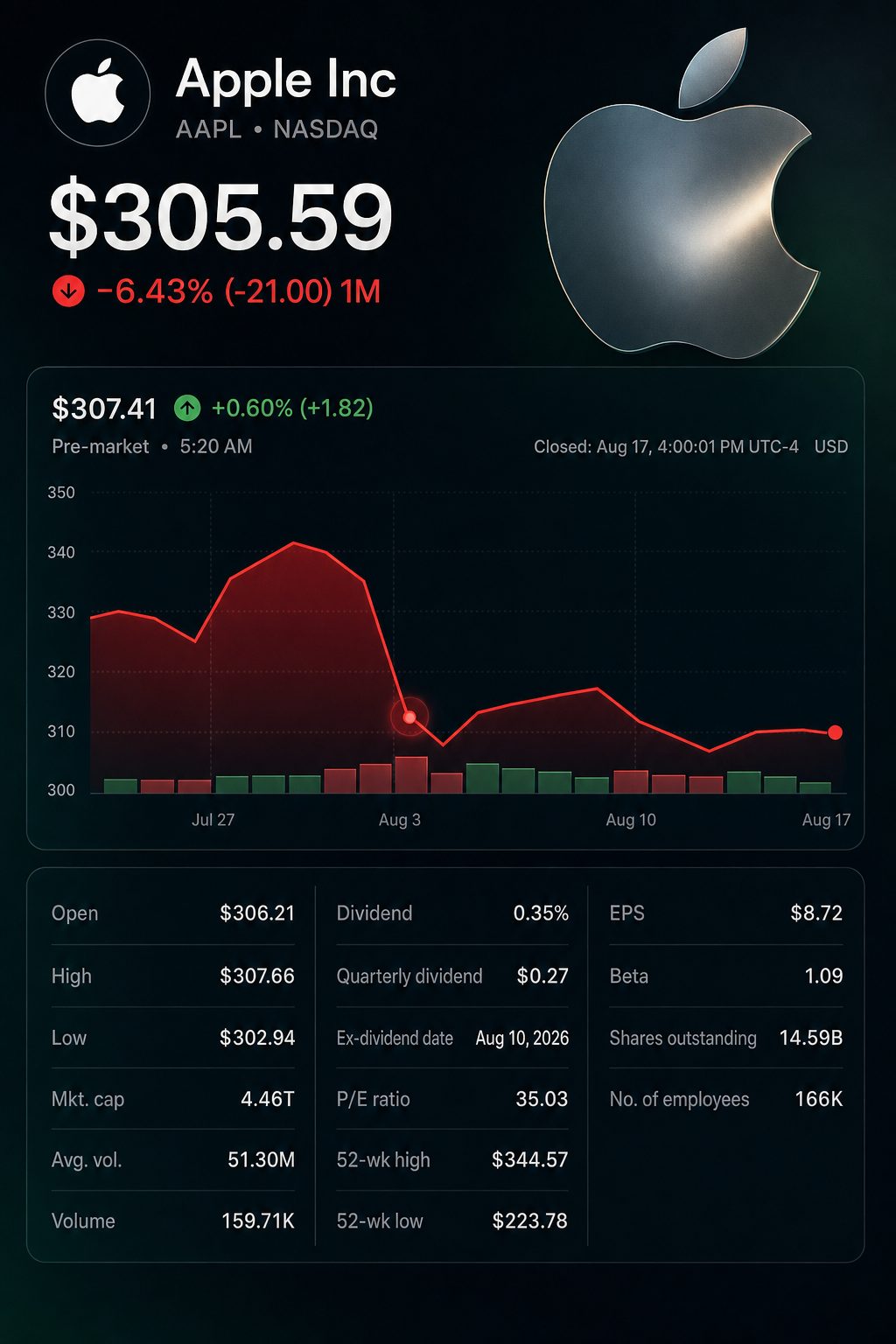
Shares slipped only 0.11% on Monday, outperforming a 0.52% S&P 500 decline. Memory suppliers rallied after reports that Washington discouraged Apple from buying Chinese chips. That market response underlines the scarcity behind Apple’s cost problem.
| Monday market move | Change | Investor read-through |
|---|---|---|
| Apple | -0.11% | Resilient against weaker market |
| Micron Technology NASDAQ:MU | +4.1% | U.S. memory-demand support |
| Sandisk NASDAQ:SNDK | +8.9% | Memory-cycle optimism |
| S&P 500 | -0.52% | Broad risk-off session |
Rothschild & Co Redburn analysts called Apple’s AI progress disappointing. They argued that using open models from Nvidia Corporation NASDAQ:NVDA could improve performance and reduce dependence on Alphabet Inc. NASDAQ:GOOGL Gemini. Their bull case reaches $400, roughly 30% above recent trading.
| Analyst view | Recommendation | Target | Main argument |
|---|---|---|---|
| Rothschild & Co Redburn, August 17 | Bull case | $400 | Nvidia AI partnership potential |
| Citi, July 13 | Buy | $365 | Pricing power and iPhone 18 cycle |
| Jefferies, August 10 | Underperform | $263.66 | Product differentiation and memory costs |
| 35-analyst consensus | Moderate Buy | $327.40 | Wide $200-$400 target range |
The target spread is unusually wide. It reflects two competing profit engines. Hardware still drives volume, while AI and services support the valuation multiple.
The next catalysts are concrete. Investors need confirmed iPhone pricing, memory-supply terms and evidence that AI improves device demand. A premium foldable model could also lift average selling prices, though volume estimates remain uncertain.
Risks: Component estimates may change before launch. A large price increase could reduce shipments. Absorbing costs would pressure hardware margins, while delayed AI progress could weaken the $400 bull case.
Apple does not need to choose between price and margin entirely. Storage tiers, product mix and supplier savings offer other levers. Still, the estimated 13-point gap sets the scale of September’s decision.
Related articles: NASDAQ:AAPL