
SANTA CLARA, California, August 17, 2026, 16:54 PDT — U.S. cash markets were closed.
- Nvidia closed at $225.01, down 0.07%, after unveiling the Ohio financing structure.
- The maximum $105 billion backstop equals 2.09 quarters of latest operating cash flow.
- The direct SB Energy equity investment is far smaller at $1.5 billion.
NVIDIA Corporation NASDAQ:NVDA committed up to $105 billion of support for an OpenAI data-center project in Ohio. That ceiling equals 2.09 times Nvidia’s latest quarterly operating cash flow. It also exceeds core balance-sheet liquidity by the same ratio.
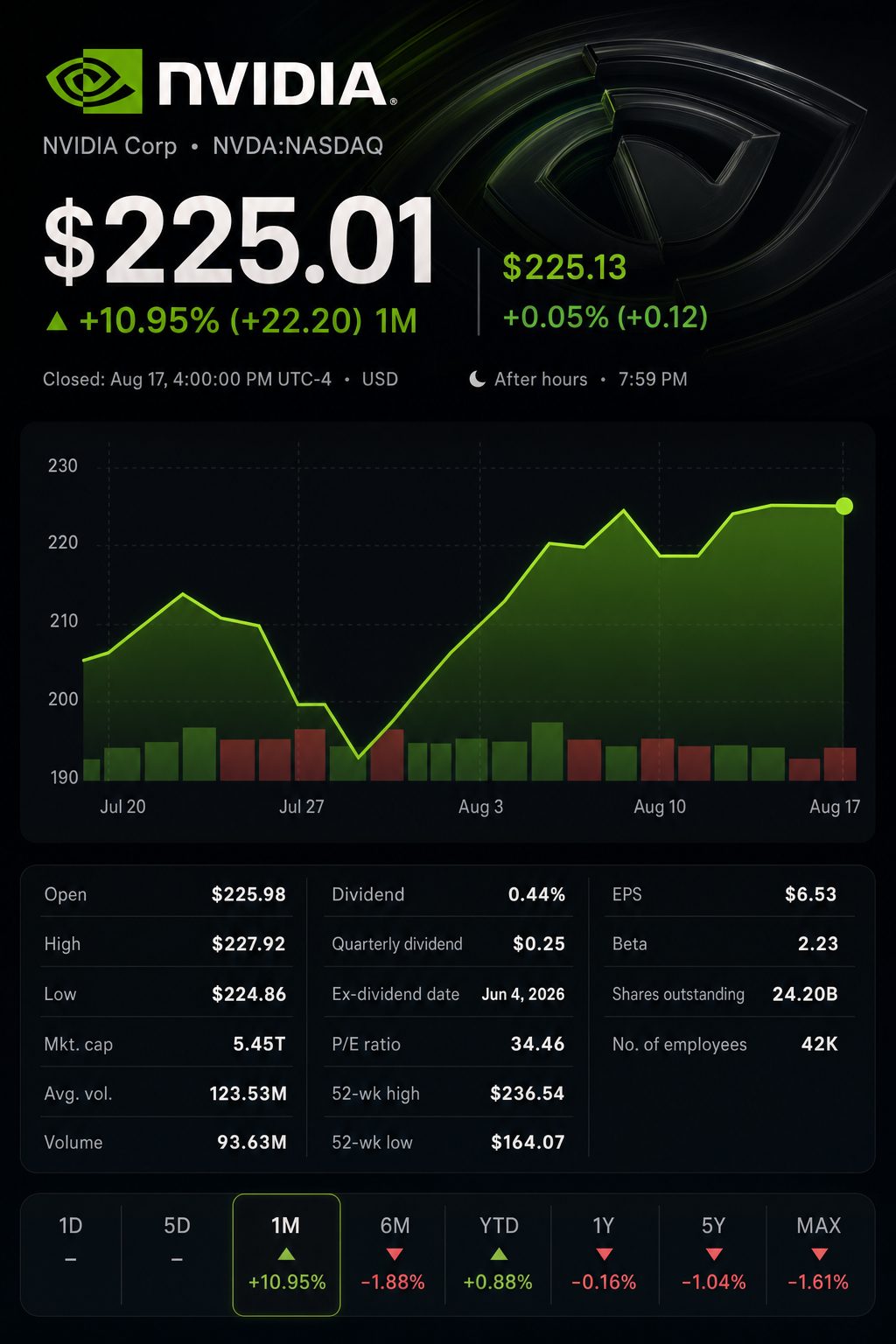
The commitment is contingent. It is not an upfront $105 billion payment. Nvidia will back selected lease, power and residual-value obligations while investing $1.5 billion directly in project developer SB Energy.
Investors showed little alarm. Nvidia closed Monday at $225.01, down 0.07%. Volume reached 93.6 million shares, only 64% of its 65-day average.
| Ohio commitment comparison | Amount | Relationship to Nvidia |
|---|---|---|
| Maximum financial backstop | Up to $105.0 billion | Contingent, not upfront cash |
| Direct SB Energy investment | $1.5 billion | 2.98% of core liquidity |
| Cash and marketable debt securities | $50.3 billion | Backstop equals 2.09 times this pool |
| Including marketable equity securities | $80.6 billion | Backstop equals 1.30 times this pool |
| Latest quarterly operating cash flow | $50.3 billion | Backstop equals 2.09 quarters |
| Market capitalization | $5.45 trillion | Backstop equals 1.93% |
OpenAI signed a 20-year lease for capacity developed by SB Energy, a unit of SoftBank Group Corp. TYO:9984. The campus could reach eight gigawatts. Its first 800 megawatts are targeted for 2028.
Nvidia will be the exclusive chip supplier for the site. The guarantees cover selected obligations rather than the full construction cost. That design limits immediate cash use while helping SB Energy raise project debt.
“This is not circular financing,” CEO Jensen Huang said. He estimated OpenAI could generate $600 billion of Nvidia revenue through 2030. That estimate equals 5.7 times the maximum backstop, but depends on full deployment and repeated upgrade cycles. Financial Times
| Latest operating measure | Q1 fiscal 2027 | Q1 fiscal 2026 | Change |
|---|---|---|---|
| Revenue | $81.6 billion | $44.1 billion | Up 85% |
| Data Center revenue | $75.2 billion | $39.1 billion | Up 92% |
| GAAP gross margin | 74.9% | 60.5% | Up 14.4 points |
| GAAP operating income | $53.5 billion | $21.6 billion | Up 147% |
| Operating cash flow | $50.3 billion | $27.4 billion | Up 84% |
Nvidia’s earnings power makes the structure feasible. First-quarter revenue rose 85% to $81.6 billion. Operating cash flow reached $50.3 billion. Data Center supplied 92% of total revenue.
Liquidity still matters. Nvidia held $13.2 billion of cash and $37.1 billion of marketable debt securities in April. It also owned $30.2 billion of marketable equity securities. The combined $80.6 billion remained below the backstop ceiling.
The market is pricing large growth before the project starts. Nvidia’s $5.45 trillion valuation equals about 67 times latest quarterly revenue. Shares have gained 20.7% this year and sit 4.9% below their 52-week high.
| Analyst or consensus | Recommendation | Price target | Upside vs. $225.01 |
|---|---|---|---|
| S&P Global consensus | Strong Buy | $302.83 | 34.6% |
| KeyBanc | Overweight | $330 | 46.7% |
| Raymond James | Strong Buy | $323 | 43.5% |
| Bernstein | Outperform | $315 | 40.0% |
| Morgan Stanley | Overweight | $288 | 28.0% |
Analysts remain bullish. The 61-analyst consensus is Strong Buy, with a $302.83 average target. That implies 34.6% upside. The published target range runs from $180 to $500, showing wide disagreement about duration and risk.
The week ahead centers on financing details and chip demand. Nvidia’s next confirmed earnings report is August 26, after the close. Investors will test whether its $91 billion quarterly revenue outlook supports the added credit exposure.
Risks: OpenAI’s lease is long, while AI hardware changes quickly. Power, construction or financing delays could reduce deployment. A guarantee call could exceed Nvidia’s current core liquidity, even though its cash generation is strong.
Related articles: NASDAQ:NVDA