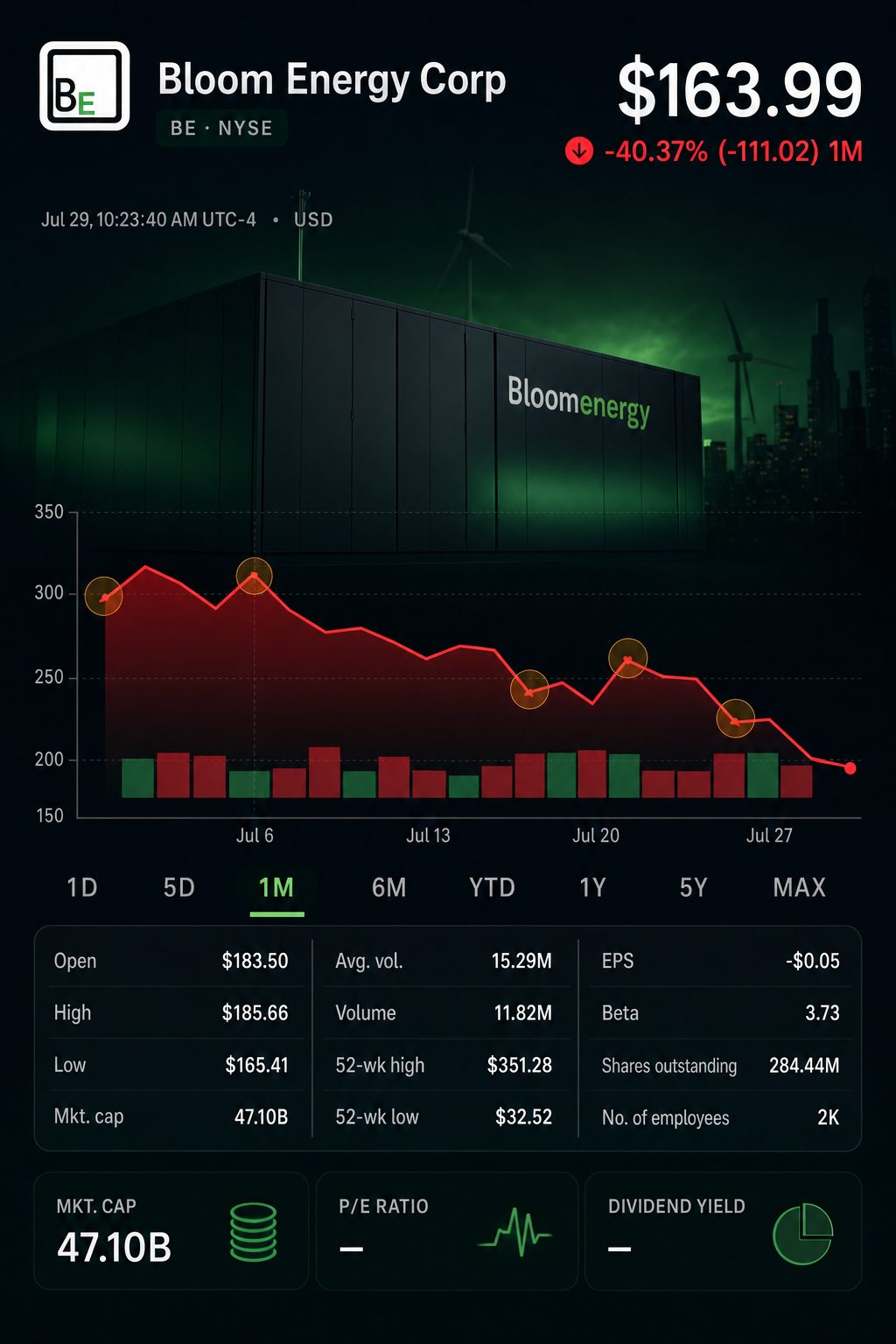
Shares of Bloom Energy Corporation NYSE:BE climbed 4.3% in early trading on Wednesday. The stock was priced at $173.94 as of 9:40 a.m. EDT, after reaching $188.50, representing a 13.0% increase compared to Tuesday’s closing value.
Shares rose after Bloom posted its highest-ever quarterly results. Revenue came in at $1.065 billion, topping analyst forecasts of about $826 million. Adjusted earnings were 78 cents, ahead of the consensus estimate of 41 cents.
The key figure appeared in an updated regulatory filing on Wednesday. Bloom disclosed that a single unnamed customer accounted for approximately 73% of its revenue in the second quarter. This customer was not identified as a related party.
The revision addressed switched period labels in Bloom’s customer-risk disclosure, confirming that the 73% statistic referred to the second quarter.
Based on the filing’s rounded percentage, that stake is valued at approximately $778 million. This amount is almost double Bloom’s total revenue from the prior year. The figures presented below are initial estimates.
Q2 concentration measure
Amount
Comparison
Total revenue
$1,065.4 million
Increase of 165.5% from prior year
Largest customer, preliminary
About $777.7 million
Accounts for 73% of revenue in the quarter
All other customers, preliminary
About $287.6 million
Represents 27% of quarterly revenue
Largest customer versus Q2 2025 total
1.94 times
Q2 2025 revenue stood at $401.2 million
The focus is significant as Bloom has also lifted its full-year outlook. The midpoint for 2026 revenue forecast rose by 12.5% to $4.05 billion, while midpoint guidance for adjusted EPS increased 31.7% to $2.70.
At the midpoint, Bloom requires approximately $2.23 billion in sales for the second half. This figure stands 23% higher than revenue from the first half. It breaks down to an average of $1.12 billion per quarter, 4.8% above the second quarter’s total. All figures are preliminary estimates.
The calculations indicate slight sequential growth over the present run rate. Maintaining strong deliveries to major customers remains particularly crucial.
Stronger sales drove higher profitability. Gross margin increased to 33.4%, up from 26.7%. Operating margin improved to 17.1%, compared with negative 0.9% in the prior year.
Bloom reported positive operating cash flow of $226.4 million, compared to a negative $213.1 million in the same quarter last year.
Chief Executive KR Sridhar stated, “Bloom is now a standard for AI onsite power.” He noted that leading U.S. hyperscalers and over a dozen other operators had given their approval to Bloom’s systems. Bloom Energy
With a share price of $173.94, Bloom’s market capitalisation stood at around $56.2 billion, which represents approximately 13.9 times the updated revenue midpoint. The company’s shares are also valued at about 64 times the midpoint of its adjusted EPS outlook. These multiples remain preliminary.
Concentration remains the key risk. Approximately 65% of first-half revenue came from just two customers. Warranty liabilities totaled $77.8 million, and recourse debt was close to $2.48 billion.
For investors, the upcoming focus is on breadth. If growth is distributed among multiple customers, the improved outlook appears more sustainable.
Bloom reported second-quarter revenue of $1.065 billion, up 165.5% from a year earlier. Adjusted diluted EPS stood at $0.78, exceeding estimates that ranged from $0.40 to $0.41. Revenue forecasts published before the results were between approximately $816 million and $826 million. GAAP operating income came in at $182.2 million, compared to a loss of $3.5 million. Operating cash flow turned positive at $226.4 million, reversing a negative $213.1 million. The results outperformed across key metrics.
Is Bloom on track to meet its updated 2026 targets?
Management forecasts revenue of $3.9–$4.2 billion and adjusted EPS of $2.55–$2.85. First-half revenue reached $1.816 billion, putting $2.084–$2.384 billion needed in the second half. That equates to a quarterly revenue range of $1.042 billion to $1.192 billion. Second-quarter revenue hit $1.065 billion, close to the lower end of the required pace. Achieving the midpoint of guidance requires more growth, but not another similar increase. Management notes that its 2026 guidance is not tied to any single project. Large delivery timings may result in quarterly revenue fluctuations.
How does the current share price reflect its valuation?
At 9:47 a.m. ET, Bloom was up about 2.9% at $171.64. The stock began trading at $183.50, touching lows of $171.64 and highs of $188.50 in early moves. With shares near 63.6 times adjusted earnings based on the $2.70 guidance midpoint, the valuation remains elevated. This hinges on sustained growth beyond 2026 and gross margins holding close to 34%. If results fall short, volatility could be heightened as a result.
What is the potential range for Bloom Energy shares in the coming year?
FactSet’s current median target stands at $287.50, with projections spanning from $100 to $390. The median suggests an estimated 67.5% potential gain from $171.64. The lowest target indicates a possible 41.7% decline, while the highest points to a 127.2% increase. Based on the target spread, a practical base range is $250–$290. This figure is not official company guidance. Analysts’ ratings reflect 15 bullish, 15 Hold, and three bearish recommendations. Several price targets could be updated following Tuesday’s earnings results.
What level of risk does Bloom face from reliance on a small number of customers?
The revised 10-Q reports that a single unrelated client accounted for about 73% of revenue in the second quarter. For the first six months, two customers made up approximately 44% and 21% of total revenue. The customer with 21% was listed as a related party. Bloom did not name these customers in the concentration disclosure. Executives state "customer" could refer to either the funding source or the end user of the power. Still, a delay at one campus could significantly impact revenue for a given quarter. MarketScreener
Can the reported $20 billion backlog at Bloom be considered reliable?
Bloom Energy’s most recent full backlog disclosed stands at about $20 billion as of December 2025. The product-related segment reached approximately $6 billion, an increase of around 2.5 times. Management reports backlog outpacing revenue growth, but has not issued an updated overall figure. The 10-Q details $494.1 million in unsatisfied performance obligations, a figure excluding certain short-term agreements and right-to-invoice deals. As a result, public filings do not allow for a complete reconciliation between backlog and performance obligations.
How will the broader Brookfield collaboration impact future earnings?
Brookfield increased its financing framework from $5 billion to $25 billion. This refers to available financing capacity, not confirmed revenue for Bloom. Management describes it as a financial shelf, with actual use reliant on customer demand. According to Bloom, its power systems have been validated by every major U.S. hyperscaler. The company also references over a dozen neocloud firms, AI labs, and colocation providers. These are company assertions, not verified customer agreements. The framework strengthens access to funding, but the conversion to revenue is still uncertain.
Does Bloom have a solid enough balance sheet to support fast expansion?
Cash on hand at the end of June stood at $2.667 billion, compared with debt carrying value of around $2.478 billion, resulting in net cash before lease liabilities of about $189 million. Operating cash flow for the first half totaled $300.0 million. Free cash flow for the second quarter was near $174.8 million. The company’s revolving credit facility had $510 million in available borrowing. Principal repayments of $2.5 billion are scheduled for 2030. Short-term liquidity appears sufficient, but refinancing risk continues.
Is Bloom able to satisfy demand without encountering constraints in materials or production?
Management states that production capacity and supply availability are not current limiting factors. The company reports scandium visibility supporting 25 gigawatts, without reliance on China. However, specific sourcing details are not disclosed as the terms are proprietary. Inventory increased to $758.2 million from $643.3 million since December. The July short report questioned material availability, but Bloom dismissed its findings. Q2 performance has strengthened confidence, though supply transparency is still restricted.
What level of dilution and accounting drag is associated with Oracle?
Oracle exercised a cashless warrant in May, leading to the issuance of 1.905 million Bloom shares. To enable net settlement, Bloom issued an additional 248,798 shares. The combined fair value totaled $324.4 million. Under accounting standards, the consideration will be amortized as reduced revenue across future deliveries. Shares outstanding at period close were 293.35 million, a 4.8% increase since December. Oracle's move bolsters demand visibility, though shareholders face concrete dilution and an impact from accounting treatment.
Michał Rogucki is a senior markets reporter at TS2.tech. His coverage ranges from stocks and technology to economic developments affecting global markets. He graduated from Humboldt University of Berlin and worked in investment research and market analysis before becoming a financial journalist.
Surprising starts and permits data can impact homebuilders, mortgage-sensitive stocks, Treasury yields, and the dollar if results deviate significantly from consensus estimates.
#02
Home Depot Q2
The results and outlook provide key insights into housing turnover, renovation demand, professional customer activity, and U.S. discretionary spending.
#03
09:15 ET industrial production
A robust or disappointing factory or utilities report can shift expectations for economic growth, cyclical stocks, bond yields, and the Federal Reserve’s policy direction.