
SUMMIT, New Jersey, August 18, 2026, 04:19 EDT — With U.S. cash markets shut, premarket activity had begun.
Kenvue Inc. NYSE:KVUE dropped 2.14% to $18.79 on Monday. Increased online searches for acetaminophen brought renewed attention to its Tylenol brand early Tuesday. However, the main factor behind the stock’s decline was its merger formula.
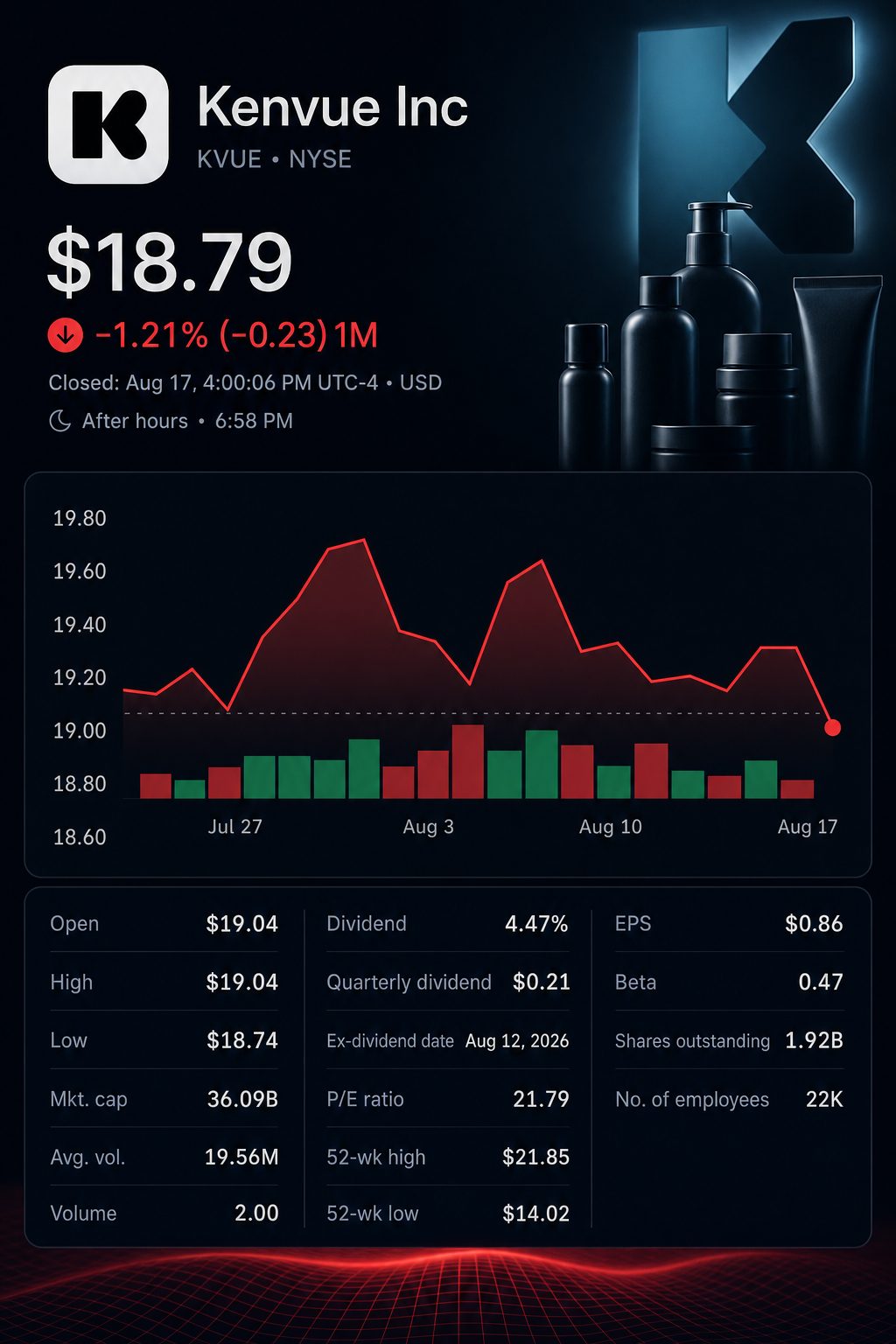
Shares of Kimberly-Clark Corporation NASDAQ:KMB slid $2.48 to $107.91, reducing the stock portion of its Kenvue offer by nearly $0.36. Kenvue shares declined $0.41. Close to 88% of Kimberly-Clark’s drop was attributed to deal-related calculations.
The difference is significant. Kenvue currently trades in part as a merger stub, rather than purely as a consumer-health share. Developments regarding product safety may increase the spread. Shifts in Kimberly-Clark shares can alter the value of the offer before anything else.
| Monday deal measure | Value | Investor reading |
|---|---|---|
| Kenvue closing price | $18.79, fell 2.14% | Implied share target |
| Kimberly-Clark closing price | $107.91, slipped 2.25% | Determines equity portion |
| Cash and stock offer | $19.28 | $3.50 + 0.14625 KMB shares |
| Total merger spread | 2.6% | Excludes timing, close risks |
| KMB-dependent portion | 81.8% of total offer | Main factor for daily price |
The rise in acetaminophen use alone does not indicate a new defect or prompt regulatory changes. According to the U.S. Food and Drug Administration, the drug is considered safe and effective if taken as instructed, but it cautions that exceeding recommended doses can result in liver failure or even death. Adults should not exceed 4,000 milligrams per day. As of early Tuesday, there was no new recall or updated labeling by the FDA.
Tylenol is part of Kenvue’s Self Care segment, though the firm does not report individual Tylenol sales. The Self Care unit generated $1.589 billion in revenue in the second quarter, representing 40.2% of total company sales. This figure covers the broadest segment Kenvue reports for the brand, and does not serve as a specific Tylenol revenue calculation.
| Q2 2026 segment | Net sales | Reported growth | Organic growth |
|---|---|---|---|
| Self Care | $1.589 billion | 2.2% | 0.6% |
| Skin Health and Beauty | $1.113 billion | 5.1% | 3.7% |
| Essential Health | $1.253 billion | 2.3% | 1.1% |
| Total | $3.955 billion | 3.0% | 1.6% |
Self Care achieved a return to U.S. organic growth in the last quarter. Kenvue noted an uptick in Tylenol demand, with Zyrtec increasing its market share and Pepcid maintaining strong performance. However, Self Care volume declined by 0.6%. That drop was counterbalanced by a 1.2% improvement in price and mix.
Broader operations strengthened, though margins narrowed. Adjusted earnings increased to $0.31 per share, up from $0.29. Adjusted gross margin declined by 70 basis points to 60.2%. The impact of inflation, tariffs and transactional currency costs surpassed certain supply-chain cost reductions.
Kirk Perry, Chief Executive, stated that Kenvue achieved “broad-based gains across every segment and region.” He also noted the transformation remains “firmly on track.” The company anticipates the Kimberly-Clark transaction will close in the fourth quarter. Kenvue earnings release
Acquisition terms are still a focus. Kenvue shareholders will receive $3.50 in cash and 0.14625 of a Kimberly-Clark share per Kenvue share. The transaction received approval from both sets of shareholders in January. Foreign regulatory clearances and standard closing conditions are outstanding.
Analysts remain more reserved compared to the merger announcement. The consensus rating is Hold. The average price target of $19.83 is 5.5% higher than Monday’s closing price, but just 2.8% above the present implied offer.
| Analyst measure | Current reading | Versus $18.79 close |
|---|---|---|
| Consensus | Hold | 14 analysts |
| Strong Buy / Buy | 1 / 1 | 14% of ratings |
| Hold / Sell / Strong Sell | 12 / 0 / 0 | 86% Hold |
| Average target | $19.83 | 5.5% upside |
| Low / high target | $18 / $23 | -4.2% / +22.4% |
Three indicators are key for investors ahead of Tuesday’s market open. Kimberly-Clark’s premarket activity has an immediate effect on the offer. Any updates from the FDA have the potential to shift the product risk profile. Approval of the merger will dictate if the 2.6% spread narrows.
Risks: Any fresh warning, recall, or unfavorable legal outcome related to acetaminophen could negatively impact Tylenol demand and further expand the spread. If Kimberly-Clark’s value drops, the offer is automatically reduced. Regulatory holdups or a failed transaction would shift focus back to Kenvue’s independent margins and brand management.