
MENLO PARK, California, August 10, 2026, 14:36 EDT – Meta NASDAQ:META shares pulled back after a rally, as optimism surrounding the company’s Muse project was tested against Meta’s planned $145 billion in expenditures.
- Meta has launched the Muse Glimmer open-weight model, enabling use on local computers.
- By 14:19 EDT, shares had relinquished roughly 92% of their highest intraday advance.
- Capital spending in the second quarter accounted for 97.5% of operating cash flow.
- Analysts are still positive, assigning 37 buy ratings and five hold recommendations.
Meta Platforms, Inc. NASDAQ:META introduced Muse Glimmer on Monday, an open-weight AI model capable of performing agentic tasks on a personal computer equipped with a single graphics card. However, most of the initial stock surge faded over the course of the session.
The post-launch fade is more significant than the initial surge. Investors are evaluating if recent AI offerings can warrant the substantial investment in infrastructure. Meta’s latest quarterly results highlighted this ongoing challenge.
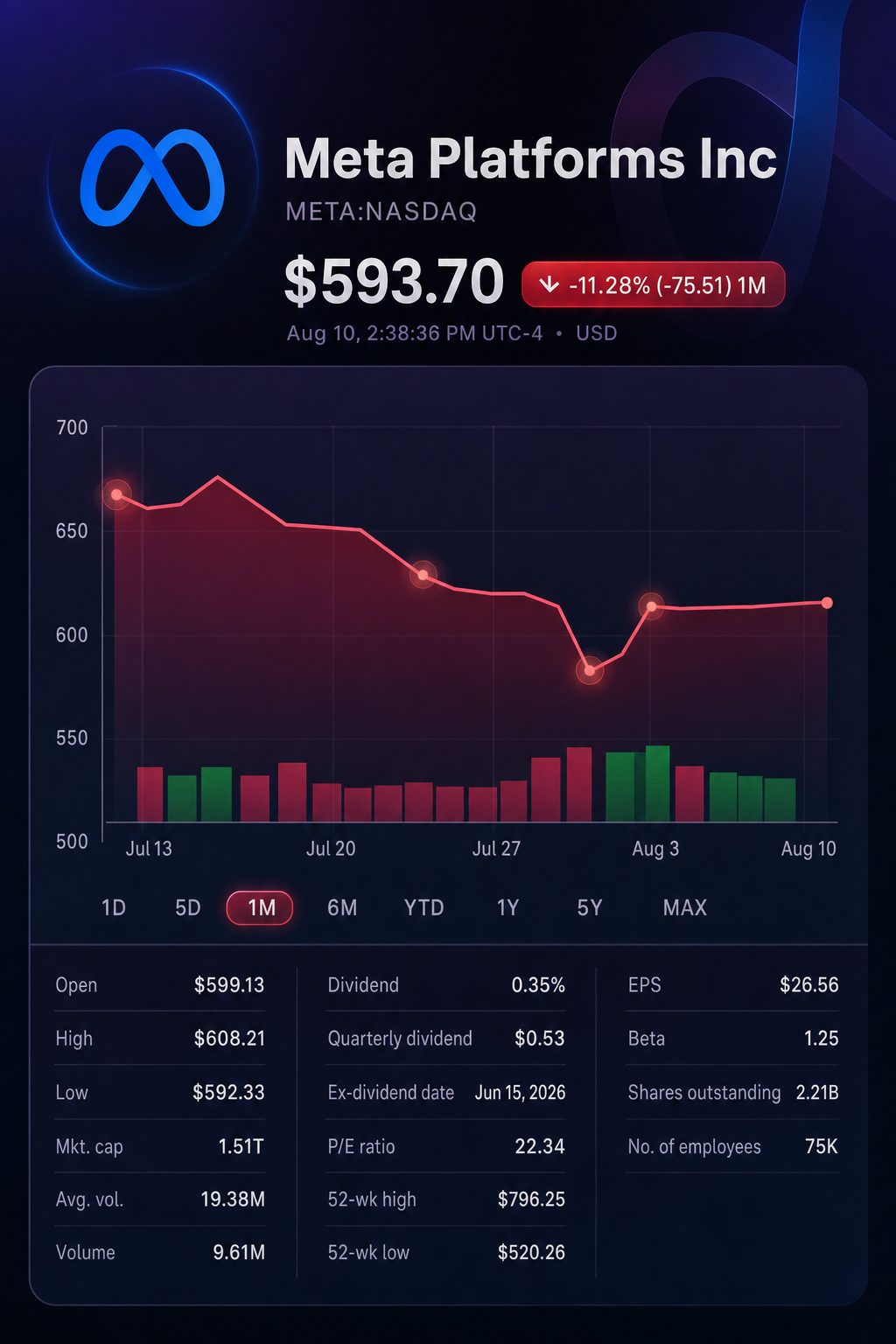
Meta shares were at $593.39 as of 14:19 EDT, a rise of 0.22%. The stock earlier reached $608.21, 2.72% higher than its previous close, but then gave up around 92% of those gains.
| Monday market measure | Value | Versus prior close |
|---|---|---|
| Previous close | $592.10 | — |
| Opening price | $599.13 | +1.19% |
| Session high | $608.21 | +2.72% |
| Price at 14:19 EDT | $593.39 | +0.22% |
| Percentage of peak gain lost | 92.0% | From market data |
The table calculates the previous close of $592.10 based on Google’s reported gain of $1.29. The peak-gain figure contrasts the high of $16.11 with the final $1.29 increase. Market data may be updated ahead of the close.
Muse Glimmer is available under a permissive open-source license. Meta intends to offer developers access to the more advanced Muse Spark 1.2 model as well. The move broadens the lineup beyond a single lightweight version.
Chief Executive Mark Zuckerberg stated, “We’ve got even bigger models that are coming soon.” His remark suggests an ongoing series of launches rather than the completion of the product lineup. Reuters
| AI announcement | What Meta disclosed | Investor relevance |
|---|---|---|
| Muse Glimmer | Open weight; operates on a single GPU | Expands access for lower-cost developers |
| Muse Spark 1.2 | Plans to release weights | Benchmarks Meta’s advanced model development |
| Community fund | $1 billion | Targets opposition to local data centers |
| 2026 capital spending | $130 billion to $145 billion | Establishes the bar for AI profit expectations |
Reuters verified the existence of the two-model roadmap and the $1 billion community fund. Meta outlined a capital-expenditure range of $130 billion to $145 billion in its July earnings report. The fund represents 0.69% of the range’s upper limit.
The impact of increased spending is apparent. Revenue for the second quarter increased by 28% to $60.80 billion. Expenses climbed 55%, leading to an 8% decline in operating income, while free cash flow decreased to $784 million.
| Q2 measure | 2026 | 2025 | Change |
|---|---|---|---|
| Revenue | $60.80 billion | $47.52 billion | up 28% |
| Costs and expenses | $42.03 billion | $27.08 billion | increase of 55% |
| Operating income | $18.78 billion | $20.44 billion | down 8% |
| Operating margin | 31% | 43% | down 12 percentage points |
| Diluted EPS | $6.18 | $7.14 | decrease of 13% |
Meta disclosed operating cash flow of $31.86 billion, alongside capital expenditures totaling $31.08 billion. As a result, capital investment accounted for 97.5% of the firm’s operating cash flow. The company calculates free cash flow after deducting property acquisitions and finance-lease principal repayments.
A solid profit driver remains. Daily active users across the family of apps totalled 3.60 billion. Advertising impressions climbed 14%, and the average price per ad grew by 12%.
Meta projects third-quarter revenue between $61 billion and $64 billion. The company maintains its full-year expense outlook at $165 billion to $169 billion. Management continues to anticipate that 2026 operating income will surpass last year’s figure.
Wall Street sentiment is still positive. The consensus 12-month price target stands at $752.45, representing a 26.8% premium to the 14:19 share price. In contrast, the lowest target, at $580, is 2.3% under the same price.
| Analyst measure | Value | Implied move from $593.39 |
|---|---|---|
| Buy ratings | 37 out of 42 | — |
| Hold ratings | 5 out of 42 | — |
| Sell ratings | 0 out of 42 | — |
| Average target | $752.45 | +26.8% |
| High target | $1,000 | +68.5% |
| Low target | $580 | -2.3% |
Over the past three months, 42 analysts’ ratings have been aggregated by Google Finance. Among the latest actions, Jefferies set a target of $710, Roth MKM gave a figure of $750, while CMB International projected $830, with all three firms issuing buy ratings.
Zuckerberg maintains that advanced AI ought to be “broadly distributed.” Making AI models’ weights open can lower expenses for developers and help increase usage. However, this approach alone does not demonstrate a payoff for Meta’s infrastructure investment. Associated Press
Risks: Model adoption could trail expenditure, while open weights might reduce direct monetisation. Meta is also contending with data-center pushback, lawsuits, and youth-safety hearings, which management warns could result in a material loss.
The upcoming trial involves Muse Spark 1.2. Investors seek proof that a more advanced model can boost either usage or revenue before the $130 billion to $145 billion capital plan consumes another year of funds.
Related articles: NASDAQ:META