
NEW YORK, August 9, 2026, 15:15 EDT —
Advanced Micro Devices NASDAQ:AMD ended Friday trading at $483.36, declining 1.21%. U.S. markets did not open on Sunday. Shares were 6.79% lower compared to Tuesday’s close.
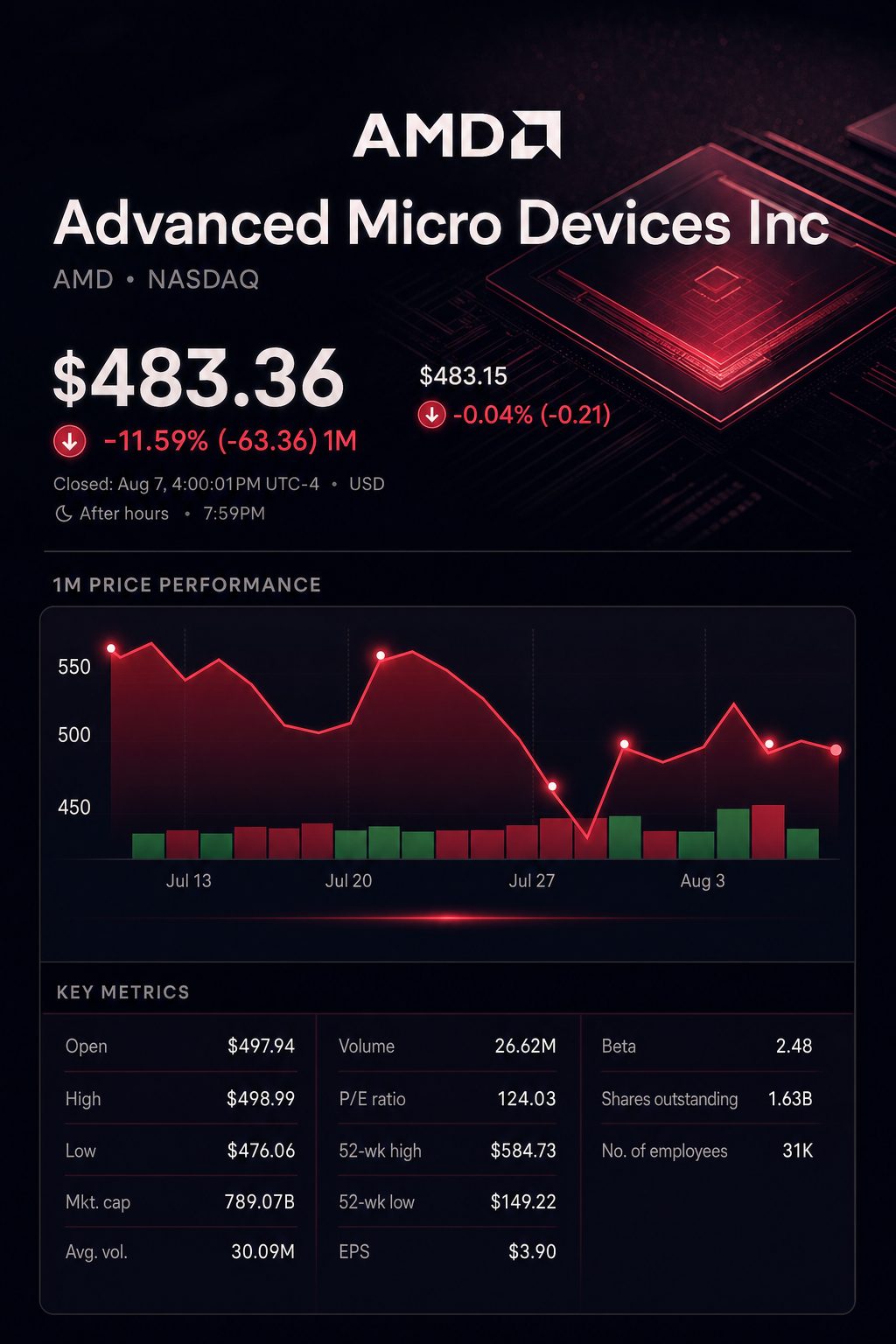
AMD advanced 1.51% compared with the previous Friday. After a 7.00% surge on Tuesday, Wednesday’s session wiped out those gains, resulting in a round trip through the week.
| Session | Close | Daily move |
|---|---|---|
| Friday, July 31 | $476.15 | −1.90% |
| Monday, August 3 | $484.64 | +1.78% |
| Tuesday, August 4 | $518.58 | +7.00% |
| Wednesday, August 5 | $482.05 | −7.04% |
| Thursday, August 6 | $489.28 | +1.50% |
| Friday, August 7 | $483.36 | −1.21% |
The PHLX Semiconductor Index advanced 9.24% over the week. With AMD rising 1.51%, the difference stood at 7.73 percentage points. This difference points to a reassessment of expectations unique to the company, instead of a broader sector decline.
Quarterly results surpassed Wall Street’s visible expectations. Second-quarter revenue topped LSEG consensus estimates by 2.3%, and adjusted earnings exceeded projections by 2.5%. The midpoint of Q3 revenue guidance was 3.8% ahead of consensus. However, that did not suffice.
| Measure | AMD figure | Consensus | Difference |
|---|---|---|---|
| Q2 revenue | $11.54 billion | $11.28 billion | +2.3% |
| Q2 adjusted EPS | $1.66 | $1.62 | +2.5% |
| Q2 Data Center revenue | $6.72 billion | $6.48 billion | +3.7% |
| Q3 revenue midpoint | $13.00 billion | $12.52 billion | +3.8% |
Nvidia NASDAQ:NVDA continues to be AMD’s chief competitor in AI accelerators. Bernstein analyst Stacy Rasgon stated, “We suspect expectations had moved higher, and the buyside already has a fairly bullish outlook.” Reuters
The income breakdown accounts for this high threshold. Data Center produced $2.103 billion in operating income, making up 105.7% of AMD’s total $1.990 billion. Calculations indicate that some segment profit was offset by unassigned expenses.
| Business | Q2 revenue | Revenue change | Q2 operating income | Q2 2025 operating income |
|---|---|---|---|---|
| Data Center | $6.718 billion | +107% | $2.103 billion | −$155 million |
| Client and Gaming | $3.841 billion | +6% | $582 million | $767 million |
| Embedded | $977 million | +19% | $386 million | $275 million |
| All Other | — | — | −$1.081 billion | −$1.021 billion |
| Total | $11.536 billion | +50% | $1.990 billion | −$134 million |
The comparison is notably influenced by a significant base effect. Second quarter 2025 results reflected $800 million in inventory and related charges associated with U.S. export restrictions on MI308 GPUs.
Chief Executive Lisa Su stated, “We enter the second half with strong momentum as EPYC demand accelerates, Instinct deployments scale and Helios begins to ramp.” AMD earnings release
On Thursday, AMD announced an agreement to acquire Taalas, a Toronto startup focused on designing custom silicon for AI inference, the process that executes trained AI models. AMD intends to incorporate Taalas’ solutions into its Instinct GPUs. The companies did not reveal the financial details of the deal.
Wall Street remained generally positive, but reactions varied. Some analysts, including Morgan Stanley, set a $465 target, which is under Friday’s close, while two others predicted targets of $700. The spreads referenced below reflect $483.36.
| Date | Firm | Rating | Old target | New target | Vs. Friday close |
|---|---|---|---|---|---|
| Aug. 6 | Argus | Buy | $450 | $625 | +29.3% |
| Aug. 5 | Rosenblatt | Buy | $665 | $700 | +44.8% |
| Aug. 5 | Wells Fargo | Overweight | $615 | $700 | +44.8% |
| Aug. 5 | Mizuho | Outperform | $625 | $580 | +20.0% |
| Aug. 5 | JPMorgan | Neutral | $385 | $550 | +13.8% |
| Aug. 5 | Morgan Stanley | Equalweight | $410 | $465 | −3.8% |
AMD’s main risk lies in its supply obligations. The company reported $30.3 billion in unconditional commitments, with $17.4 billion due through the rest of 2026. These are not capital expenditures but relate to supply, cloud services, software, and licenses. A slower rollout could result in surplus inventory or idle capacity.
AMD is set to appear next on Tuesday during KeyBanc’s Technology Leadership Forum. The live webcast begins at 9:30 a.m. MDT, or 11:30 a.m. EDT. AMD has not revealed which subjects will be discussed.
Macro risks are looming. July consumer price figures are due on Wednesday at 8:30 a.m. EDT, with producer price data set for release Thursday at the same hour. Stronger-than-expected results could push up yields and weigh on semiconductor stocks.
Related articles: NASDAQ:AMD