
NEW YORK, August 11, 2026, 10:38 EDT
- Cardinal Health projected adjusted earnings per share for fiscal 2027 between $12.40 and $12.60.
- The $12.50 midpoint exceeds the LSEG consensus by 3.8%.
- A single tariff reimbursement increased adjusted EPS in the fourth quarter by $0.31.
Cardinal Health, Inc. NYSE:CAH approached an all-time high on Tuesday as its updated profit outlook surpassed analyst expectations. Shares advanced 3.6% to $245.64 during morning trade.
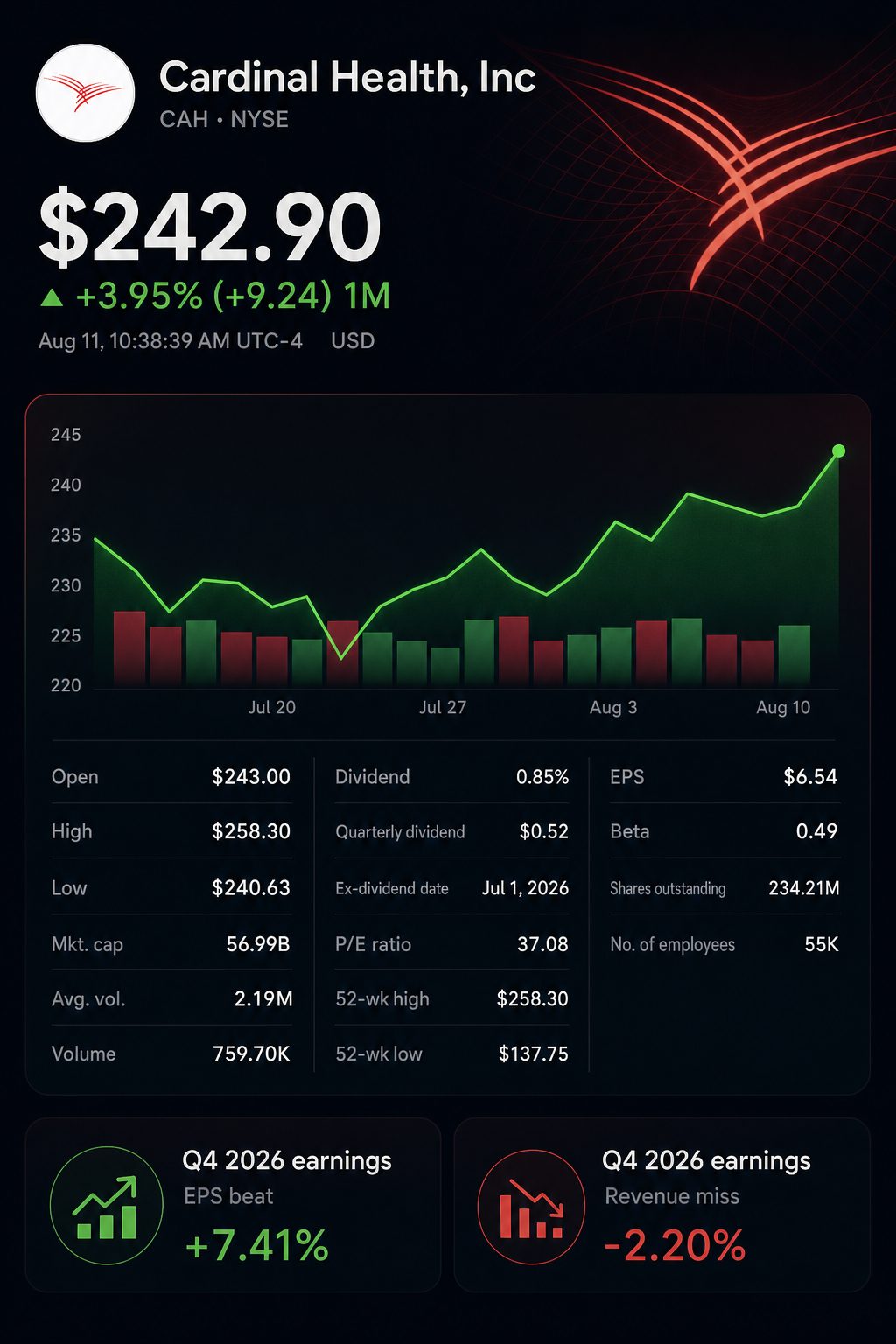
The distributor projects adjusted earnings for fiscal 2027 in the range of $12.40 to $12.60 per share. The midpoint of $12.50 is 3.8% higher than the $12.04 consensus estimate from LSEG, according to Reuters.
However, the pace of growth requires perspective. Cardinal’s 13%-15% projection is calculated off earnings that remove a single tariff refund. Using reported fiscal 2026 earnings, growth at the midpoint is around 11%.
| Fiscal 2027 EPS bridge | Value | Midpoint comparison |
|---|---|---|
| Company outlook | $12.40-$12.60 | Midpoint: $12.50 |
| LSEG average estimate | $12.04 | Compared to guide midpoint: +3.8% |
| FY2026 adjusted EPS, not including refund | $10.95 | Against guide midpoint: +14.2% |
| FY2026 adjusted EPS as reported | $11.26 | Against guide midpoint: +11.0% |
Cardinal Health provided the adjusted base and guidance in its statement. LSEG supplied the consensus. This calculation outlines how the company arrives at its 13%-15% growth range, excluding the refund as a recurring contributor to profit.
The quarter produced mixed results. Revenue came in below expectations, but adjusted earnings surpassed forecasts by 20.2%. Excluding the refund, the adjusted earnings beat is reduced to 7.4%.
| Fiscal Q4 2026 | Actual | Wall Street estimate | Year earlier |
|---|---|---|---|
| Revenue | $63.67 billion | $65.03 billion | $60.16 billion |
| Reported adjusted EPS | $2.91 | $2.42 | $2.08 |
| Adjusted EPS excluding refund | $2.60 | $2.42 | $2.08 |
| GAAP EPS | $1.70 | Not cited | $1.00 |
The official statement showed revenues up by 6% and GAAP EPS climbing 70%. Estimates from LSEG were provided by Reuters. Tariff recovery contributed $100 million to operating income and $0.31 per share.
Chief Executive Jason Hollar said, “Fiscal 2026 was a standout year for Cardinal Health.” He noted that each of the company’s five operating segments achieved double-digit profit growth prior to considering tariff recoveries. Cardinal Health
Underlying performance was led by pharmaceutical and specialty products, which accounted for 92% of revenue in the quarter. Profit in this segment increased at over three times the pace of sales.
| Operating segment | Q4 revenue | Revenue growth | Q4 profit | Profit growth |
|---|---|---|---|---|
| Pharmaceutical and Specialty Solutions | $58.8 billion | 6% | $645 million | 21% |
| Global Medical Products and Distribution | $3.1 billion | -2% | $150 million | Not meaningful |
| Other businesses | $1.7 billion | 7% | $183 million | 14% |
Cardinal Health reported an increase in pharmaceutical sales, citing higher demand for branded and specialty medications. Medical distribution revenue declined, which the company attributed to reduced volumes and anticipated repayments of refunds to clients. Profit growth in that division was credited to the same tariff recovery.
Cash conversion presents a more challenging comparison. Adjusted free cash flow for fiscal 2026 was $5.0 billion. The updated forecast stands between $3.5 billion and $4.0 billion, with a midpoint of $3.75 billion.
| Fiscal 2027 operating outlook | Guidance | Investor read-through |
|---|---|---|
| Pharma revenue growth | 3%-5% | Pace lags Q4’s 6% |
| Pharma profit growth | 8%-11% | Lower than the 21% recorded in Q4 |
| Other revenue growth | 11%-13% | Highest sales growth bracket |
| Adjusted free cash flow | $3.5-$4.0 billion | Middle point 25% lower versus FY2026 |
| Share repurchases | About $1 billion | Bolsters per-share results |
The decrease at the midpoint of free cash flow is due to an elevated base in the previous year. Management expects to allocate roughly $700 million towards capital expenditures. The board approved an additional $5 billion for its share buyback program, lifting the total authorization to $6.4 billion.
Cardinal is pursuing expansion through acquisitions, paying around $360 million for Strive Medical and AdaptHealth Corporation’s (NASDAQ:AHCO) diabetes unit. These transactions broaden its direct-to-consumer home-care footprint.
Rivals are also benefiting from the specialty-drug trend, although their growth rates vary. Cardinal posted the quickest underlying profit growth among the three in their most recent quarters.
| Distributor | Latest quarterly revenue | Revenue growth | Adjusted EPS | EPS growth |
|---|---|---|---|---|
| Cardinal Health | $63.67 billion | 6% | $2.60 underlying | 25% |
| McKesson Corporation NYSE:MCK | $105.4 billion | 8% | $9.93 | 20% |
| Cencora, Inc. NYSE:COR | $84.8 billion | 5.1% | $4.48 | 12% |
The analysis considers Cardinal’s earnings per share, adjusted for refunds, alongside the most recent figures for McKesson and Cencora. McKesson posted the highest sales growth, while Cardinal recorded the strongest profit increase.
The record-breaking price has absorbed much of the previous analyst upside. The table reflects each firm’s latest cited action prior to Tuesday’s results.
| Firm | Recommendation | Target | Change from $245.64 |
|---|---|---|---|
| Citigroup | Buy | $265 | +7.9% |
| Baird | Outperform | $251 | +2.2% |
| Mizuho | Outperform | $240 | -2.3% |
| Evercore ISI | Outperform | $240 | -2.3% |
| JPMorgan | Neutral | $215 | -12.5% |
Citigroup’s July price target followed a renewed Buy rating. Additional analyst actions are listed in the latest histories on Investing.com and Benzinga. Analysts’ consensus target prior to results stood at $252.40, representing a 2.8% premium to Tuesday’s figure.
Risks: Demand for specialty products could ease, generic price levels may soften, and integration expenses may follow acquisitions. Repayment of tariffs is still unclear. Ongoing federal probes and the potential for losing customer contracts might further weigh on margins.
“We enter Fiscal 2027 with momentum,” Hollar said. Analysts now face the task of weighing a streamlined 14.2% earnings-growth midpoint against a projected 25% decline in adjusted free cash flow. The revised target is expected to drive the next move. Cardinal Health