
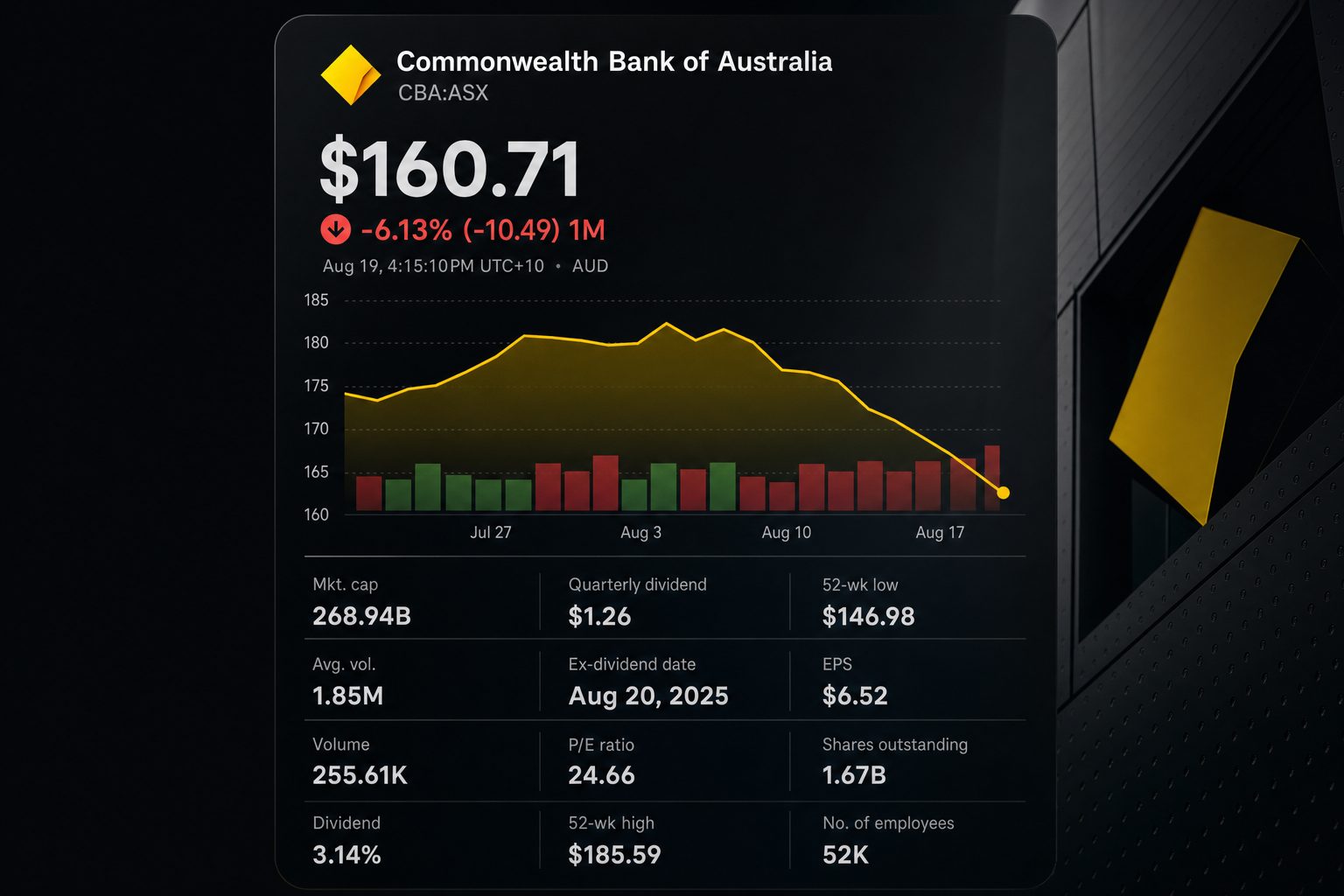
SYDNEY, August 20, 2026, 10:15 AEST — Commonwealth Bank of Australia ASX:CBA opened Thursday trading after its shares tumbled 8.8% over the week, following the announcement of a record annual cash profit. Shares ended Wednesday down 1.18% at A$160.71.
The retreat has reduced what was an extreme valuation gap, but not eliminated it. CBA continues to trade at 25.42 times trailing earnings, which is roughly 34% higher than the 18.92-times average of its three main competitors. Its trailing dividend yield of 3.04% remains 31% lower than their 4.40% average.
| Market measure | CBA reading | Investor signal |
|---|---|---|
| Aug. 19 close | A$160.71 | Fell 1.18% on the day |
| One-week change | -8.80% | Valuation reset following results |
| One-year change | -6.13% | Stock falls even with rising earnings |
| Consensus target | A$125.21 | 22.09% under latest close |
| Analyst consensus | Strong Sell | 14 analysts; zero Buy or Hold calls |
Tensions are evident. CBA reported a 7% rise in cash net profit after tax to A$10.982 billion for the year ended June. Operating income climbed by 6%, and return on equity stood at 14.0%. Growth for the bank matched or surpassed system levels in five main domestic products.
| FY26 measure | Result | Year-on-year |
|---|---|---|
| Cash net profit | A$10.982bn | up 7% |
| Pre-provision profit | A$16.469bn | increased 6% |
| Net interest margin | 2.05% | up 3 basis points |
| Operating expenses | A$13.755bn | rose 6% |
| Loan impairment expense | A$788m | up 9% |
| Return on equity | 14.0% | up 50 basis points |
| Full-year dividend | A$5.05 a share | rose 4% |
Chief Executive Matt Comyn stated that “growth is slowing, with higher interest rates and inflation placing uneven pressure on household incomes and economic activity.” He noted housing applications have levelled off in the past few weeks. CBA statement
Credit metrics provide the clearest evidence for caution. Home-loan arrears rose to 0.73%, and personal-loan arrears climbed to 1.72%. CBA attributed most of the rise to pressures from living costs. Its provision buffer of A$2.7 billion offers a safeguard, though additional increases in arrears could put its valuation premium at risk.
The common-equity Tier 1 ratio stood at 12.0%, exceeding the regulatory minimum of 10.25%, indicating solid capital levels. However, just A$300 million of the intended A$1 billion buyback took place. The buyback programme expired on August 12 and was not renewed.
| Australian major bank | Google Finance ticker | Trailing P/E | Trailing dividend yield |
|---|---|---|---|
| Commonwealth Bank | ASX:CBA | 25.42x | 3.04% |
| ANZ Group Holdings | ASX:ANZ | 19.25x | 4.41% |
| Westpac Banking | ASX:WBC | 17.08x | 4.44% |
| National Australia Bank | ASX:NAB | 20.42x | 4.34% |
| Peer average, CBA not included | — | 18.92x | 4.40% |
The numbers illustrate the doubt. CBA’s earnings yield, calculated as the reverse of its P/E ratio, stands at 3.93%. The average among its three peers is 5.34%. Investors are receiving around 1.41 percentage points less in earnings yield in exchange for CBA’s scale, operational performance, and capital resilience.
| Analyst or firm | Recommendation | Price target | Date |
|---|---|---|---|
| Andrew Lyons, Jefferies | Sell | A$144.99 | Aug. 13 |
| Richard Wiles, Morgan Stanley | Sell | A$124.00 | Aug. 13 |
| Matthew Wilson, Jarden | Sell | A$90.00 | Aug. 12 |
| John Storey, UBS | Sell | A$135.00 | Aug. 12 |
| S&P Global consensus | Strong Sell | A$125.21 average | Aug. 13 update |
Comyn offloaded around A$8.4 million worth of CBA shares on Friday, two days following the result, at slightly more than A$168 each. The sale was largely completed via a family trust amid his marital separation. He continues to hold 111,829 performance rights and restricted shares.
The sale represents roughly 0.003% of CBA’s market capitalisation of A$272 billion. The impact on supply is minimal. However, the timing may influence sentiment, particularly as a majority of analysts currently expect further declines.
CBA intends to revamp rewards for nine million customers starting October 1. This update comes ahead of a planned cap on card interchange fees that may cost Australian banks around A$660 million each year. While this would have only a minor impact compared to CBA’s earnings, it introduces a fresh margin challenge.
Risks: The case for a bearish valuation may be undermined if demand for home loans steadies and arrears stop rising. Greater risk lies in the reverse. An increase in credit losses, shrinking margins or expenditures exceeding the planned A$2.4 billion FY27 investment could prompt investors to push for a multiple in line with peers.
The following indicator is operational rather than cosmetic. Investors are monitoring if CBA can maintain its 2.05% margin amid increasing expenses and credit costs. This outcome will determine if the premium will compress further.
Related articles: ASX:CBA


Record profit, shrinking patience
CBA's earnings remain solid. The share price still carries a large premium, and analysts see another 22% downside to their average target.
The premium is still the story
Trailing earnings multiple compared with Australia's other major banks.
FY26 operating scorecard
Year ended June 30, 2026.
| Measure | Result | YoY |
|---|---|---|
| Cash profit | A$10.98bn | +7% |
| Pre-provision profit | A$16.47bn | +6% |
| Net interest margin | 2.05% | +3bp |
| Operating expense | A$13.76bn | +6% |
| Impairment expense | A$788m | +9% |
| Return on equity | 14.0% | +50bp |
Analysts remain firmly bearish
STRONG SELL • 14 analysts • Aug. 13 update
Stable mortgage applications, contained arrears and a steady 2.05% margin would support CBA's quality argument.
Higher credit losses, weaker margins or FY27 investment above A$2.4 billion would make a peer-like multiple harder to avoid.
CET1 is 12.0%, above the 10.25% regulatory minimum. The full-year dividend rose 4% to A$5.05 a share.