
Mark Cuban Puts Forward Employee-Equity Tax Proposal With Dual Cost Threshold

Mark Cuban Puts Forward Employee-Equity Tax Proposal With Dual Cost Threshold

DALLAS, August 25, 2026, 08:08 CDT

  • Mark Cuban is calling for increased corporate taxes on firms that fail to provide equity to all employees.
  • The proposal is a concept rather than formal legislation, and it does not specify any penalty rate or set out implementation guidelines.
  • For a sample firm, a rise of two percentage points in taxes corresponds to a stock grant valued at 1% of payroll.

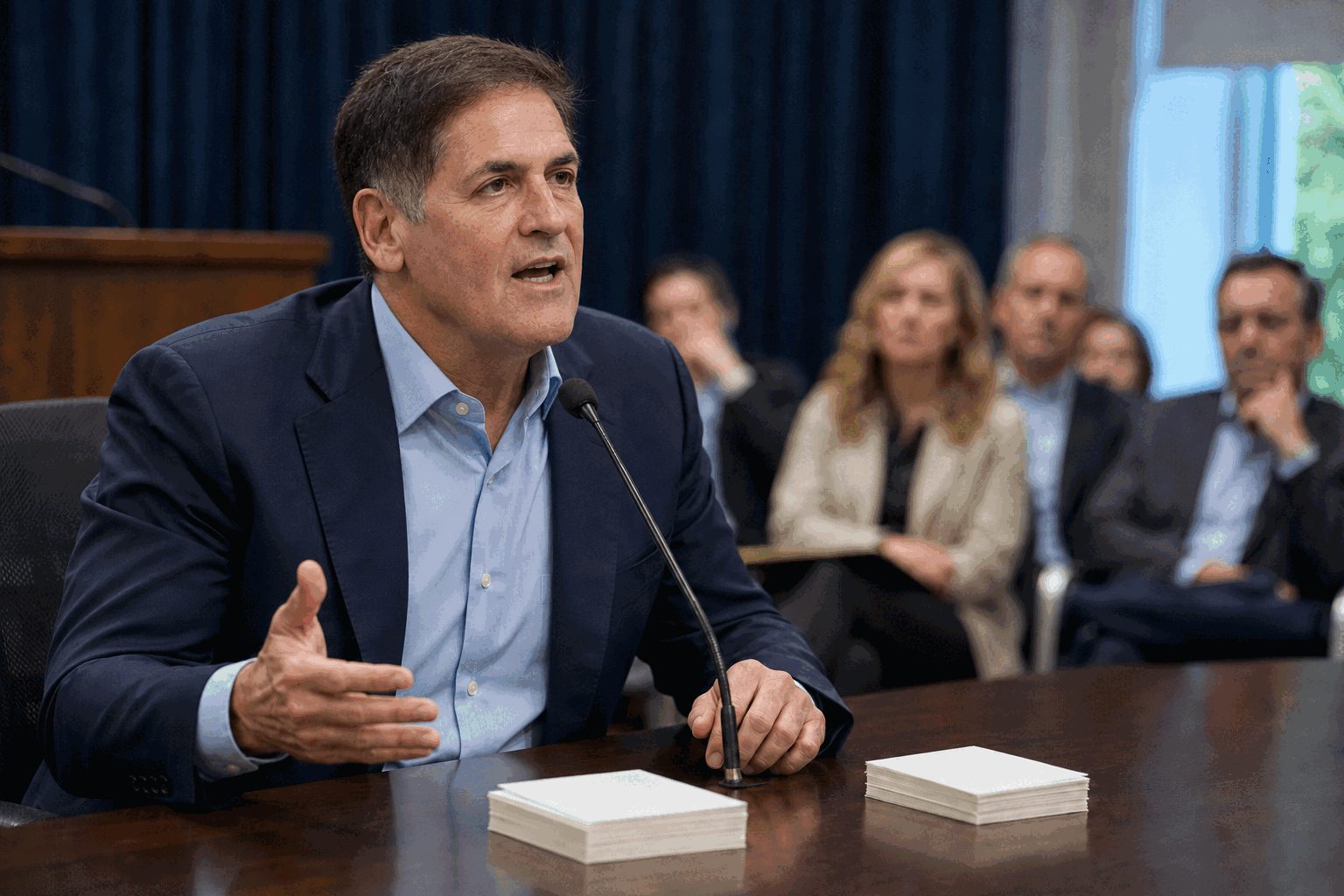
Mark Cuban has presented a new ultimatum to corporate America: either grant every employee equity or incur higher taxes. The idea lacks a formal bill, named supporter, or detailed rate. Still, it sets out a clear trade-off for investors ahead of Tuesday’s U.S. market open.

The impact may show up as increased taxes or a reduction in shareholder value. Which option costs less relies on factors like taxable income, payroll, and how the award is structured. Cuban’s proposal raises issues beyond just fairness.

Cuban stated that lawmakers should “increase the taxes of any company that doesn’t offer equity to every employee.” He further suggested that equity awards should be distributed on a pro rata basis compared to non-founder executives. The specific formula was not given. Fortune

For example, a hypothetical firm with $1 billion in taxable profits and $2 billion in cash payroll would incur a $20 million expense for a broad-based stock grant equal to 1% of payroll, based on its grant-date fair value. Similarly, a two percentage point rise in tax rates would result in an additional $20 million cost.

Illustrative tax rateTax on $1B incomeAdditional tax over 21%Payroll-equivalent value
21% current rate$210M
22% scenario$220M$10M0.5%
23% scenario$230M$20M1.0%
25% scenario$250M$40M2.0%
Illustrative only. Cuban proposed no rate. Award percentages use $2B of payroll and exclude tax deductions, vesting and valuation changes.

The break-even point varies significantly among business models. Employers with low margins and high payrolls would require more equity to match the same percentage award. Meanwhile, companies generating high profits might see a higher tax burden in relation to payroll.

The federal corporate tax rate stands at 21%, reduced from a previous maximum of 35% prior to the 2017 tax overhaul. Introducing a Cuban-style penalty would require Congress to specify the applicable rate, identify affected companies, and establish the criteria for eligible equity.

Wider ownership may influence the distribution of market returns. In 2022, 58% of U.S. households held stocks, either directly or through intermediaries. The share for direct holders stood at 21%. Stock ownership varied from 34% in the bottom 50% income group to 95% among the top 10%.

Employee ownership is already widespread, although typical programs are not structured like Cuban’s proposal. In 2023, U.S. employee stock ownership plans included 15.1 million participants and managed $2.06 trillion in assets. Of these, public-company plans represented 12.2 million participants.

The proposal addresses the difference in compensation between executives and employees. According to the Economic Policy Institute, chief executives at 350 major U.S. firms earned an average realized compensation of $22.98 million in 2024. This amount was 281 times higher than the pay of an average worker, based on the institute’s methodology.

Major issuers are already incurring significant equity expenses. Amazon.com, Inc. reported $19.47 billion in stock-based compensation in 2025, compared with $22.01 billion in 2024. This figure illustrates the scale, but does not indicate whether Amazon would meet the criteria of Cuban’s unspecified test.

The accounting approach is important. Stock awards typically decrease reported earnings as they are counted as compensation expense. Issuing new shares or dilutive awards may also reduce earnings per share, but buybacks can counteract that impact.

Cuban referenced his experience at Broadcast.com, noting that 330 employees were granted equity ahead of Yahoo’s $5.7 billion purchase, which resulted in 300 becoming millionaires. He said this stemmed from a profitable acquisition, adding that it does not demonstrate a typical return under a nationwide requirement.

Risks: An employee’s income and position may be vulnerable if the company’s stock price declines, given both are tied to the same employer. Required equity awards might dilute existing shareholders, potentially prompt compensatory share repurchases, or lead to a reduction in cash-based pay. Valuation and liquidity challenges could also arise for private companies.

Investors can follow a straightforward checklist: monitor for released legislative text, outlined penalties, vesting provisions, tax deductibility details, and a precise pro rata award definition. Until these emerge, the two-point break-even remains a scenario rather than a forecast.

Mark Cuban employee-equity tax idea — investor dashboard
Macro / policy · investor dashboard

Mark Cuban’s employee-equity tax idea

A proposed tax-or-equity choice turns broad employee ownership into an auditable cost test. The market issue is where the burden lands: cash taxes, compensation expense or shareholder dilution.
IDEA — NOT LEGISLATIONData checked August 25, 2026, 08:08 CDT / 15:08 CEST
Current federal rate
21%
Flat corporate rate since 2018
Illustrative break-even
+2 pts
Equals a 1% payroll award in the model
Families owning stock
58%
Directly or indirectly, 2022 Fed survey
ESOP participants
15.1M
Across U.S. plans, 2023

Tax-versus-equity scenario

Model: $1B taxable income · $2B cash payroll · award measured at grant-date value
RateTaxExtra vs 21%Payroll-equivalent equity
21% current$210M
22%$220M$10M0.5%
23%$230M$20M1.0%
25%$250M$40M2.0%
Illustrative only. Cuban did not propose a penalty rate. The model excludes deductions, vesting, forfeitures, share-price changes and buybacks.

Incremental cost curve

$0M$10M$20M$30M$40M 21%22%23%25% $10M$20M$40M

Who owns the market?

Lower 50% incomes
34%
Middle 40%
78%
Top 10%
95%
Share of U.S. families with direct or indirect stock holdings, 2022 Survey of Consumer Finances.

Existing employee-ownership base

ESOP plans6,609
Total participants15.1M
Plan assets$2.056T
Public-company plan participants12.2M
2023 Department of Labor Form 5500 data compiled by NCEO. ESOPs are not the same as Cuban’s undefined pro-rata model.

Policy timeline

2018Federal corporate rate falls to 21%.
2022Latest Fed family-finance survey: 58% own stock directly or indirectly.
2023ESOP assets reach $2.056T.
Aug. 24, 2026Cuban proposes the tax-or-equity choice.
Next gateBill text, rates, eligibility and vesting rules.

Market transmission

Cash taxHigher statutory burden lowers after-tax earnings and free cash flow.
Compensation expenseGrant-date value can reduce reported operating profit.
DilutionNew shares or awards can lower earnings per share.
RetentionVesting may reduce turnover and align employees with firm value.
BuybacksRepurchases can offset dilution but consume cash.

Relative sensitivity

Tech / high-SBC issuers HighExisting equity systems help execution; dilution is already visible.
Retail / hospitality HighLarge payrolls make broad awards expensive.
Buyback-heavy mature firms MediumCapital returns may absorb the offset.
Private companies HighValuation, liquidity and employee exits complicate awards.

Supporting listed-company scale example

$19.47B
Amazon.com, Inc. (NASDAQ:AMZN) stock-based compensation in 2025, versus $22.01B in 2024.

This shows the magnitude equity pay can reach at a large issuer. It does not indicate whether Amazon would qualify under Cuban’s proposal, because no compliance test exists.

Investor watchlist

1. Actual legislative sponsor and text
2. Penalty rate and tax base
3. “Pro rata” award formula
4. Vesting, deductions and forfeitures
5. Private-company liquidity rules
Scenario calculations are TS2 analysis, not a forecast. Time-sensitive data are labeled with source periods; dashboard timestamp: August 25, 2026, 08:08 CDT / 15:08 CEST.
Marcin Frąckiewicz

Marcin Frąckiewicz is the founder and CEO of TS2 Space, a satellite communications company working with customers worldwide. His experience spans satellite communications, telecommunications and technology ventures. He graduated from the Warsaw School of Economics (SGH) and writes about space technology, artificial intelligence, stocks and the technology companies and industries he follows. Follow Marcin Frąckiewicz on Google News, Facebook or LinkedIn.

US Stock Market Today Updates

AI PORTFOLIO

Top Stock Picks

Today’s highest-ranked model selections.

#1 STRONG BUY

Kodiak Gas Services

NYSE:KGS • Energy infrastructure 88/100 • ★★★★☆
#2 STRONG BUY

Neurocrine Biosciences

NASDAQ:NBIX • Healthcare 87/100 • ★★★★☆
#3 STRONG BUY

Alphabet Class A

NASDAQ:GOOGL • Communication services 85/100 • ★★★★☆
#4 BUY ON WEAKNESS

Applied Materials

NASDAQ:AMAT • Semiconductor equipment 84/100 • ★★★★☆
#5 ACCUMULATE

JPMorgan Chase

NYSE:JPM • Financials 80/100 • ★★★★☆
View full portfolio
Editorial model selection. Not personalised advice.
MARKET CALENDAR

Key Events Today

The catalysts most likely to move markets.

#1

Consumer Confidence • 10:00 ET

A large surprise can reset expectations for household spending and near-term growth, with read-through to Treasuries, USD and cyclical stocks.

#2

New Home Sales • 10:00 ET

Housing remains highly rate-sensitive; the print can move homebuilders, mortgage-sensitive names and the long end of the Treasury curve.

#3

Intuit earnings • After close

Guidance can influence software multiples and sentiment around U.S. small-business activity.

View full calendar
Times and estimates may change. Verify before trading.
Launch of 7.1 Million King Charles 10p Coins in UK Circulation Gauges Collector Demand
Previous Story

Launch of 7.1 Million King Charles 10p Coins in UK Circulation Gauges Collector Demand

Montreal-Trudeau Death Brings Ground-Handling Safety to Fore for Investors
Next Story

Montreal-Trudeau Death Brings Ground-Handling Safety to Fore for Investors