
REDWOOD CITY, California, August 27, 2026, 04:35 (EDT)
- RASONQUE debuted with a wholesale price of $39,800 for a 30-day supply.
- RVMD rose 1.9% on Wednesday and was up 2.3% in premarket trading on Thursday.
- RBC projects third-quarter sales of $28 million and expects $148 million in the fourth quarter.
Revolution Medicines has debuted its first commercial product in the U.S. following the launch of RASONQUE. The pancreatic cancer pill, taken once daily, is priced at $39,800 for a month’s supply.
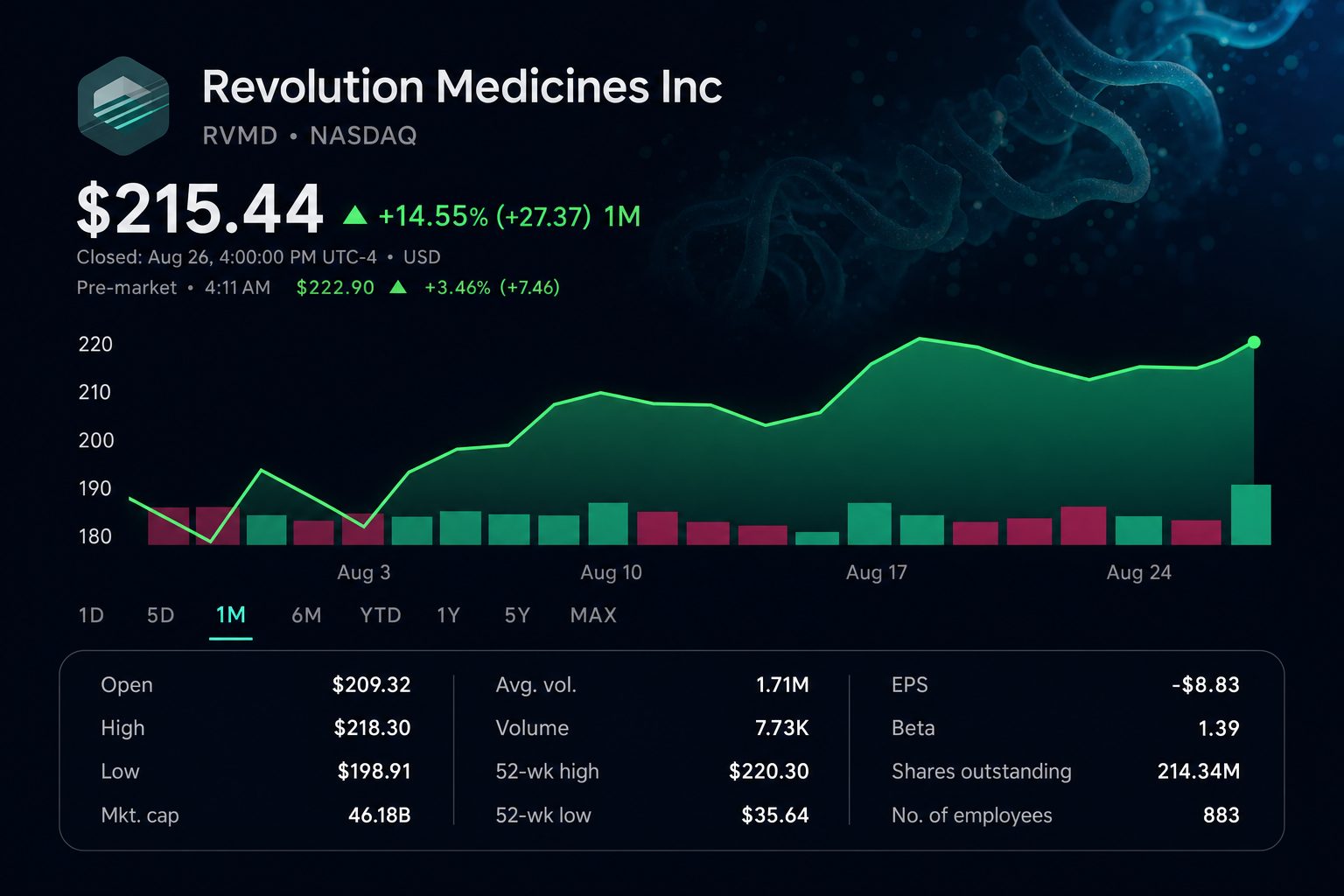
Revolution Medicines (NASDAQ: RVMD) shares finished Wednesday’s session up 1.9% at $215.44. In premarket trading on Thursday at 04:30 EDT, the stock was last seen at $220.46, an increase of 2.3%.
The market reaction to the stock is significant. RVMD jumped over 40% in one day after April trial data increased anticipation of approval. The next challenge for valuation will be gauging actual paid demand, rather than the likelihood of regulatory approval.
RBC Capital Markets projects U.S. sales of $28 million for the third quarter. Sales are forecast to reach $148 million in the fourth quarter and $1.1 billion in 2027. The firm maintained its Outperform rating.
The fourth-quarter forecast represents approximately 3,719 wholesale supply units each month. Prior to factoring in discounts and patient assistance, this equates to around 1,240 units monthly. Over 2,000 patients had previously obtained early access.
Clinical findings back the launch. The FDA has cleared RASONQUE for adults with metastatic pancreatic adenocarcinoma previously treated with other therapies. The approval also includes patients who cannot undergo multiagent treatments.
| RASolute 302 measure | RASONQUE | Standard chemotherapy | Difference |
|---|---|---|---|
| Median overall survival | 13.2 months | 6.7 months | +6.5 months |
| Median progression-free survival | 7.2 months | 3.6 months | +3.6 months |
| Objective response rate | 30% | 11% | +19 percentage points |
| Administration | 300 mg tablet daily | Cytotoxic regimen selected by physician | Pill compared to infused therapy |
The median overall survival was 13.2 months compared to 6.7 months for chemotherapy. The hazard ratio stood at 0.40, indicating a 60% lower risk of death. Progression-free survival doubled as well, reaching 7.2 months.
The label does not mandate use of a companion diagnostic, eliminating a testing step and expanding eligibility to patients with both known and unknown RAS mutations. Pancreatic adenocarcinoma occurs in about 55,000 Americans annually.
RVMD’s market capitalisation of $46.2 billion already prices in significant anticipated sales. This figure stands at roughly 42 times the 2027 RASONQUE projection from RBC. The multiple drops to about four when compared to the company’s long-term worldwide forecast of $11.5 billion.
The company’s balance sheet is sufficient for the rollout. As of June 30, Revolution reported $3.9 billion in cash and investments. Research expenses for the quarter totaled $394.9 million, and general expenses climbed to $110.2 million.
Analysts maintain a positive outlook. According to Public, among those covering RVMD, 19 analysts collectively assign a consensus Buy rating. Of these, 42% designate it as a Strong Buy, and 5% suggest a Hold.
Risks: The rollout relies on insurance coverage, production capacity, patient adoption and tolerability. Cautions cover skin toxicity, diarrhea, gastrointestinal perforation and lung inflammation. Valuation could face pressure if early access conversion is sluggish.
Investors are set to focus on prescription numbers and net pricing. The initial sales report will indicate if clinical demand is translating to reimbursed usage. This data will be more significant than the modest premarket increase seen on Thursday.



![UK Stock Market Today 27/08/2026 [UPDATE: 09:59 BST] [FTSE Loss Deepens to 0.6% as Oil Majors Slide]](https://ts2.tech/wp-content/uploads/2026/08/UK-market-dashboard-2026-08-27-0959-480x384.jpg "UK Stock Market Today 27/08/2026 [UPDATE: 09:59 BST] [FTSE Loss Deepens to 0.6% as Oil Majors Slide]")