
HENDERSON, Nevada, August 27, 2026, 07:30 EDT —
- VolitionRx shares opened at $0.67 on Thursday, marking a 97.5% increase from the previous day’s close.
- Premarket trading saw volume hit 143.86 million shares, roughly 10.5 times the implied shares outstanding.
- The sepsis-biomarker study led to an estimated $4.50 million increase in equity value.
VolitionRx Limited stock surged almost 100% ahead of Thursday’s U.S. market open, following news of clinical validation for its Nu.Q NETs blood biomarker in sepsis. Shares reached $0.67 at 07:30 EDT, marking a gain of 97.49%, with premarket volume at 143.86 million shares premarket data.
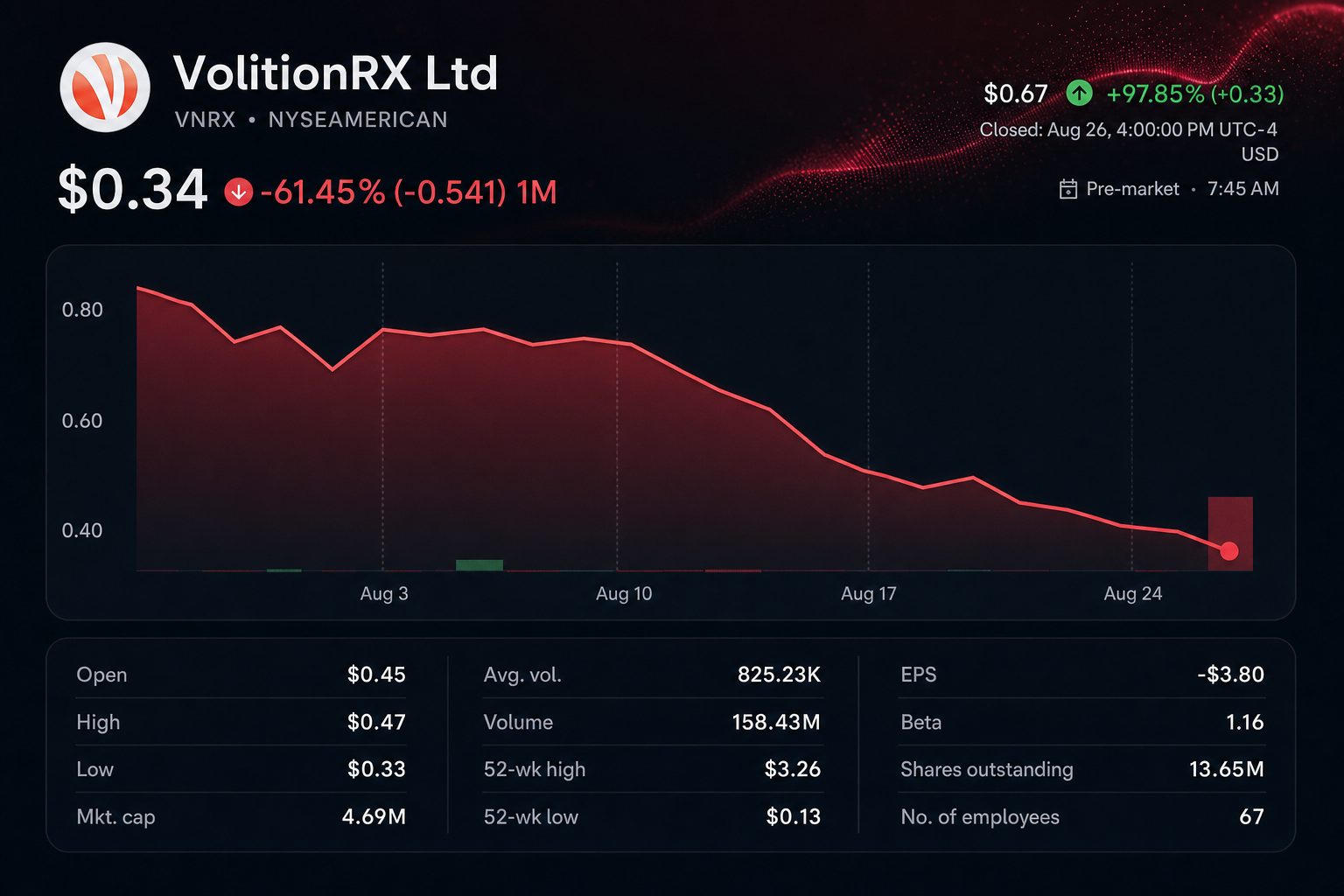
Trading volume stood out more than the price action. In premarket hours, turnover was about 10.5 times Yahoo Finance’s figure of 13.65 million shares outstanding. This level of activity indicates that traders cycled through the small float multiple times ahead of the main session.
VolitionRx Limited (NYSE American:VNRX) added approximately $4.50 million to its equity value. This estimate uses the $0.33 share price rise over the implied number of shares outstanding share statistics.
The gain on paper represents 86.6% of VolitionRx’s $5.2 million in operating cash used during the second quarter. This casts the rally as a shift in perceived commercialization potential rather than a sign of fresh revenue.
| Measure | Latest figure | Investor context |
|---|---|---|
| Premarket price | $0.67 | Rose 97.49% at 07:30 EDT |
| Premarket volume | 143.86 million | About 10.5× shares implied |
| Implied value added | $4.50 million | Equal to 86.6% of Q2 operating cash usage |
| Q2 revenue | About $0.4 million | Roughly unchanged versus a year ago |
| Q2 operating loss | $4.2 million | Decreased 34% from a year earlier |
| Q2 operating cash use | $5.2 million | Decreased 18% from previous year |
| Sepsis opportunity | $2.8 billion | Annual market, according to company |
A peer-reviewed report published in Critical Care Medicine acted as the catalyst. According to VolitionRx, Nu.Q NETs H3.1 independently forecasted 28-day mortality as well as the requirement for renal-replacement therapy in sepsis and septic shock company release and study summary.
Biomarker concentrations increased alongside the severity of acute kidney injury. An editorial published with the study suggested that the assay has potential to pinpoint a group experiencing NET-mediated injury. This differentiation could inform the structure of future trials and choices regarding treatment.
Validation marks an initial phase. The company must still secure licenses, regulatory approvals, and achieve adoption targets before any recurring diagnostic revenue results from the finding. VolitionRx reported it is in active talks regarding commercial and licensing opportunities, but did not reveal contract values.
The estimate for the addressable market comes from the company itself. VolitionRx values the yearly sepsis market opportunity at $2.8 billion. This amount is over 300 times greater than its approximate $9.15 million implied premarket equity value, although it does not represent a projection for sales.
Financing risk remains a key focus on the balance sheet. As of June 30, VolitionRx had $2.79 million in cash and recorded $10.44 million in operational outflows for the first half. Second-quarter funding comprised $1.2 million sourced from its at-the-market facility and $4.1 million from issuing shares and warrants second-quarter results.
Revenue is still limited. Sales doubled, climbing 112% to $1.4 million in the first half. Second-quarter revenue totaled approximately $0.4 million. The operating loss for the quarter reached $4.2 million, exceeding revenue by more than a factor of ten.
Enhanced cost management supported the result. Operating expenses dropped 32% in the second quarter, while the operating loss decreased by 34%. The use of operating cash was 18% lower compared to a year ago.
Careful attention is required when comparing share counts. VolitionRx executed a one-for-20 reverse stock split on April 28 and subsequently issued more equity. As a result, the current implied number of shares is not the same as in previous regulatory documents first-quarter filing.
Risks: The study outcome does not assure clearance, reimbursement, or clinical uptake. Licensing discussions may not lead to significant financial results. Limited premarket liquidity might heighten volatility, and ongoing cash outflows may necessitate additional dilution.
Related articles: Biotechnology