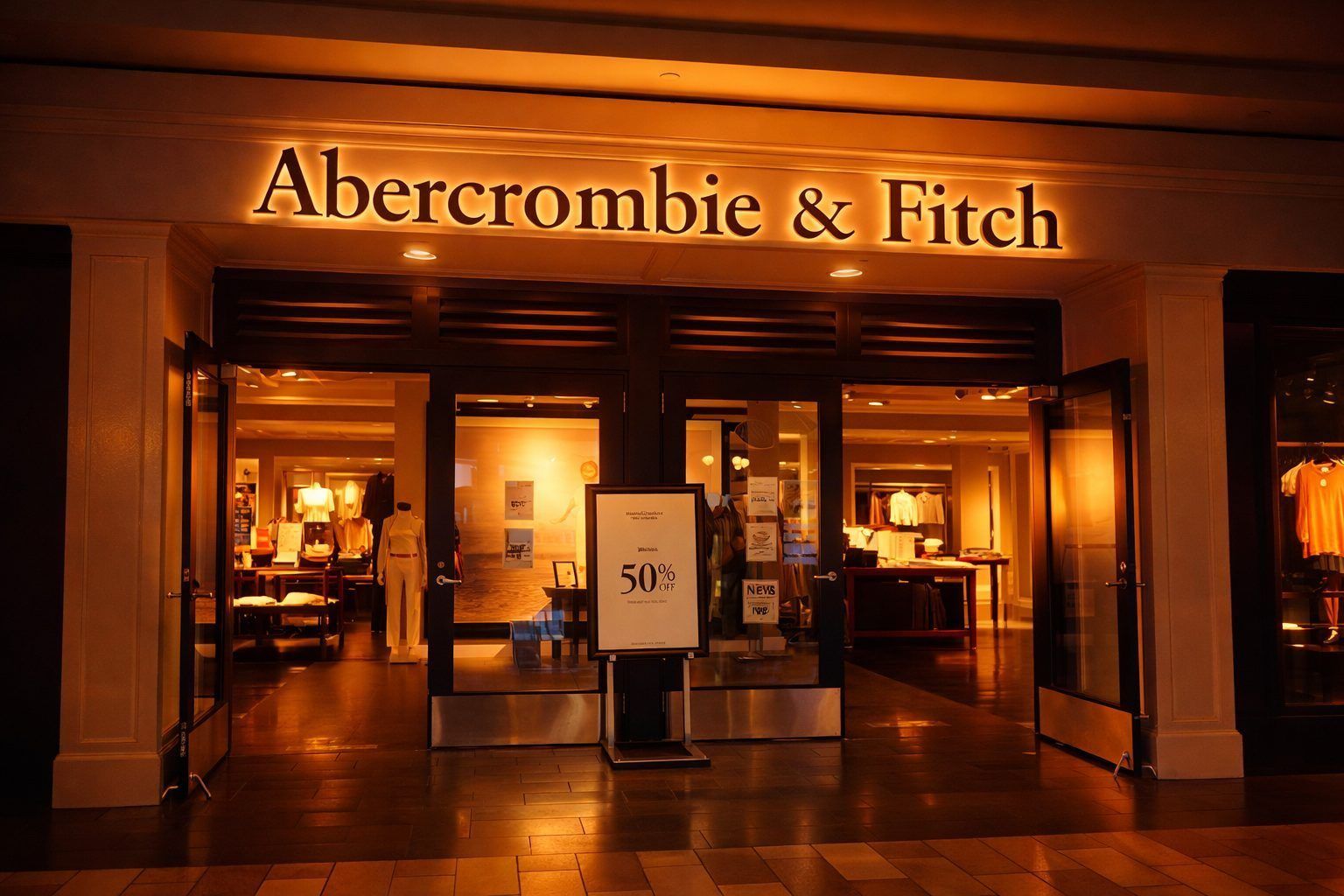
Abercrombie & Fitch Co. (NYSE: ANF) is ending 2025 with the kind of price action that makes both momentum traders and long-term investors squint at the screen and mutter, “Wait… what just happened?”
In the holiday-shortened session on December 24, 2025, ANF finished around $126.78, up about 2.40% on the day, after trading between roughly $122.85 and $128.27 with about 1.07 million shares traded. Investing.com That puts Abercrombie’s equity value in the mid-cap neighborhood, with a market capitalization near $5.81 billion as of the close. StockAnalysis
The broader tape helped: U.S. equities rallied into the Christmas break, with the Dow and S&P 500 closing at record highs in thin holiday trading, according to Reuters. Reuters But ANF’s story is also intensely company-specific: a year of consumer caution, tariff chatter, and brand mix drama… followed by a sharp rebound driven by earnings updates, analyst resets, and the market re-pricing what “normal” looks like for this retailer.
Below is a full, up-to-date (as of 24.12.2025) look at ANF stock news, forecasts, and current analysis, plus what investors are watching heading into 2026.
ANF stock today: Why Abercrombie is showing up on traders’ radars
One of the more telling “today signals” comes from MarketBeat’s December 24 screen: it flagged Abercrombie & Fitch (ANF) as one of the apparel stocks with the highest recent dollar trading volume, alongside names like Nike, Target, lululemon, and TJX. MarketBeat
That kind of inclusion isn’t a fundamental thesis by itself—it’s more like a streetlight revealing where market participants are clustering. High-dollar volume tends to show up when:
- investors are aggressively repositioning after earnings or guidance,
- analyst coverage shifts the narrative,
- options activity pulls the stock around,
- or a chart “level” breaks and triggers systematic buying/selling.
ANF has had a bit of all of the above in the last month.
The biggest December 2025 headline hiding in plain sight: ANF’s one-month face-melter rebound
Zoom out a little and ANF’s late-2025 action becomes… dramatic.
According to Investing.com’s historical data, the stock closed at $65.61 on Nov. 24, 2025, then surged to about $126.78 by Dec. 24, 2025. Investing.com That’s roughly a 93% jump in a month—a near-doubling that doesn’t happen quietly.
This swing also sits inside a wide 52‑week range (Investing.com lists roughly $65.40 to $164.80), underscoring that ANF has been trading like a high-beta consumer name—because it is one. Investing.com
So what actually changed?
The core fundamental catalyst: Hollister strength and a raised outlook
The most important fundamental anchor for the recent repricing is the company’s late-November earnings update.
Reuters reported that Abercrombie & Fitch raised its annual profit forecast after strong third-quarter performance, highlighting demand strength (particularly at Hollister) and pointing to a solid holiday setup. Reuters also noted:
- Net sales rose ~7% to about $1.29 billion for the quarter ended Nov. 1, 2025 (per LSEG data cited by Reuters).
- Adjusted EPS was about $2.36, topping expectations.
- The company guided to Q4 sales growth of 4% to 6% and Q4 profit of $3.40 to $3.70 per share.
- Full-year EPS was expected around $10.20 to $10.50 (a lift vs. prior). Reuters
On the brand mix specifically, MarketWatch described a lopsided picture: Hollister surged while the Abercrombie brand lagged, yet overall results still beat expectations and the stock bounced sharply. MarketWatch
Translation: the company’s “engine” in 2025 looked a lot like Hollister momentum plus disciplined inventory and pricing—enough to offset softness elsewhere and keep the earnings machine running.
The main risk the company itself keeps waving at investors: tariffs and margin pressure
It’s easy to get hypnotized by a one-month rally, but Abercrombie has also been explicit about what can bite margins.
Earlier in 2025, Reuters reported that Abercrombie joined other retailers in forecasting weaker annual sales growth and warned of margin pressure from higher freight costs, more promotions, and a tariff impact (Reuters cited a ~$5 million impact to annual operating margin from tariffs, among other headwinds). Reuters
That same Reuters report also noted a new $1.3 billion stock buyback program announced in 2025 and management’s expectation of significant repurchases. Reuters
So the bull case and bear case are kind of stapled together:
- Bull case: strong merchandising + brand momentum + disciplined inventory + buybacks amplify EPS.
- Bear case: tariffs + promotions + freight + consumer pullback compress margin and put guidance at risk.
This tension is a big reason analyst price targets are spread out.
Corporate news investors are factoring in: CFO promotion disclosed in a December 8‑K
One clean, factual corporate update in the December news flow: a Form 8‑K filing.
In an 8‑K dated with an event on Dec. 11, 2025, the company disclosed it promoted Robert J. Ball from Senior Vice President and CFO to Executive Vice President and CFO, and approved related compensation changes (including a stated base salary and incentive/equity targets). SEC
Why does the market care? Usually not because “someone got promoted.” It matters because:
- it signals continuity and governance stability,
- clarifies compensation incentives (important in a buyback-heavy EPS story),
- and can hint at how the board is thinking about the next phase of execution.
For investors who track management quality in retail (where execution is everything), this kind of filing is part of the mosaic.
Institutional activity headline: one fund disclosed a full exit (but note the timing)
Another widely circulated item in the December news cycle: Kettle Hill Capital Management disclosed it fully exited its ANF position during the third quarter, according to an SEC filing referenced in a Nasdaq-hosted article (originally written for The Motley Fool). Nasdaq
Important nuance: 13F-based stories are backward-looking. They can influence sentiment, but they usually describe positioning as of a prior quarter-end, not what’s happening this week.
Still, these headlines can matter in the short run because they shape the “who is buying/selling this thing?” narrative around a volatile stock.
ANF stock forecast and analyst price targets: “Moderate Buy” ratings, but average targets imply downside
As of Dec. 24, 2025, the consensus picture looks strangely split: analysts are not broadly screaming “sell,” but many average targets sit below the current price after the rally.
Here are the key consensus snapshots:
MarketBeat (12-month analyst view)
MarketBeat shows a “Moderate Buy” consensus rating, based on 12 analyst ratings, split between 6 Buys and 6 Holds. It lists an average price target around $110.10, with estimates ranging roughly from $90 to $130—which implies downside from the late-December price zone. MarketBeat
StockAnalysis (analyst consensus + recent actions)
StockAnalysis lists an analyst consensus of “Buy” and an average target around $111.36 (range $90–$130), also implying a negative one-year move from the Dec. 24 close around $126–$127. StockAnalysis
StockAnalysis also summarizes notable recent actions in December, including:
- Goldman Sachs initiating coverage at Strong Buy with a $120 target (Dec. 11, 2025)
- Jefferies maintaining a strong rating while lifting its target (Dec. 10, 2025)
- several Hold/Neutral stances with lower targets from other banks StockAnalysis
MarketWatch (range shows disagreement)
MarketWatch’s analyst snapshot (as indexed in the search results) lists a wide distribution: high ~$140, median ~$118, low ~$90, and average ~$114. MarketWatch
The “shape” of this matters more than any single number. A wide range typically means the Street can’t agree on one of the following:
- how durable Hollister-driven growth is,
- whether promotions/tariffs normalize or worsen,
- and what multiple ANF deserves after a big run.
Valuation debate: “Overvalued” by one model, “cheap” by another lens
A clean way to summarize today’s valuation argument is: it depends on what you believe about margins and growth durability.
Simply Wall St’s December 19 analysis framed the stock as trading above a modeled fair value (it cited a narrative fair value near $111 and described the shares as about 6.7% overvalued at the time of that write-up). It also highlighted that the stock was trading above some analyst targets, and pointed to tariff headwinds and renewed promotional intensity as pressure points. Simply Wall St
But the same piece also acknowledges why value-oriented investors keep circling back: on an earnings multiple basis, the stock can screen as inexpensive versus parts of specialty retail—suggesting the market may be discounting a future margin reset. Simply Wall St
So the valuation question isn’t really “Is the P/E low?” It’s: is today’s earnings power sustainable? Retail stocks live and die by that question.
Technical and momentum analysis: “stronger relative strength,” but watch for extension risk
For traders and technically minded investors, ANF has also been showing up in relative strength screens.
An Investor’s Business Daily item in mid-December said ANF’s Relative Strength (RS) Rating rose to 81 (crossing the “80+” threshold IBD often highlights for leadership). It also said the stock looked extended after clearing a cited buy point and suggested waiting for a new setup or a pullback to key moving averages. Investors
That matches what the price history shows: when a stock nearly doubles in a month, the next move often depends less on last quarter’s earnings and more on whether new buyers keep stepping in.
What matters next for Abercrombie & Fitch stock in early 2026
Going into 2026, ANF investors are likely to focus on five practical things (not vibes, not nostalgia, not mall memories):
1) Holiday demand proof (and what it cost in promotions)
Management talked up holiday expectations and guided to Q4 sales growth; the market will want to see whether demand came through without sacrificing gross margin. Reuters
2) Hollister’s durability vs. Abercrombie brand stabilization
The late-2025 narrative is that Hollister is doing the heavy lifting. If that growth cools—or if Abercrombie brand weakness persists—investors will re-rate the story quickly. MarketWatch+1
3) Tariffs, sourcing, and freight
Tariffs and supply chain costs were repeatedly flagged as margin risks in 2025. Any change in policy, sourcing costs, or promotional intensity can swing earnings leverage. Reuters
4) Buyback pace and capital allocation discipline
Reuters reported a large buyback authorization and the company has clearly used repurchases as part of the EPS engine. How aggressively management continues to repurchase at higher prices will matter. Reuters
5) Analyst target resets after the December rally
When a stock runs above many published targets, you often get a second wave of commentary: either targets rise to “catch up,” or the Street reiterates caution and the stock needs earnings to do the convincing.
Bottom line on ANF stock as of 24.12.2025
On December 24, 2025, Abercrombie & Fitch stock is trading like a company with two stories stapled together:
- A real operational turnaround (especially brand momentum at Hollister, improved execution, and guidance that beat lowered expectations), and
- A risk-heavy retail setup where tariffs, promotions, and consumer demand can flip the margin math fast.
Analyst consensus ratings lean constructive (Buy/Moderate Buy), but the average price targets from multiple trackers cluster closer to the $110–$115 area—below where ANF closed on Dec. 24—suggesting the rally has moved faster than many forecasts. MarketBeat+2StockAnalysis+2
In other words: the market is currently pricing ANF as if the next phase goes reasonably well. Early 2026 will be about whether results justify that confidence—or whether the stock’s volatility reasserts itself.