
NEW YORK, August 4, 2026, 06:09 EDT — AMC Entertainment NYSE:AMC saw a record-breaking weekend that could account for up to 14% of its quarterly core revenue, according to analysts.
AMC Entertainment Holdings, Inc. NYSE:AMC is estimated to have brought in approximately $206 million from ticket and concession sales during its record five-day streak. The preliminary figure is based on applying second-quarter average spending per customer to 10.2 million visits. The estimate does not include other theatre revenue and does not represent official company guidance.
The figure represents 14.3% of AMC’s admissions and concessions revenue for the second quarter. The activity occurred over five days. Attendance was 2.6 times higher than the average daily rate for the quarter.
Five-day high compared to second-quarter reference point
| Metric | Record five days | Q2 2026 benchmark |
|---|---|---|
| Attendance | 10.2 million | 71.29 million |
| Admissions and food sales per patron | $20.19 | $20.19 |
| Admissions and food sales | $205.9 million | $1.439 billion |
| Share of Q2 core revenue | 14.3% | 100% |
| Attendance compared to Q2 five-day rate | 2.6 times | 1.0 time |
Initial reporter estimates are based on AMC’s combined attendance and revenue figures for the second quarter. Real weekend spending could vary.
AMC did not release a revenue number for the weekend, but said records were broken for total revenue, admissions, and food-and-beverage. “Spider-Man: Brand New Day” grossed $360 million domestically and $932 million globally. Rentrak’s Paul Dergarabedian described the weekend lineup as the “all-time biggest domestic weekend.” AMC Entertainment Holdings, Inc.
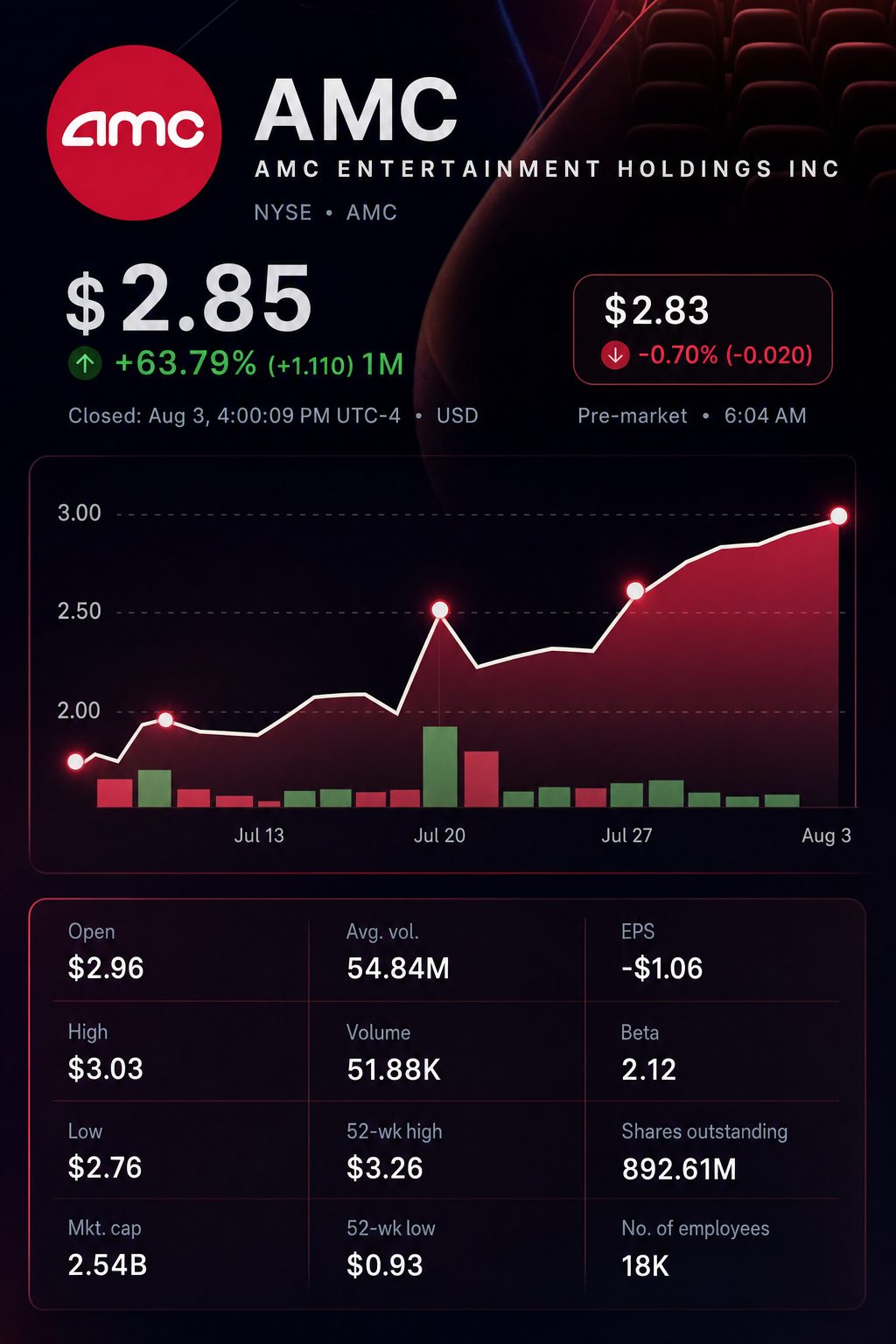
U.S. regular trading had ended when this was published. Premarket trading remained active. AMC last traded flat at $2.85 in after-hours action. The stock climbed 1.1% on Monday, marking its sixth consecutive session of gains. Between July 24 and July 31, shares increased by 24.2%.
Monday performance compared to key peers
| Company | Close | Daily move | Approximate equity value |
|---|---|---|---|
| AMC Entertainment Holdings, Inc. NYSE:AMC | $2.85 | up 1.1% | $2.54 billion |
| Cinemark Holdings, Inc. NYSE:CNK | $37.87 | up 3.5% | $8.82 billion |
| IMAX Corporation NYSE:IMAX | $51.00 | up 6.6% | $2.89 billion |
| The Marcus Corporation NYSE:MCS | $30.69 | up 5.5% | $0.95 billion |
AMC’s market capitalization is based on its most recently disclosed 892.6 million shares outstanding. Values for peers reflect current market data.
AMC’s increase lagged each of its three peers. This is notable after the industry achieved a record. However, the stock started Monday having climbed for five straight sessions. A significant part of the short-term rebound had already been factored in.
Operating leverage proved significant in the second quarter, with revenue up 14.2% and adjusted EBITDA up 69.6%. Operating cash flow rose by 70.1%. Chief Executive Adam Aron stated the quarter demonstrated “the inherent operating leverage in our business model.” SEC
Operating results for the second quarter
| Metric | Q2 2026 | Q2 2025 | Change |
|---|---|---|---|
| Revenue | $1.597 billion | $1.398 billion | +14.2% |
| Attendance | 71.29 million | 62.81 million | +13.5% |
| Adjusted EBITDA | $321.4 million | $189.5 million | +69.6% |
| Adjusted EBITDA margin | 20.1% | 13.6% | +6.5 points |
| Operating cash flow | $235.4 million | $138.4 million | +70.1% |
| Free cash flow | $190.1 million | $88.9 million | +113.8% |
| GAAP net loss | $11.4 million | $4.7 million | Loss increased |
AMC uses free cash flow as a non-GAAP metric.
Despite improved operational results, a GAAP loss was reported. Interest expenses for the quarter totaled $136 million, comprising 42.3% of adjusted EBITDA. Much of the operating profit was offset by these financing costs.
The basis for valuation has shifted, too. By July 22, AMC had 892.6 million shares in circulation. The company’s diluted average share count for the second quarter stood at 722.0 million. With Monday’s closing price, the equity value comes to $2.54 billion based on the most recent share total, or $2.06 billion if calculated with the quarterly average.
Assessment of capital structure and potential dilution
| Measure | Latest figure | Comparison or calculation |
|---|---|---|
| Shares outstanding | 892.6 million | 23.6% higher than Q2 average |
| Q2 diluted average shares | 722.0 million | 66.7% greater than Q2 2025 |
| Equity value at $2.85 | $2.54 billion | $2.06 billion with Q2 average |
| Debt principal | $3.914 billion | 1.54x equity value |
| Cash and equivalents | $778.4 million | Net debt about $3.136 billion |
| Unissued, unreserved authorized shares | 168.3 million | 18.9% of shares outstanding |
| First-half adjusted EBITDA | $359.7 million | Interest costs were 76.7% of EBITDA |
Reporter figures for equity value, net debt, and percentages.
Debt continues to be the major limiting factor. Interest expense in the first half amounted to 76.7% of adjusted EBITDA. AMC still holds authorization for 168.3 million more shares that have not yet been issued or reserved. That represents nearly 20% of the existing share count.
Industry figures are still uneven. Domestic box-office revenue is 10% higher than levels seen in 2025, yet remains 16% under 2019 figures. The record-setting weekend has boosted immediate theatre throughput, but it has not demonstrated a complete rebound in attendance.
AMC has not scheduled any investor events for the upcoming week. The main focus remains on the film’s performance during its second weekend. Select IMAX theaters in North America will start showing “Spider-Man” on Thursday, August 6, with “The Odyssey” also featured on the same screens. AMC Entertainment Holdings, Inc.
Risks are still focused. The initial estimate is based on stable second-quarter spending in all markets. Real ticket rates, demand for premium formats, and concession sales may vary. Significant declines in attendance, high interest costs, or more issuance could counteract record visitor numbers.
The attendance data sends a clear signal to investors. Valuation standards are tighter. To keep up, record levels of traffic need to cut debt more quickly than shares increase.
Related articles: NYSE:AMC