Updated: December 1, 2025
Aon plc stock snapshot as of December 1, 2025
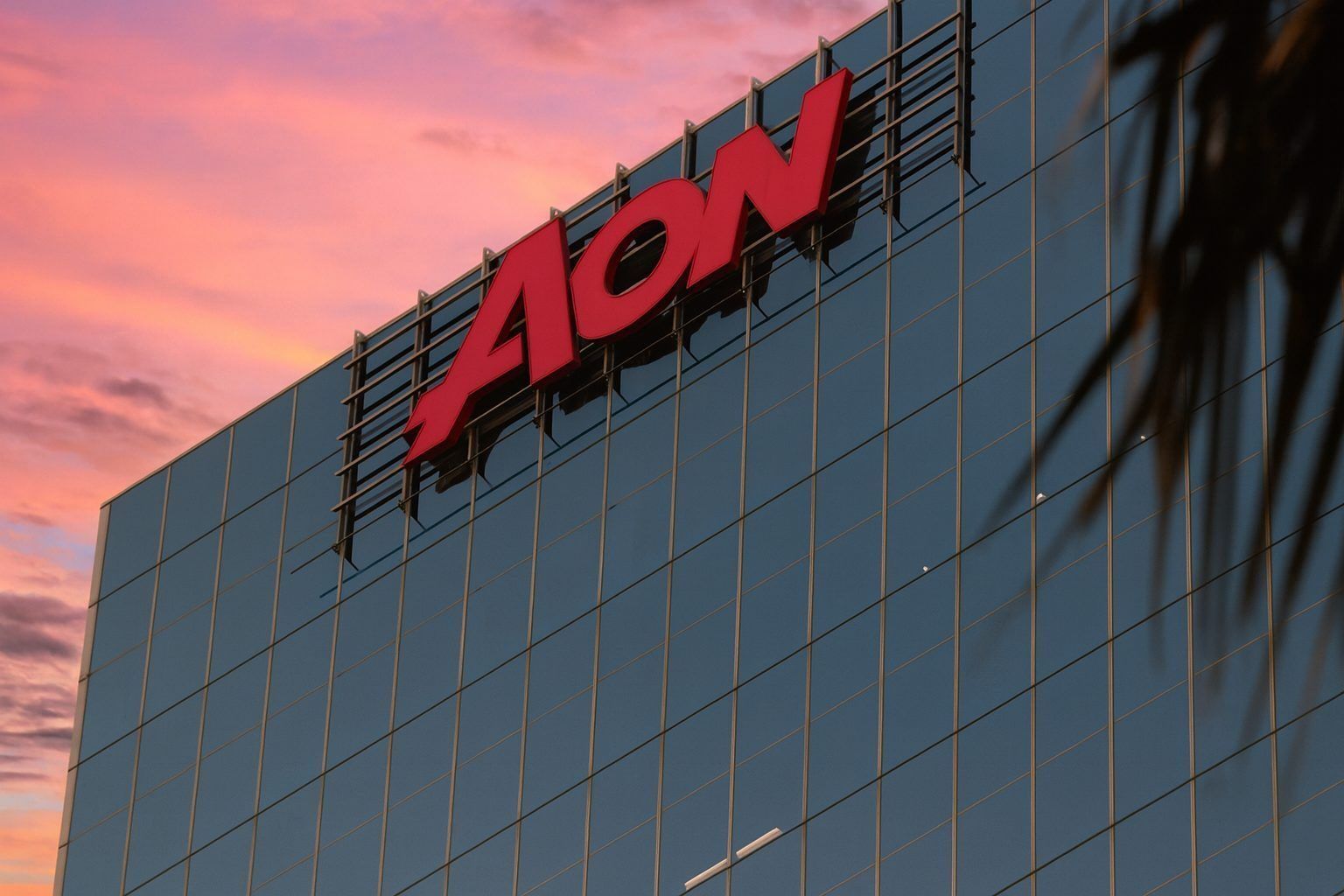
Aon plc (NYSE: AON), the global insurance and professional services broker, is trading in the middle of its 12‑month range after a busy 2025 marked by a major divestiture, solid earnings growth and continuing share buybacks.
- Share price: around $351 per share in New York trading on December 1, 2025, down roughly 0.7% on the day. MarketBeat
- Market capitalization: about $75–76 billion. MarketBeat+1
- 12‑month range: roughly $324 to $413 per share. MarketBeat
- Valuation: trailing P/E around 28–30 and forward P/E near 18, implying investors still pay a premium for Aon’s earnings stream versus the broader market. MarketBeat+1
- Performance: approximately ‑4% year‑to‑date and about ‑9% over the past year, despite improving fundamentals. Benzinga
- Dividend yield: around 0.8–0.9%, based on a quarterly dividend of $0.745 per share (annualized ~$2.98). Aon Investor Relations+1
Institutional investors continue to dominate the shareholder base: recent filings show institutions holding well over 80% of the float, with one example being Ceredex Value Advisors lifting its stake to more than 136,000 shares in recent months. MarketBeat
Q3 2025 earnings: A steady beat driven by risk management demand
Aon’s latest earnings report on October 31, 2025 set the tone for the stock heading into year‑end.
According to the company’s Q3 2025 release, total revenue increased 7% to about $4.0 billion, driven by broad‑based growth across both risk and human capital businesses. Organic revenue growth also came in at 7%, with currency providing a modest tailwind and acquisitions/divestitures a small headwind. Aon plc Global Media Relations
Key Q3 highlights:
- Risk Capital revenue (Commercial Risk + Reinsurance) rose around 7% to $2.5 billion.
- Human Capital revenue (Health + Wealth Solutions) grew roughly 8% to $1.5 billion. Aon plc Global Media Relations
- Adjusted net income attributable to shareholders climbed about 11% to $660 million, with adjusted EPS up 12% to $3.05 versus $2.72 a year earlier. Aon plc Global Media Relations+1
- Net income under GAAP rose 34%, reflecting operating leverage and lower one‑off costs related to prior transactions. Aon plc Global Media Relations
A Reuters summary noted that Aon beat Wall Street’s profit expectations as businesses continued to prioritize sophisticated risk‑management solutions despite macro uncertainty. Commercial Risk Solutions revenue grew about 7% to nearly $2.0 billion, with health and wealth segments also contributing to the top line. Reuters
On costs, operating expenses increased only 3% year‑on‑year to around $3.2 billion, significantly slower than revenue growth, helping push operating income higher and supporting margin expansion. Management also highlighted the ongoing benefits of its “Aon United” strategy and restructuring savings. Aon plc Global Media Relations+1
Cash flow and buybacks
Aon continues to translate earnings into strong cash generation:
- Operating cash flow for the first nine months of 2025 rose 14% to about $2.1 billion.
- Free cash flow increased 13% to roughly $1.9 billion over the same period. Aon plc Global Media Relations
Capital returns remain aggressive:
- In Q3, Aon repurchased roughly 0.7 million shares for about $250 million, leaving $1.6 billion of authorization remaining at September 30. Aon plc Global Media Relations
- A separate risk disclosure highlighted that the company bought back about 690,000 shares at an average price of $362 during the quarter and that the broader program has authorization of around $27.5 billion, raising questions about liquidity and balance‑sheet flexibility if conditions worsen. TipRanks
This combination of rising free cash flow and aggressive buybacks is central to the bull case on AON, but it is also one of the key financial risk factors investors need to weigh.
Strategic pivot: $2.7 billion NFP wealth sale refocuses the portfolio
One of 2025’s defining events for Aon is its decision to sell most of the wealth management businesses it gained through the NFP acquisition.
On September 3, 2025, Aon announced a definitive agreement to sell a significant majority of NFP’s wealth business – including Wealthspire Advisors, Fiducient Advisors, Newport Private Wealth and related platforms – to Madison Dearborn Partners for an estimated $2.7 billion. Expected after‑tax cash proceeds are about $2.2 billion, with closing targeted for late Q4 2025, subject to regulatory approvals. PR Newswire+1
Media coverage from Reuters and the Financial Times framed the divestiture as part of a broader move to sharpen Aon’s focus on core insurance brokerage and advisory operations, while redeploying capital into higher‑priority areas such as AI, risk analytics and institutional wealth consulting (which Aon is keeping). Reuters+1
From a stock‑holder’s perspective, this deal has several implications:
- Simpler business mix: Aon becomes more concentrated in businesses where it already enjoys scale and brand strength – commercial risk, reinsurance and corporate human capital solutions.
- Balance‑sheet optionality: Net cash proceeds give management flexibility to pay down debt, fund more buybacks or invest in technology and data capabilities.
- Earnings mix shift: NFP’s wealth operations contributed a relatively small share of group EBITDA (about $127 million on a trailing twelve‑month basis), so the sale may be only modestly dilutive to earnings but accretive to returns if the proceeds are deployed efficiently. PR Newswire+1
Investors will be watching year‑end disclosures and 2026 guidance closely to see exactly how Aon allocates the cash windfall and what the pro‑forma earnings profile looks like after the divestiture.
Dividends, leverage and S&P’s outlook
Aon is also returning cash through a steadily rising dividend. The company’s 2025 dividend schedule shows:
- Q1 2025: $0.675 per share
- Q2, Q3, Q4 2025: $0.745 per share each Aon Investor Relations
Based on the latest quarterly payout of $0.745, the annualized dividend is about $2.98 per share, implying a yield near 0.8–0.9% at the current share price. Data from Koyfin indicates Aon has raised its dividend for 14 consecutive years, underscoring management’s commitment to returning capital. Koyfin
On the flip side, Aon runs with meaningful leverage. Recent metrics show:
- Debt‑to‑equity ratio around 1.9x
- Beta of about 0.86, indicating less volatility than the broader equity market MarketBeat
A recent S&P Global Ratings research update in mid‑November 2025 revised Aon’s outlook to “stable” and laid out expectations for capital deployment: dividends of roughly $600–700 million through 2026, acquisition spending of $300–400 million in 2025 and $500 million–1.5 billion in 2026. SP Global
Combined with the large buyback authorization, these figures suggest Aon is walking a tightrope between shareholder returns and balance‑sheet strength. Ratings agencies appear comfortable for now, but prolonged macro stress or aggressive additional buybacks could test that stance.
What Wall Street thinks: Analyst ratings and 12‑month price targets
Despite the stock’s underwhelming recent performance, analysts are generally positive on Aon heading into 2026.
Consensus from MarketBeat
MarketBeat’s aggregation of 18 Wall Street analysts over the past 12 months shows: MarketBeat
- Consensus rating: Moderate Buy
- Breakdown: 12 Buy, 5 Hold, 1 Strong Buy, 0 Sell
- Average 12‑month price target:$416.56
- Target range:$379 (low) to $448 (high)
- Implied upside: about 18–19% from the current ~$351 share price
Recent research actions include both upgrades and target cuts – Barclays, for example, trimmed its target from $420 to $379 and now rates the stock “Equal Weight,” while others such as TD Cowen and Citigroup maintain Buy‑level ratings with targets in the low $400s. MarketBeat+1
A MarketBeat news piece also highlights that institutional ownership sits above 86%, with multiple asset managers modestly increasing positions, and that analysts expect FY 2025 EPS around $17.2. MarketBeat
Other consensus snapshots
Different data providers show small variations but tell the same basic story:
- Benzinga reports a consensus Buy rating with an average target near $391, with the most bullish analyst at $448 and the most cautious around $309. Benzinga
- Public.com compiles 13 analyst ratings, showing 31% Strong Buy, 46% Buy and 23% Hold, none rating the stock a Sell. Its average target sits around $414.62. Public
- TipRanks cites an average price target near $419, implying just over 23% upside from recent levels. TipRanks
Taken together, Wall Street sees moderate upside over the next year, with price targets broadly clustered in the high‑$300s to mid‑$400s.
Quant models and long‑term price projections
For investors interested in longer‑dated scenarios, Benzinga’s recent deep‑dive brings in algorithmic forecasts from CoinCodex. Benzinga
Their indicative range of projections suggests:
- 2025: average modeled price around $353, with “bull” and “bear” cases roughly in the mid‑$340s to low‑$360s.
- 2026: wider channel, with bullish scenarios above $400 and bearish ones closer to $300.
- 2030: average forecast near $419, with bull‑case scenarios approaching $490+ and bear cases in the mid‑$360s.
These models are based on historical price behavior and volatility rather than detailed fundamental analysis. Benzinga explicitly cautions that such outputs should be treated as illustrative, not as precise forecasts or recommendations. Benzinga
In plain language: most systematic models and human analysts expect gradual appreciation rather than explosive growth, assuming Aon continues to deliver mid‑single‑digit organic revenue growth and uses buybacks to compound EPS.
Bull case: Why some investors like Aon here
The bullish thesis around AON in late 2025 generally rests on five pillars, echoed across analyst notes and independent research: Benzinga+1
- Structural demand for risk management
Geopolitical volatility, cyber threats, climate risk and complex supply chains are all pushing clients toward more sophisticated risk and insurance solutions, which plays directly to Aon’s strengths in Commercial Risk and Reinsurance. - High‑margin advisory and analytics
A growing portion of revenue comes from fee‑based advisory and data‑driven services, which can be more stable and higher margin than traditional commission‑based brokerage. - Consistent organic growth and pricing power
Q3’s 7% organic revenue growth shows that Aon can grow faster than GDP even in a choppy economic backdrop, helped by modest rate increases in certain lines and cross‑selling across its global client base. Aon plc Global Media Relations+1 - Capital return engine
Strong free cash flow, ongoing buybacks and a rising dividend create a shareholder‑friendly capital allocation story. Over time, reducing the share count can materially lift EPS and offset modest topline growth. Aon plc Global Media Relations+1 - Portfolio simplification and focus
The NFP wealth divestiture and other portfolio moves are seen as sharpening Aon’s focus on its highest‑return businesses, which could support higher margins and more predictable earnings over the medium term. PR Newswire+1
Bear case: Key risks and challenges
The more cautious camp focuses on a different set of issues, several of which were highlighted in Benzinga’s bear‑case discussion and TipRanks’ risk disclosure. Benzinga+1
- Leverage and aggressive buybacks
Aon’s relatively high debt load, combined with large ongoing share repurchases, may limit flexibility in a downturn and increase sensitivity to higher interest rates. - Competitive and cyclical pressures
The global insurance brokerage market is intensely competitive. If insurance pricing softens in key lines (property, cyber, D&O), brokerage fee growth could slow. Analysts also point to weaker conditions in sectors like financial services and private equity, which can weigh on new business. Public+1 - Macro and FX headwinds
Aon is heavily exposed to global economic trends and foreign exchange swings. Slower economic growth or continued FX volatility can drag reported results, even if underlying client relationships remain intact. Benzinga - Execution risk around portfolio changes
Frequent acquisitions and divestitures – including the buy‑and‑sell sequence around NFP – carry the risk of integration hiccups, culture clashes and distraction. There is also the question of whether Aon is selling attractive long‑term assets too early or at the right valuation. PR Newswire+1 - Regulatory and legal risk
As one of the largest global brokers, Aon is always exposed to regulatory scrutiny and potential litigation, especially around complex risk transfer structures and pension/benefits consulting.
Near‑term catalysts to watch
Heading into 2026, a few events and milestones are likely to shape the next leg of AON’s share‑price story:
- Goldman Sachs U.S. Financial Services Conference – December 10, 2025
CFO Edmund Reese is scheduled to present, offering fresh commentary on capital allocation, the NFP divestiture and 2026 outlook. A live webcast will be available on Aon’s investor website. Stock Titan+1 - Closing of the NFP wealth sale (expected late Q4 2025)
Investors will want clarity on net proceeds, debt paydown vs. buybacks, and the impact on run‑rate earnings. - Q4 2025 and full‑year guidance
Management has reiterated confidence in its 2025 financial targets and in “sustainable growth in 2026 and beyond.” The next earnings release will show whether that confidence holds up against macro and industry headwinds. Reuters - Any rating actions or updated views from agencies and banks
Given the scale of the buyback program and portfolio reshaping, future commentary from S&P, Moody’s or leading brokers on leverage and risk will be closely watched. SP Global+1
Bottom line: How Aon plc looks going into 2026
Putting it all together, Aon enters 2026 with:
- Solid operating momentum, demonstrated by 7% organic growth and double‑digit EPS gains in Q3. Aon plc Global Media Relations+1
- A cleaner, more focused business mix, following the sale of most of the NFP wealth unit. PR Newswire+1
- A shareholder‑friendly but assertive capital allocation policy, combining rising dividends, substantial buybacks and active M&A. Aon plc Global Media Relations+2Aon Invest…
- Moderate upside implied by consensus 12‑month price targets in the low‑ to mid‑$400s. Benzinga+3MarketBeat+3TipRanks+3
At the same time, investors must weigh:
- Higher leverage and the financial risk of heavy buybacks,
- Exposure to cyclical insurance pricing and macro conditions, and
- Execution risk around ongoing portfolio reshaping and technology investment. TipRanks+2Benzinga+2
For long‑term, fundamentally oriented investors, Aon remains a quality franchise with durable competitive advantages, but likely one where returns will be driven as much by disciplined capital allocation as by topline growth.
As always, this article is for informational and educational purposes only and does not constitute investment advice, an offer, or a recommendation to buy or sell any security. Before making any investment decision, consider your own financial situation, objectives and risk tolerance, and consult a qualified financial adviser if needed.