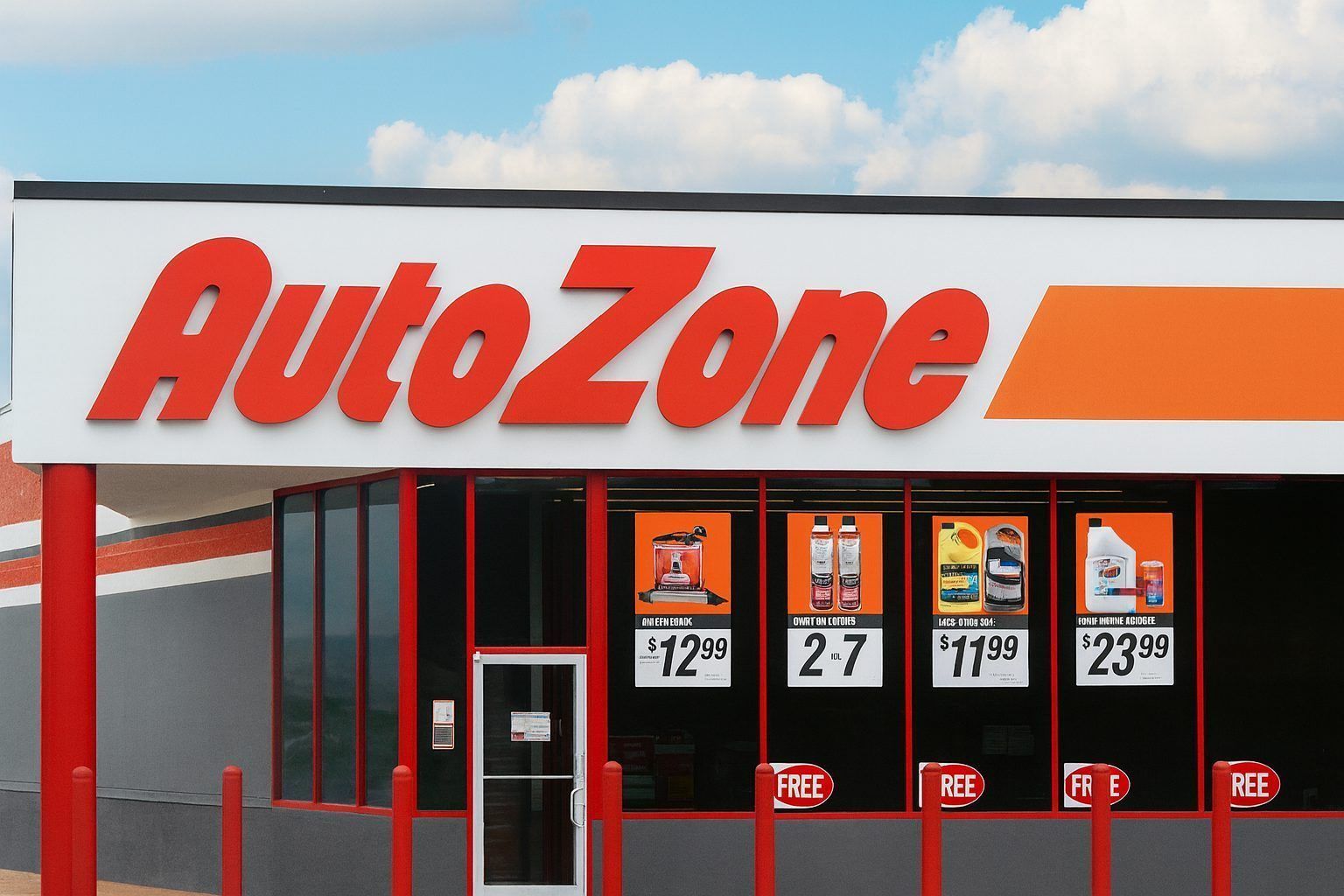
AutoZone, Inc. (NYSE: AZO) delivered a sharp shock to investors on Tuesday, December 9, 2025. After reporting fiscal first‑quarter results that missed Wall Street expectations on both earnings and same‑store sales, the stock tumbled about 7% and briefly became the worst‑performing name in the S&P 500 for the day. Barron’s+1
As traders digest the numbers and the macro backdrop ahead of Wednesday’s U.S. Federal Reserve decision, here’s a structured look at what happened after the bell on December 9 and what matters most before the market opens on December 10.
1. How AutoZone Stock Traded on December 9
By the closing bell on Tuesday:
- Closing price: AutoZone finished at $3,496.77, down 7.17% from Monday’s close of $3,766.96. StockAnalysis
- Intraday range: Shares opened at $3,694.89, traded as high as $3,720.63 and fell as low as $3,460.23, underscoring a volatile session following the earnings release. StockAnalysis
- Volume: Roughly 379,000 shares changed hands, well above typical daily volume, signaling strong institutional participation in the sell‑off. StockAnalysis
- After‑hours: Trading after the close was muted; by about 5:45 p.m. ET, the last reported after‑hours trade was effectively unchanged from the regular-session close at $3,496.77. Yahoo Finance
Earlier in the day, Barron’s noted AutoZone as the worst performer in the S&P 500, highlighting that the single‑day drop was the steepest for the stock since 2022. Barron’s
Despite Tuesday’s slump, AutoZone is still up around 9% year‑to‑date, but now trades nearly 19% below its 52‑week high of about $4,355 set in September 2025. StockStory
2. Inside AutoZone’s Fiscal Q1 2026 Earnings
AutoZone’s quarter ended November 22, 2025, and results were released before Tuesday’s opening bell, followed by a conference call at 10:00 a.m. ET. AutoZone+1
Headline numbers
- Net sales:
- $4.6 billion, up 8.2% year‑over‑year, slightly below the roughly $4.64 billion consensus estimate. Financial Modeling Prep+1
- Earnings per share (EPS):
- $31.04, down from $32.52 a year ago and missing analyst expectations of about $32.2–$32.4 per share (roughly a 3.7% EPS miss). Financial Modeling Prep+2StockStory+2
From a top‑line standpoint, this was a solid growth quarter; from an expectations standpoint, it was a mild but visible miss.
Same‑store sales and footprint
Same‑store sales are the heart of any retail story, and AutoZone’s performance was mixed versus expectations: Quiver Quantitative+2Finviz+2
- Total same‑store sales (reported): +5.5% vs ~5.7% expected
- Total same‑store sales (constant currency): +4.7% vs 5.6% expected
- Domestic same‑store sales: +4.8% vs 4.9% expected
- International same‑store sales: +11.2% vs 9% expected
On the growth side, the company continued an aggressive expansion strategy:
- Net new stores:53 this quarter (39 in the U.S., 12 in Mexico, 2 in Brazil) Fox Business+1
- Total stores:7,710 globally, including 6,666 in the U.S. Quiver Quantitative+1
That store growth, combined with mid‑single‑digit comps, explains the strong revenue increase, even if it fell just shy of the Street’s models.
Margin pressure and LIFO impact
The sell‑off is less about sales growth and more about profitability:
- Gross margin fell about 203 basis points (2.03 percentage points) to 51.0%, with management and multiple analyses flagging a non‑cash LIFO inventory accounting impact of ~212 basis points as the main driver. Quiver Quantitative+1
- Operating expenses rose to 34.0% of sales, up from 33.3% a year earlier, reflecting wage, technology and growth investments. Quiver Quantitative
- Operating profit declined 6.8% to about $784 million; net income fell to $530.8 million from $564.9 million in the prior year’s quarter. Quiver Quantitative
In short: AutoZone is still growing quickly but is giving back some margin as it deals with inflation, tariffs, and internal investment spending.
3. Why the Market Reacted So Harshly
On paper, the miss looks small. So why the ~7% drop?
1. Another earnings miss in a high‑expectation stock
Barron’s pointed out that this quarter marked roughly the sixth straight earnings miss for AutoZone, even as same‑store sales growth has accelerated over that stretch. Barron’s
When investors pay a premium multiple, even a modest miss can trigger a “valuation reset,” especially after a strong run. Heading into Tuesday, the stock had gained double digits year‑to‑date and was trading relatively close to a rich 52‑week high. StockAnalysis+1
2. Margin compression is harder to ignore
Multiple analyses emphasized that:
- Gross margin was hit not just by pricing, but by LIFO accounting effects,
- Operating margin slipped from roughly 19–20% to the high‑16% range,
- Expenses are climbing as AutoZone invests in people, infrastructure and international growth. Quiver Quantitative+2Financial Modeling Pr…
That combination makes investors ask whether this margin profile is the “new normal” or just a passing phase of investment and macro noise.
3. Tariffs and cost inflation in the background
Several commentaries referenced tariff‑related cost pressure and higher selling, general and administrative (SG&A) expenses as ongoing headwinds, particularly for imported parts and inventory. StockStory+1
In a world where the Fed is still wrestling with inflation and politicians are happy to tinker with trade policy, leveraged, inventory‑heavy retailers tend to make investors nervous.
4. Sector‑wide sympathy selling
AutoZone wasn’t alone. O’Reilly Automotive and Advance Auto Parts also traded lower on Tuesday as the market repriced the whole auto‑parts group after AutoZone’s results. Barron’s+1
When the sector leader stumbles, exchange‑traded fund flows and quant models often amplify the move across peers — and then circle back to the leader again.
4. What the Street Is Saying: Ratings, Targets and Fresh Takes
Consensus still skews bullish
Despite Tuesday’s shock, analyst consensus remains broadly positive:
- According to StockAnalysis, 21 analysts currently rate AZO a “Strong Buy”, with an average 12‑month price target around $4,503, implying nearly 29% upside from Tuesday’s close. StockAnalysis
Pre‑earnings, several high‑profile analysts had already refreshed their views:
- Goldman Sachs upgraded AutoZone from Neutral to Buy on December 5, 2025, with a price target of $4,262.
- BMO Capital has an Outperform rating and a $4,600 target.
- Raymond James maintains Strong Buy at $4,800, while Morgan Stanley remains Overweight with a $4,700 target. Benzinga
On the other hand, Zacks currently assigns AZO a Rank #3 (Hold), reflecting an expectation that the stock may perform in line with the broader market in the near term after a -3.7% earnings surprise on EPS and a small revenue miss. Finviz+1
Fundamental and valuation takes
- Financial Modeling Prep highlights that AutoZone now trades at a trailing P/E near the mid‑20s, with a price‑to‑sales ratio a little above 3x and a heavily negative debt‑to‑equity ratio reflecting the company’s long history of buybacks. Financial Modeling Prep
- Seeking Alpha commentary frames AutoZone as a “defensive, all‑weather compounder” and argues that around $3,500 per share, the stock trades at roughly 24x forward earnings and ~17x EV/EBITDA, which the author views as an attractive re‑entry point despite short‑term margin pressure. Seeking Alpha+1
These are, of course, third‑party opinions — but they help explain why some institutional investors may treat sharp drawdowns in a long‑term compounder as an opportunity rather than a red flag.
5. Technical Picture: Support, Breakdown and the Bearish Scenario
While fundamental analysts debate margins and growth, technical traders are watching the chart:
- A recent technical analysis from Verified Investing argues that AZO’s price action has completed a “head‑and‑shoulders” topping pattern, with the stock breaking below key support around the mid‑$3,400s and potentially targeting the $2,600 area if the pattern fully plays out. Verified Investing
From a pure price‑action perspective:
- Tuesday’s low near $3,460 marks an important short‑term support area; a clear break and sustained trade below that zone would reinforce the bearish technical case. StockAnalysis
- The stock is now significantly below its recent highs, and any bounce will have to contend with overhead resistance from prior consolidation in the $3,700–$3,900 range. StockAnalysis+1
Technical patterns are probabilistic, not prophetic — but they feed directly into how short‑term traders position ahead of the next session.
6. Macro Backdrop Before the December 10 Open
AutoZone doesn’t trade in a vacuum. The macro environment going into Wednesday’s open is unusually dense:
- U.S. equity indices closed mixed on Tuesday: the Dow fell about 0.4%, the S&P 500 slipped roughly 0.1%, while the Nasdaq added around 0.1%; small caps outperformed with the Russell 2000 hitting a new high. Investopedia+1
- The 10‑year U.S. Treasury yield climbed to roughly 4.19%, reflecting ongoing tension between growth hopes and inflation risk. Investopedia+1
- Bitcoin traded near $93,000, gold remained elevated, and crude oil slipped toward the high‑$50s per barrel. Investopedia+1
Most importantly for Wednesday:
- The Federal Reserve concludes its final policy meeting of 2025 on December 10, with markets pricing an ~87% probability of a 25‑basis‑point rate cut to a 3.5–3.75% federal funds target range. Investopedia+1
- Reporting from the Wall Street Journal and others highlights an unusually divided Fed, with a sizeable bloc of officials skeptical about further easing, even as the labor market cools. The Wall Street Journal
- Separately, White House economic adviser Kevin Hassett — floated as a possible future Fed chair — has argued there is “plenty of room” to cut rates further, adding another layer of political noise around monetary policy. Reuters
In addition, international economic calendars point to key November inflation data (CPI and PPI) landing mid‑week, events that can jolt bond yields and consumer‑facing stocks alike. Rio Times
For a retailer like AutoZone, interest rates matter: they shape discount rates used by analysts, financing costs for buybacks, and the broader health of discretionary consumer spending.
7. Key Things to Watch Before the December 10, 2025 Open
Going into Wednesday’s session, here are the main lenses through which traders and longer‑term investors are likely to view AutoZone:
- Pre‑market price and liquidity
- Does AZO continue to see heavy selling in pre‑market trading, or does liquidity dry up and the stock stabilize near Tuesday’s close? High pre‑market volume skewed to the downside would signal that institutions are still exiting.
- Follow‑through on Tuesday’s low
- The $3,460–$3,500 zone is now short‑term support. A gap down through that range at the open could accelerate technical selling, while a flat or slightly higher open would hint that the worst of the knee‑jerk reaction may be over. StockAnalysis+1
- Fresh analyst revisions and commentary
- Watch for updated price targets, rating changes, and estimate revisions published overnight and early Wednesday. Given the pre‑existing bullish tilt — and the mildness of the miss — the key question is whether analysts frame this as a blip or as the start of a structurally lower margin profile. StockAnalysis+2Benzinga+2
- Takeaways from the earnings call
- Notes and transcripts from Tuesday’s call (including commentary on tariffs, wage inflation, international growth and the LIFO impact) will continue to circulate. Expect investors to focus on:
- How management characterizes margin pressure — transitory vs structural
- The pace and scale of future share repurchases
- The strategy behind continued store expansion given macro uncertainty Quiver Quantitative+2Finviz+2
- Notes and transcripts from Tuesday’s call (including commentary on tariffs, wage inflation, international growth and the LIFO impact) will continue to circulate. Expect investors to focus on:
- Sector reaction: O’Reilly and Advance Auto Parts
- AutoZone’s peers often trade as a group. A rebound in O’Reilly Automotive and Advance Auto Parts could ease pressure on AZO, while continued weakness across the category could signal a broader derating of auto‑parts retailers. Barron’s+1
- Macro headlines: Fed and inflation
- Any surprise in inflation data or a more hawkish‑than‑expected tone from the Fed later on Wednesday would tend to pressure richly valued consumer names and highly levered balance sheets. A cleanly dovish cut, by contrast, could support valuations even in the face of company‑specific wobbles. Reuters+3Investopedia+3The Wall Street Jou…
- Positioning narratives: “Buying the dip” vs. “Broken story”
- Fundamentally oriented bulls will argue that:
- Sales growth remains healthy
- International comps are strong
- The business model has decades‑long proof of resilience Quiver Quantitative+2Finviz+2
- Bears and short‑term traders will focus on:
- Margin deterioration
- Tariff and cost overhangs
- The possibility that high‑teens P/E multiples are too rich in a higher‑rate world Financial Modeling Prep+2StockStory+2
- Fundamentally oriented bulls will argue that:
How that tug‑of‑war resolves in the first hour of trading on December 10 will set the tone for AZO into year‑end.
8. Bottom Line: A Strong Franchise Facing a Higher Bar
As of Tuesday night, the core AutoZone story hasn’t collapsed:
- The company is still growing revenue at high‑single‑digit rates. Financial Modeling Prep+1
- Same‑store sales remain positive across domestic and international markets, and the store base continues to expand. Quiver Quantitative+2Fox Business+2
- Long‑term analyst consensus is still broadly bullish, with price targets well above current levels. StockAnalysis+1
However, the bar for execution has moved higher:
- Investors now demand clearer evidence that margin pressure from tariffs, LIFO and higher operating expenses can be managed without permanently eroding profitability. Quiver Quantitative+2Financial Modeling Pr…
- Short‑term technicals are fragile, giving traders an excuse to push the stock around price levels that matter for algorithms and risk models. Verified Investing+1
- The macro backdrop — with a divided Fed and looming inflation data — adds another layer of uncertainty to all richly valued consumer names. The Wall Street Journal+2Barron’s+2
For now, AutoZone remains what it has long been: a high‑quality, capital‑intensive retailer with a strong competitive position, but also with enough leverage and valuation risk that earnings days can be brutal when expectations are not met.