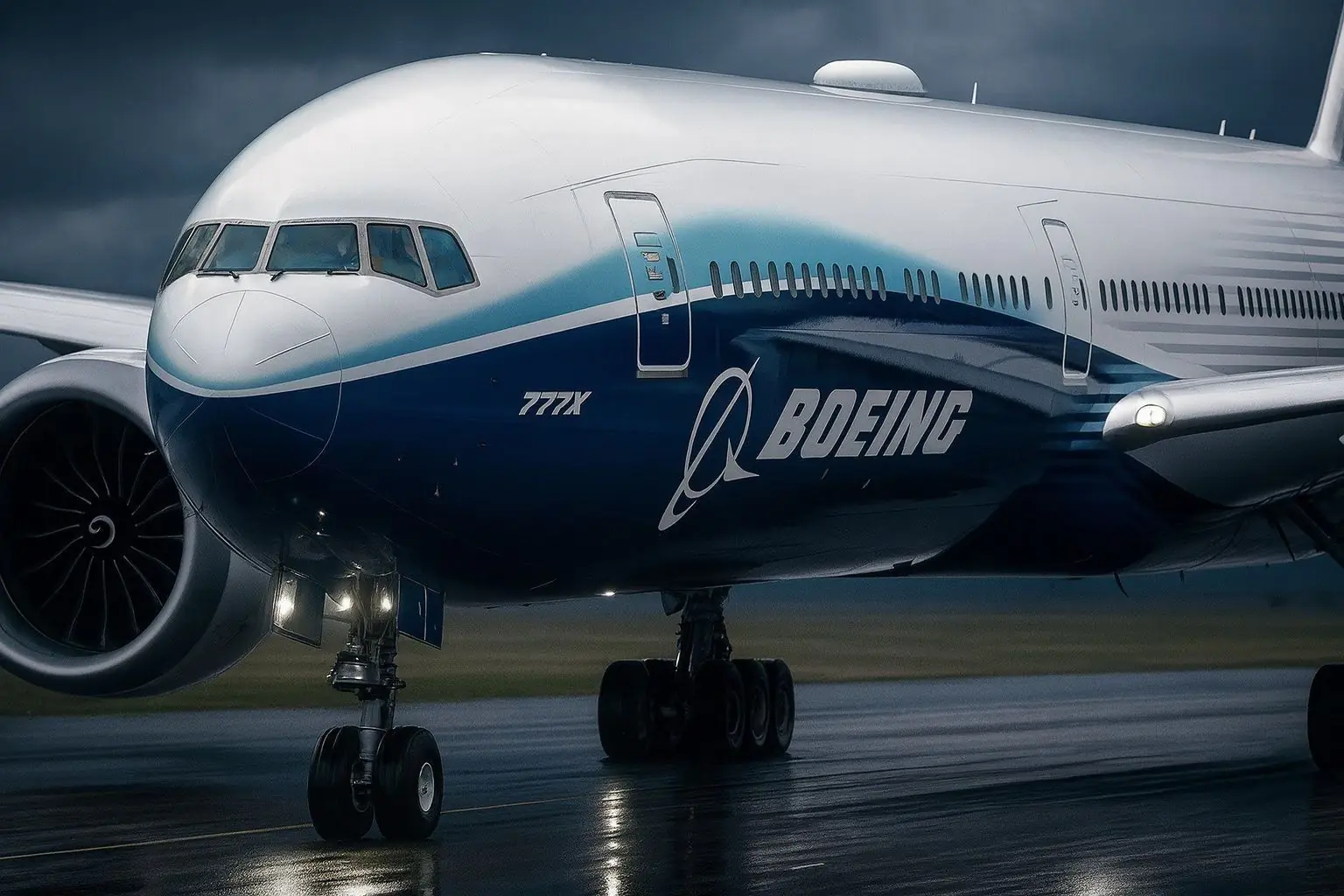
Data and news current as of December 1, 2025. This article is for informational purposes only and is not investment advice.
BA Stock at the Start of December 2025
Boeing’s BA stock is trading around $189 per share as of midday UTC on December 1, 2025, putting it roughly in the middle of its 52‑week range of about $129 to $243. StockInvest
Over the past year and a half, the share price has swung between hopes of a full post‑pandemic recovery and persistent concerns over safety, certification delays, and cash burn. Even so, by late October Boeing shares were up roughly low‑20% year‑to‑date, outpacing many industrial peers despite ongoing losses. MarketWatch
From an equity‑risk standpoint, BA remains a high‑beta, high‑volatility name: TradingView data pegs its beta around 1.6 and typical daily volatility near 1.5%, underscoring that Boeing tends to move more than the broader market in both directions. TradingView
The question many investors are asking now: with new multi‑billion‑dollar defense wins, a $10.55 billion asset sale, and a painful 777X setback, is BA stock set up for a genuine turnaround in 2026—or another bout of turbulence?
What Just Happened: Q3 2025 Earnings and the 777X Shock
Boeing’s Q3 2025 results (reported October 29) were a mixed bag:
- Revenue: $23.3 billion, up strongly on higher commercial jet deliveries. Boeing Investors+1
- GAAP loss per share:–$7.14;
- Core (non‑GAAP) loss per share:–$7.47. Q4cdn+1
The big swing factor was a $4.9 billion pre‑tax charge on the 777X program, which pushed the company to a net loss of about $5.3 billion in the quarter and delayed first 777‑9 deliveries to 2027, roughly seven years behind the original 2020 target. Q4cdn+2AP News+2
Despite the earnings hit, several underlying trends were more positive:
- Boeing delivered 160 commercial jets in Q3, its best quarterly total since 2018. AP News+1
- The commercial airplanes division saw revenue jump nearly 50% year‑over‑year to just over $11 billion, though it still posted a multi‑billion‑dollar operating loss because of the 777X charge. MarketWatch+1
- The company generated positive free cash flow of roughly $0.2–0.25 billion, its first positive quarter since 2023, aided in part by the timing of a deferred $700 million payment to the U.S. Department of Justice related to earlier 737 MAX crashes. Q4cdn+1
Even after these improvements, Boeing has now reported 17 consecutive quarters of core per‑share losses, highlighting how long the recovery is taking. MarketWatch
For BA stock, Q3 reinforced a key narrative: cash flow and demand are improving, but execution risk—especially around the 777X—remains very real.
Regulatory Backdrop: FAA Loosens Some Restrictions, Tightens Others
The regulatory story in late 2025 is nuanced, but net‑positive for Boeing’s ability to ramp production:
- In September 2025, the U.S. FAA said it would ease heightened oversight on Boeing’s 737 MAX and 787 programs, allowing the company to resume performing final safety checks before delivery, instead of having the FAA sign off aircraft by aircraft. www.alphaspread.com+1
- As part of that shift, the FAA approved an increase in the 737 MAX production cap from 38 to 42 jets per month, with potential for further increases if quality metrics continue to improve. AP News+1
At the same time, regulators are not easing up on safety:
- In mid‑November, the FAA proposed two new airworthiness directives covering about 165 Boeing 787s and 340 Boeing 777s in the U.S. fleet to address a risk of uncommanded altitude changes (787) and a potential landing‑gear pump‑related fire hazard (777). Aviation A2Z+2Facebook+2
These directives will likely require software updates and some hardware work, adding incremental cost and engineering bandwidth demands, but they are manageable compared with the earlier MAX‑grounding era.
Bottom line: the regulatory environment is still tough but gradually normalizing, which is critical for BA’s production‑driven cash‑flow story.
Major Contracts and Backlog: Defense Gives BA Stock a Boost
$4.7 Billion Apache Deal with Poland
One of the biggest recent wins for Boeing’s defense, space and security segment is a Foreign Military Sales contract to build 96 AH‑64E Apache attack helicopters for Poland, valued at nearly $4.7 billion. Seeking Alpha+3Boeing Investors+3Investing…
- Deliveries are expected to start in 2028, making Poland the largest Apache operator outside the U.S.
- The program deepens Boeing’s presence in Eastern Europe and supports a long production run for the Apache line.
Additional Pentagon Orders: KC‑46A Tankers and More
Separately, the U.S. Department of Defense recently awarded Boeing two major contracts worth more than $7 billion combined, including: Investors+2Yahoo Finance UK+2
- A roughly $4.7 billion contract (overlapping with the Apache deal) for upgraded AH‑64E helicopters and support.
- A $2.47 billion addition to an existing contract for 15 more KC‑46A Pegasus aerial refueling tankers for the U.S. Air Force.
These wins help stabilize Boeing’s defense backlog, which has been a bright spot relative to the more cyclical commercial business.
Commercial Aviation: Dubai Airshow, Middle East Demand and Production Ramps
Flydubai and Emirates at the 2025 Dubai Airshow
At the 2025 Dubai Airshow, Boeing managed a partial commercial comeback:
- flydubai signed a Memorandum of Understanding for 75 Boeing 737 MAX jets, with options for 75 more, an order valued around $13 billion at list prices. Reuters+4Boeing Investors+4AeroTime+4
- The carrier had just ordered 150 Airbus A321neo aircraft, but the new 737 MAX deal allows it to balance fleet needs with a mix of Airbus and Boeing narrowbodies. AP News+1
- Boeing also dominated the show’s first day with a massive Emirates order for 777X jets valued at about $38 billion, reinforcing long‑term demand for the delayed widebody. Reuters+2AP News+2
These orders feed into Boeing’s already large commercial backlog of around $630+ billion, which includes hundreds of 737 MAX, 787, and 777X aircraft. AP News+1
Middle East Growth: Boeing’s 2025 Commercial Market Outlook
Boeing’s 2025 Commercial Market Outlook (CMO) highlights the Middle East as a critical long‑term growth engine:
- The region’s airline fleet is projected to more than double by 2044, driven by tourism, trade and hub development. Stock Titan+3MediaRoom+3Travel Industry Wi…
- Boeing expects 2,950 new aircraft deliveries to Middle East carriers between 2025 and 2044, including about 1,430 single‑aisle jets, 1,370 widebodies, and 120 freighters. Stock Titan
For BA stock, the takeaway is that long‑term demand for Boeing’s widebody and narrowbody jets looks robust, especially in high‑growth hub regions.
Production: 737 MAX and 787 Ramps
Operationally, Boeing is steadily ramping output, though still below pre‑crisis ambitions:
- Industry tracking shows Boeing produced around 32 737 MAX aircraft in November 2025, reflecting stable, but not yet aggressive, monthly rates. eplaneai
- The company has no immediate plan to activate a new 737 MAX line in Everett for at least the next 12 months, focusing instead on improving throughput and quality at existing lines. Flight Global
- A recent Bloomberg report noted that Boeing is making progress in its “war against defects” at the 737 plant—reducing “traveled work” and lost tools—and is planning toward eventually raising output to around 60 MAX jets per month if demand, labor and supply chains cooperate. Bloomberg
On the widebody side:
- Boeing has broken ground on a $1 billion expansion at its 787 facility in North Charleston, South Carolina, aiming to raise 787 production from about 7 per month to 10 by 2026, adding roughly 1,000 jobs. Boeing Investors+2Reuters+2
As these ramps progress, unit economics and free cash flow should improve—but they depend heavily on quality control, regulatory trust and supply‑chain stability.
Portfolio Reshaping: $10.55 Billion Digital Aviation Sale
A major strategic move in 2025 was Boeing’s decision to sell large parts of its Digital Aviation Solutions business to private‑equity firm Thoma Bravo:
- The all‑cash deal, announced in April and valued at $10.55 billion, includes well‑known assets such as Jeppesen, ForeFlight, AerData and OzRunways. MediaRoom+2Boeing Investors+2
- The transaction was expected to close by year‑end and has now effectively closed in early November 2025, with the businesses relaunched as Jeppesen ForeFlight, a standalone company headquartered in Denver and San Francisco. Pilots of America+4Aviation International …
- Boeing’s own communications emphasize that the sale is designed to strengthen the company’s capital structure and let management focus more fully on core aircraft manufacturing and key technical operations. Mayer Brown+3MediaRoom+3Boeing Investors+3
For BA shareholders, the deal injects significant cash that can be used to pay down debt, support working capital and fund development programs such as the 777X—though it also means Boeing is less vertically integrated on flight‑data and navigation software.
Rating Agencies and Credit: Outlook Upgraded to “Stable”
In late October, S&P Global Ratings revised Boeing’s outlook from “negative” to “stable”, citing: SP Global
- Higher expected production rates for the 737 MAX and 787,
- Gradually improving cash flow, and
- The company’s ability to refinance and manage its substantial debt load as production normalizes.
S&P expects Boeing to increase 737 MAX output to around 42 per month and continue ramping widebody production, helping to rebuild the balance sheet over the next few years. SP Global+2AP News+2
The rating remains below pre‑MAX levels, but the outlook change is a symbolic step away from crisis‑mode.
What Wall Street Is Saying: BA Stock Forecasts and Analyst Sentiment
Analyst opinions on BA stock as of December 1, 2025, are cautiously bullish overall, with meaningful disagreements on risk and timing.
Consensus 12‑Month Price Targets
Across multiple data providers, consensus 12‑month price targets cluster well above the current ~$189 share price:
- MarketBeat:
- Tracks 27 Wall Street analysts.
- Rating mix: 6 sell, 3 hold, 15 buy, 3 strong buy.
- Consensus rating: “Moderate Buy.”
- Implied upside of about 22–23% over the next 12 months based on their average target (data updated November 30, 2025). MarketBeat+1
- StockAnalysis:
- 18 analysts.
- Consensus rating: “Strong Buy.”
- Average price target: ~$239.56, implying roughly 26–27% upside, with individual targets ranging from $140 to $282. StockAnalysis
- TradingView:
- 21 analysts’ forecast, 28 analysts on rating trend.
- Average target: about $248.71 (roughly 30%+ above the current price), with a range of $150 to $285. TradingView+1
- INDmoney (India‑focused aggregator):
- 39 analysts.
- 66.7% rate BA as Buy, 28.2% as Hold, 5.1% as Sell.
- Average target: $245, implying about 23% upside versus a cited price of ~$189.1. INDmoney
Overall, most analyst models assume Boeing shares can rise 20–30% over the next year if execution on production and cash flow stays on track.
Short‑Term Technical Takes: Not Everyone Is Bullish
Not all analysis is upbeat—particularly on the short‑term trading side:
- Technical service StockInvest currently labels BA a “sell candidate” in the very near term, noting several negative signals and the expectation of weak performance over the next few days or weeks. It cites a recent close near $189.03 with a 52‑week high of $242.69 and low of $128.88. StockInvest
This underscores that timing and risk tolerance matter: fundamental recovery and tactical trading signals can point in different directions.
Company Guidance and Independent Fundamental Views
Some independent fundamental analyses point to the company’s own medium‑term targets:
- Boeing’s guidance, as summarized in recent analyst commentary, calls for:
- Free cash flow turning sustainably positive by Q4 2025,
- More than 700 aircraft deliveries in 2026,
- 2026 revenue around $80 billion,
- Earnings per share near $3.50, and
- Free cash flow of roughly $5.6 billion. RoboForex+2Boeing Investors+2
If Boeing achieves these numbers while avoiding new major charges, many valuation models see room for multiple expansion from current levels.
Institutional Activity: Who’s Buying (and Selling) BA Stock?
Recent SEC filings and fund‑tracking services show active institutional trading in Boeing:
- Dilation Capital Management LP increased its BA stake by about 26% in Q2, making Boeing roughly 9.7% of its portfolio and its largest single position, with 86,599 shares owned. MarketBeat
- On December 1, Fisher Asset Management LLC disclosed that it acquired about 196,666 BA shares, a roughly 3.8% increase in its holdings. MarketBeat
- Also on December 1, Claret Asset Management Corp reported reducing its Boeing position, illustrating that not all institutional investors are leaning the same way. MarketBeat
This mix of large new buys and selective trims is typical for a stock in transition—institutions are re‑underwriting the story based on cash‑flow recovery versus execution risk.
Key Drivers for BA Stock in 2026 and Beyond
For investors watching BA from December 2025 onward, several themes are likely to dominate the share‑price trajectory:
- Execution on Production Ramps
- Can Boeing actually reach and sustain higher 737 MAX and 787 output without compromising quality? www.alphaspread.com+2Bloomberg+2
- 777X Timeline and Cost Control
- The 777X delay to 2027 has already cost nearly $5 billion in charges. New problems, or further slippage, could trigger more write‑downs and pressure on the stock. Q4cdn+2AP News+2
- Free Cash Flow and Debt Reduction
- Hitting the 2026 cash‑flow targets and showing a credible path to deleveraging after the $10.55 billion digital aviation sale will be critical for valuation. MediaRoom+2Manufacturing Dive+2
- Safety, Certification and Brand Trust
- New FAA directives on the 777/787, plus continuing public scrutiny after past MAX incidents, mean any major safety issue could rapidly wipe out months of stock gains. Aviation A2Z+2Instagram+2
- Macro and Airline Health
- The long‑term demand picture looks strong, especially in the Middle East and parts of Asia, but a global slowdown or geopolitical shock could lead airlines to delay or cancel orders. Stock Titan+2Reuters+2
Risks Investors Should Not Ignore
While BA’s recovery story is compelling, the stock carries significant risk:
- Operational risk: Complex global supply chains, labor issues (including strikes in defense plants), and the sheer difficulty of ramping production leave little margin for error. AP News+1
- Regulatory and legal risk: Boeing is still operating under a microscope from regulators and the U.S. Justice Department. Any perception that lessons from the MAX crisis aren’t fully embedded could bring new penalties or restrictions. AP News+2Boeing+2
- Financial risk: Despite improving cash flow, Boeing’s debt load remains large, and multiple years of losses have weakened the balance sheet relative to Airbus and historical norms. MarketWatch+2Financial Times+2
- Competitive risk: Airbus continues to execute well, posting strong profits and delivery growth, and leveraging its own backlogs (A320neo family, A350) to capture market share. Reuters+2eplaneai+2
Is BA Stock a Buy, Sell or Hold Right Now?
BA is a high‑beta turnaround stock: the rewards could be significant if Boeing delivers on its production, cash‑flow and safety goals, but setbacks could be painful.
Based on the current landscape:
- Bullish case:
- Strong and growing backlog across 737 MAX, 787 and 777X. AP News+2Reuters+2
- Multi‑year defense tailwinds from Apache, tanker and other contracts. Investors+2Boeing Investors+2
- Balance‑sheet boost from the $10.55B digital aviation sale and a shift toward positive free cash flow. Manufacturing Dive+2AeroTime+2
- Ratings agencies and most Wall Street analysts now see stabilization and upside, with average price targets 20–30% above current levels. INDmoney+3MarketBeat+3StockAnalysis+3
- Bearish case:
- Another big program shock (777X or a new aircraft) or serious safety incident could trigger fresh charges and regulatory backlash. AP News+2Aviation A2Z+2
- Execution problems on production ramps could undermine the cash‑flow story analysts are banking on. www.alphaspread.com+2Bloomberg+2
- Macro shocks, airline finances or geopolitics could slow widebody demand, especially for long‑haul routes. Stock Titan+2Reuters+2
For long‑term, risk‑tolerant investors, BA is increasingly framed as a leveraged recovery play on global air travel and defense spending. For short‑term traders, near‑term technical signals and event risks (earnings, regulatory headlines, large orders or cancellations) may dominate.
Final Thoughts
As of December 1, 2025, BA stock sits at a crossroads:
- The worst of the crisis seems to be behind Boeing—regulators are cautiously easing oversight, production is climbing, the order book is deep, and a major asset sale has bolstered the balance sheet. AP News+3www.alphaspread.com+3Reuters+3
- Yet the company is still loss‑making on a core basis, absorbing multi‑billion‑dollar program charges, and operating under intense scrutiny. Q4cdn+2MarketWatch+2
Anyone considering BA stock should carefully weigh their own risk tolerance, time horizon, and portfolio needs, and consult a qualified financial adviser before making decisions. BA offers meaningful upside if the turnaround sticks—but with turbulence still very likely along the way.