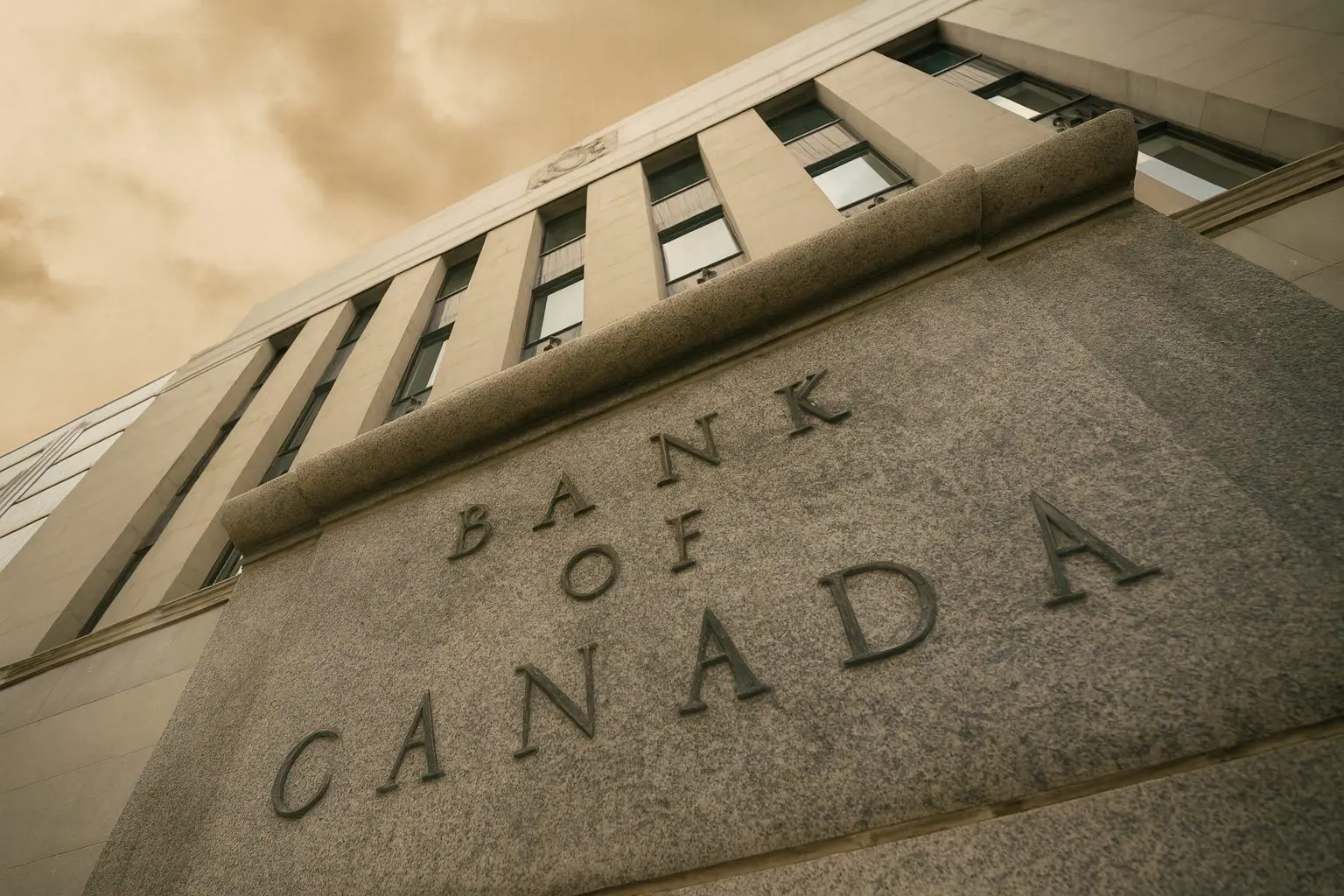
As of today, December 9, 2025, the Bank of Canada’s policy interest rate is 2.25%, and Canada’s prime rate sits at 4.45%. This level was set at the October 29 decision, when the central bank delivered its fourth quarter‑point cut of the year and signalled it may now be done easing. Scotiabank+2Ratehub.ca+2
With the final rate announcement of 2025 scheduled for Wednesday, December 10 at 9:45 a.m. ET, markets and economists almost unanimously expect the Bank of Canada (BoC) to hold rates steady and begin a prolonged pause. Bank of Canada+2Global News+2
Below is a detailed, news‑style breakdown of where the Bank of Canada interest rate stands today, what’s expected from tomorrow’s decision, and what it means for mortgages, housing, and the broader Canadian economy.
1. Bank of Canada Interest Rate Today: 2.25% Policy Rate, 4.45% Prime
Current policy rate
- The target for the overnight rate — the Bank of Canada’s key policy rate — is 2.25% today. Scotiabank
- The rate was cut from 2.50% to 2.25% on October 29, 2025, following an earlier cut in September and previous reductions in January and March. Altogether, the BoC has lowered rates by 100 basis points in 2025 and 275 basis points since cuts began in mid‑2024, taking the policy rate down from the 5% peak set during the inflation fight. Scotiabank+2Ratehub.ca+2
Banks and analysts now describe 2.25% as the bottom of the Bank’s “neutral” range (estimated at 2.25–3.25%), meaning policy is no longer aggressively stimulative but not restrictive either. True North Mortgage+1
Prime rate in Canada today
Because commercial banks price many products off the BoC rate, prime has fallen in tandem:
- Canada’s prime rate today (December 9, 2025) is 4.45%. Ratehub.ca
- Prime dropped after the October 29 cut, and now reflects a full percentage point of easing this year. Ratehub.ca+1
This prime rate directly affects variable‑rate mortgages, home‑equity lines of credit (HELOCs), and many personal and business loans.
2. What to Expect From Tomorrow’s (December 10) Rate Decision
Almost universal call for a hold
The Bank of Canada will announce its final policy decision of 2025 on Wednesday, December 10 at 9:45 a.m. ET, followed by a press conference with Governor Tiff Macklem and Senior Deputy Governor Carolyn Rogers at 10:30 a.m. Bank of Canada+1
Heading into that announcement, the consensus is overwhelming:
- A Reuters‑based summary cited by multiple outlets notes that all 33 economists in a recent poll expect the overnight rate to stay at 2.25% this week, with a majority seeing no change until at least 2027. Benefits and Pensions Monitor+1
- A Global News preview reports that “most economists” expect a hold at 2.25% after a string of positive surprises in GDP, jobs, and inflation data. Global News
- Wealth Professional and Benefits and Pensions Monitor both highlight that markets put roughly 90%+ odds on a hold, and that the BoC has likely finished its rate‑cutting cycle for now. Benefits and Pensions Monitor+1
- The C.D. Howe Institute’s Monetary Policy Council — a “shadow” governing council of private‑sector economists — explicitly recommends keeping the overnight rate at 2.25% at the December 10 meeting and maintaining that level over the next year. C.D. Howe Institute
In short, a hold tomorrow is the base‑case scenario across Bay Street, academia, and markets.
Bank commentary: “At about the right level”
After October’s cut, Governor Tiff Macklem said that the policy rate is “about the right level” to keep inflation near 2% while supporting an economy adjusting to trade and fiscal shocks, suggesting the bar for further easing is now high. Global News+1
Analysts at RBC and Scotiabank interpret those comments as a clear signal that the BoC prefers to sit on the sidelines for several meetings, letting previous rate cuts filter through the economy. Global News+1
3. Why the Bank of Canada Is Likely Done Cutting (For Now)
The consensus for a hold is grounded in a combination of cooling inflation, improving labour data, and better‑than‑expected GDP growth, even as trade tensions with the U.S. remain a major risk.
Inflation: back inside the target band
- October’s Consumer Price Index (CPI) showed headline inflation at about 2.2% year‑over‑year, down from 2.4% in September and comfortably within the BoC’s 1–3% target band. True North Mortgage+1
- Core measures of inflation — which strip out volatile components — have also eased, though not as quickly, leaving the Bank alert to underlying price pressures. True North Mortgage
With inflation neither too hot nor dangerously low, the BoC has more room to pause and watch how the economy evolves.
Labour market: stronger than expected, but not booming
Recent employment data surprised to the upside:
- Canada gained a solid number of jobs in November, pushing the unemployment rate down to roughly 6.5% after peaking above 7% in August. TD Economics+1
- TD Economics notes that the job market has shown “resiliency” even in the face of trade‑driven headwinds, while still leaving some slack that reduces pressure for rate hikes. TD Economics
Strong jobs data make further cuts harder to justify, especially when inflation is already on target.
Growth: no recession, modest expansion
The latest GDP figures also argue against more immediate easing:
- Q3 2025 GDP grew at about a 2.6% annualized pace, a stronger‑than‑expected rebound that helped Canada dodge a technical recession. True North Mortgage+2Benefits and Pensions…
- True North Mortgage’s analysis points out that the growth was driven in part by government spending, while household consumption slipped — a mixed picture, but not one that screams “emergency.” True North Mortgage
For central bankers, this is a classic “good enough” scenario: growth isn’t spectacular, but it’s positive and compatible with a neutral policy stance.
Trade war and CUSMA uncertainty
The wild card remains the trade conflict with the U.S. and the looming review of CUSMA (the Canada‑U.S.‑Mexico Agreement):
- Reuters’ recent foreign‑exchange poll highlights how delayed progress on a trade deal and ongoing tariffs are weighing on the Canadian outlook and the currency. Reuters
- Global News notes that tariffs have hurt key industries like steel, autos, and lumber, and that the BoC has had to manage these shocks without tipping the economy into recession. Global News
For now, though, the trade shock is something the Bank seems prepared to monitor rather than pre‑emptively offset with more cuts, especially after such an aggressive easing cycle.
4. What Today’s Rate Means for Mortgages, Loans and Savings
Variable‑rate mortgages and HELOCs
With the prime rate at 4.45%, most variable‑rate products are priced as prime plus or minus a spread. Ratehub.ca
- Borrowers who took out variable mortgages when the policy rate was 5% in 2023 are now benefiting from significantly lower interest costs after 275 basis points of cuts since mid‑2024. Ratehub.ca+1
- New buyers are seeing more affordable variable rates compared to the peak period, but rates remain higher than the ultra‑low environment of the early 2020s.
If tomorrow’s BoC decision is a hold, variable rates tied to prime are unlikely to move immediately. The bigger story is the signal that this level could stick around for quite a while.
Fixed‑rate mortgages
Fixed mortgage rates are more closely linked to bond yields than to the overnight rate itself:
- True North Mortgage notes that Canadian 5‑year bond yields recently climbed into the ~3% range after the strong November jobs report, pushing fixed rates slightly higher even as the BoC paused. True North Mortgage
- Expectations of a U.S. Federal Reserve cut this week, contrasted with a BoC hold, have also influenced Canadian bond markets and, by extension, fixed mortgage pricing. Reuters
For homeowners, that means fixed rates could move in a narrow, choppy range, even if the BoC stands pat.
Lines of credit, personal loans and credit cards
- HELOCs and many personal or small‑business loans are directly linked to prime, so the cumulative cuts this year have softened monthly interest charges. Ratehub.ca
- Credit card rates are less tightly tied to the overnight rate and remain high, but the cost of carrying variable‑rate debt in general is lower today than it was at the 2023 peak.
Savings accounts and GICs
On the flip side, deposit and GIC rates have drifted down with policy easing:
- Short‑term “high‑interest” savings accounts that once benefited from a 5% policy rate now reflect the lower‑yield world of a 2.25% benchmark.
- Longer‑term GICs still offer positive real returns in many cases, but the trend favours moderate, not eye‑popping, yields.
5. Housing Market: Rate Cuts Done Just as Buyers Start to Return
Lower rates have begun to thaw parts of the housing market — and many analysts think a stable, predictable rate environment could actually be more powerful for demand than additional cuts.
A new Royal LePage report, covered by CityNews and The Canadian Press today, forecasts that: CityNews Toronto
- The national aggregate home price will rise about 1% in 2026.
- Single‑family detached home prices are expected to increase roughly 2%, while condo prices could dip around 2.5%, reflecting different supply‑demand dynamics.
- The firm argues that four Bank of Canada rate cuts this year kept some buyers waiting for “just one more” move, but with the key rate now at 2.25% and a pause widely expected, more buyers may finally step off the sidelines.
Royal LePage’s CEO Phil Soper suggests that many consumers now believe the rate‑cut period is near or at its end, which reduces the incentive to wait and encourages buyers to act before prices firm further. CityNews Toronto
Other surveys cited by Reuters and The Canadian Press show:
- Home sales picked up in October, helped by lower borrowing costs. Benefits and Pensions Monitor+1
- Analysts expect modest price gains nationally in 2026 and 2027, with some regional variation, and improving affordability for first‑time buyers compared with 2023. Benefits and Pensions Monitor
6. Interest Rate Forecasts for 2026 and Beyond
Broad consensus: a long pause at 2.25%
If there is one theme that runs through nearly all current commentary, it’s this: don’t expect big moves soon.
True North Mortgage’s detailed forecast roundup shows a striking alignment among major institutions: True North Mortgage
- National Bank, TD, Scotiabank, CIBC, RBC, BMO, Desjardins, Oxford Economics and Capital Economicsall project the BoC policy rate staying at 2.25% well into 2026, with some expecting it to hold through 2027.
- Several banks see a gradual move higher later in the decade — toward 2.50–2.75% in 2027–2028 — rather than a renewed cutting cycle.
The C.D. Howe Monetary Policy Council likewise recommends keeping the overnight rate at 2.25% for at least the next year, underscoring the preference for stability. C.D. Howe Institute
A separate Wealth Professional piece summarizing polling data notes that: Wealth Professional
- All 33 economists surveyed expect a hold at 2.25% this week.
- A majority foresee no rate change until at least 2027, barring major shocks.
Minority view: risk of further cuts if trade damage deepens
Not everyone discounts the possibility of more easing:
- Capital Economics, cited in a Reuters FX poll, still expects the BoC to push its policy rate below the neutral range around mid‑2026 if core inflation settles firmly at target and the trade conflict drags on growth. Reuters
- True North’s analysis sketches a scenario where another cut to 2.0% becomes more likely if tariffs broaden, negotiations stall, and Canada slides toward recession. True North Mortgage
In other words, the baseline is a long pause, but downside risks tied to trade and global growth could still pull rates lower.
Upside risk: fiscal stimulus and stronger‑than‑expected growth
At the same time, some economists warn that fiscal policy could push in the opposite direction:
- Global News highlights that Prime Minister Mark Carney’s “enormous” budget — with billions in new spending — creates upside risks for growth and inflation. RBC’s Claire Fan sees more danger of eventual rate increases in 2026 than of renewed cuts if the economy “steamrolls ahead” faster than expected. Global News
Put simply, the fan of possible outcomes is wide:
- Base case: 2.25% for a long time.
- Bear case: additional cuts if trade shocks worsen and growth falters.
- Bull case: rate hikes in 2026–27 if inflation re‑accelerates on the back of strong growth and fiscal stimulus.
7. Key Dates: Upcoming Bank of Canada Rate Announcements
Looking beyond tomorrow’s decision, the Bank of Canada has already published its 2026 schedule for policy interest rate announcements: Bank of Canada+1
- January 28, 2026 – Interest rate announcement & Monetary Policy Report
- March 18, 2026 – Interest rate announcement
- April 29, 2026 – Interest rate announcement & Monetary Policy Report
- June 10, 2026 – Interest rate announcement
- July 15, 2026 – Interest rate announcement & Monetary Policy Report
- September 2, 2026 – Interest rate announcement
- October 28, 2026 – Interest rate announcement & Monetary Policy Report
- December 9, 2026 – Interest rate announcement
For households and businesses planning big financial decisions — home purchases, major investments, refinancing — these dates are the key checkpoints when the interest‑rate landscape could shift.
8. Quick FAQ: Bank of Canada Interest Rate Today
What is the Bank of Canada interest rate today (December 9, 2025)?
The policy (overnight) rate is 2.25%, set on October 29, 2025. Scotiabank
What is Canada’s prime rate today?
The prime rate is 4.45%, according to Ratehub’s daily tracker and mortgage‑market commentary. Ratehub.ca+1
Is the Bank of Canada expected to change rates tomorrow?
Markets and economists overwhelmingly expect the BoC to hold at 2.25% on December 10, with polls showing unanimity among economists and market‑implied odds above 90% for no change. Benefits and Pensions Monitor+2Wealth Prof…
Are more cuts likely in 2026?
The base‑case forecast from most major banks is no change through 2026, but some analysts still see a chance of further cuts if trade shocks intensify and growth weakens. True North Mortgage+2Reuters+2
Could rates go back up instead?
Yes. If growth and inflation outpace expectations — for example, if fiscal stimulus from Ottawa and a stronger global backdrop push the economy ahead more quickly — some economists see rate hikes in late 2026 or 2027 as a real possibility. Global News+1
Bottom line
On December 9, 2025, the Bank of Canada interest rate today is 2.25%, with a 4.45% prime rate and an overwhelming expectation that tomorrow’s decision will lock in a long pause.
For Canadians, that translates into:
- Stable borrowing costs for variable‑rate mortgages and lines of credit.
- A housing market that’s beginning to thaw as uncertainty about further cuts fades.
- A policy backdrop that is neither crisis‑level loose nor painfully tight — but highly sensitive to how trade tensions, inflation and fiscal policy evolve in 2026.
This article is for information and general interest only and should not be taken as personalized financial or investment advice.