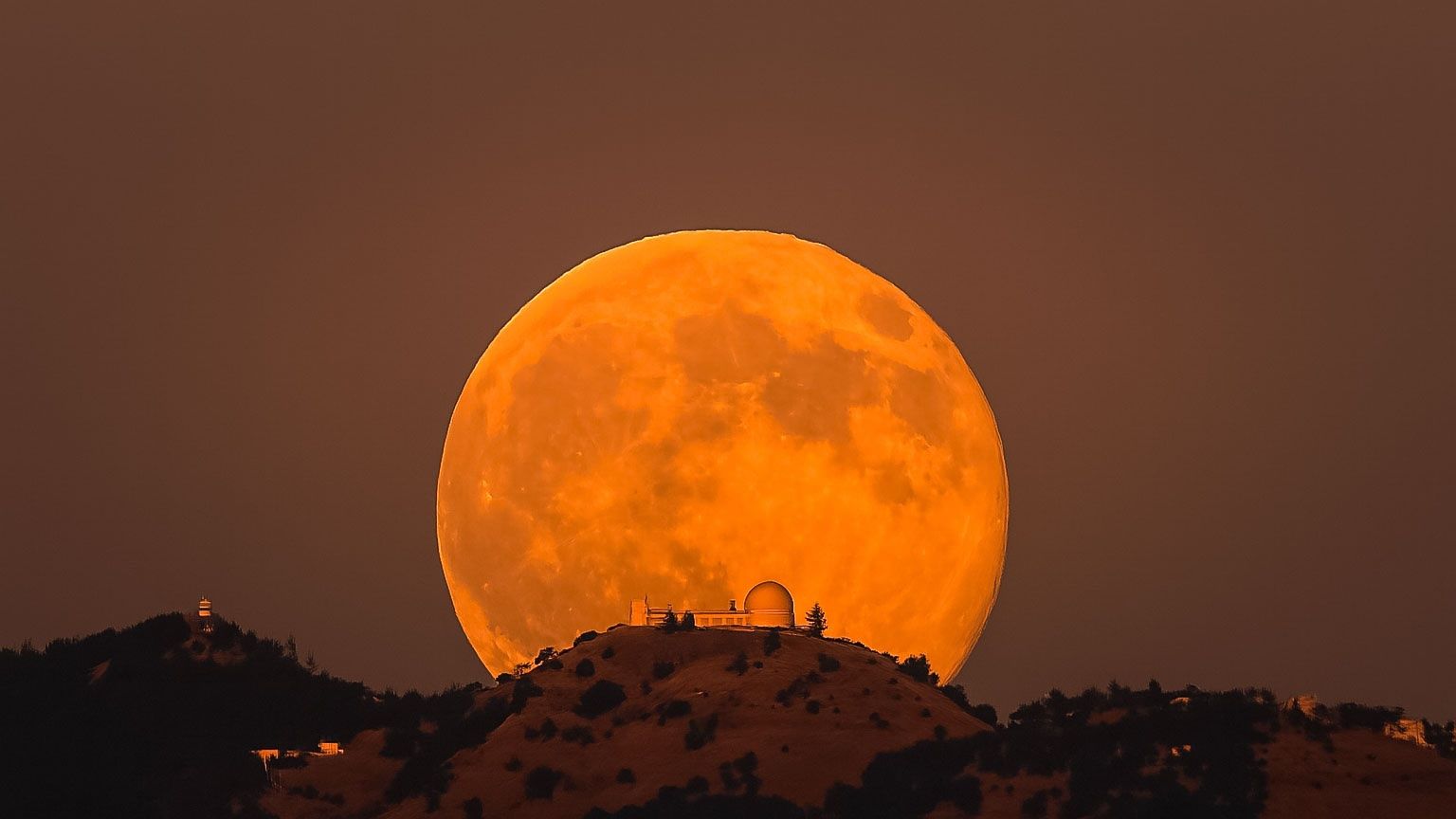

- Beaver Supermoon (Nov 5, 2025) – The full “Beaver Moon” on Nov. 5 will be a supermoon, the largest and brightest full moon of 2025ts2.techlivescience.com.
- Closest Approach – At peak it will pass roughly 356,980 km (221,818 mi) from Earthts2.tech, the closest full moon since February 2019livescience.comlivescience.com.
- Size & Brightness – NASA and astronomers note it will appear about 8–14% larger and 16–30% brighter than an average full moonlivescience.comts2.tech – bright enough to cast faint shadows on the groundnationalgeographic.com.
- Viewing Tips – No telescope is neededabcnews.go.com. The moon will be full in the early morning of Nov 5 (8:19 a.m. EST) but looks full on Nov 4–6livescience.com. The most dramatic view is at moonrise (just after sunset), when the low moon can appear extra‑large and goldennationalgeographic.comlivescience.com.
- Traditional Name – November’s full moon is traditionally the Beaver Moon (named for beavers building winter dams)livescience.com. (Because 2025’s Harvest Moon fell unusually early, this Nov. 5 full moon will by one reckoning follow the Harvest Moon, making it also a “Hunter’s Moon” this yearts2.tech.)
- No Disasters – Scientists stress that supermoons do not trigger earthquakes or disastersnzherald.co.nz. Only a slight tidal rise is expected when the moon is closerabcnews.go.com, and experts say that effect is hardly noticeable.
What Is a Supermoon?
A supermoon is not an official astronomical term, but rather a popular way to describe a full moon that coincides with the Moon’s perigee (its closest point to Earth in its elliptical orbit). As NASA explains, the Moon’s orbit is oval-shaped, so full moons can occur at varying distances. When a full moon happens near perigee, the Moon appears larger and brighter in our skylivescience.com. In fact, NASA notes that the full Moon can look up to ~14% bigger and 30% brighter at perigee than at its farthest point (apogee)livescience.com. Such perigee full moons (“supermoons”) typically occur only 3–4 times a year, in a rownbcmontana.com. November 2025’s full moon will join October’s Harvest Moon and December’s Cold Moon as a trio of supermoons closing out the yearlivescience.comnbcmontana.com. In short, the Nov. 5 moon is special because its peak fullness almost coincides with its perigee, yielding an extra impressively bright, large Moon in the skylivescience.com.
November 2025’s Beaver Moon: How Close and How Bright
The “Beaver Moon” of Nov. 5, 2025 (named for the time of year when beavers prepare for winter) will peak in brightness at 13:19 UTC (8:19 a.m. EST) on Wednesday, Nov. 5ts2.tech. At that instant, it will be only about 356,980 km (221,818 mi) from Earthts2.techlivescience.com – remarkably close. (For comparison, a typical full moon is about 384,000 km away.) This makes it the closest full moon of 2025 and the nearest since February 2019livescience.comlivescience.com. Astronomers from Space.com and Ts2.tech confirm that at perigee the Beaver Moon will appear roughly 7.9% closer and 16% brighter than averagets2.techlivescience.com. Other reports put the effect as high as ~14% larger and ~30% brighter compared to a distant full moonlivescience.comabcnews.go.com. In any case, this November full moon will stand out as an unusually intense “supermoon’s glow” – bright enough, for instance, to almost wash out nearby stars and even cast faint shadows on the groundnationalgeographic.comlivescience.com.
It’s also the second of three consecutive supermoons in 2025: following October’s Harvest Moon and preceding December’s Cold Moonlivescience.comlivescience.com. (Interestingly, 2025’s November Moon can be called the Beaver Moon, but it also qualifies as a Hunter’s Moon because the usual Harvest Moon was unusually early this yearts2.tech.) In short, all the conditions are set for a spectacular lunar display on and around Nov. 5, 2025.
How to View the Beaver Supermoon
You don’t need any special equipment to enjoy the supermoonabcnews.go.com. The full phase officially occurs in the morning hours of Nov. 5, but to Earth-bound observers the Moon will appear fully lit on the nights of Nov. 4, 5 and 6. Skywatchers should plan to watch just after sunset, when the Moon rises in the east. Astronomers say the best time is in the first hour after moonrise, when the “moon illusion” and a warm, golden tint make it look especially large and picturesquenationalgeographic.comlivescience.com. In fact, Live Science reports that the Moon will “look its best” just after it climbs above the horizon at dusklivescience.comnationalgeographic.com.
Because the Moon will be near perigee and thus brighter, observers might notice that it outshines nearby stars. The Moon will lie in the constellation Taurus at that time. On Nov. 6 it will be very close to the Pleiades star cluster (the Seven Sisters)ts2.tech – a beautiful sight if the Moon’s glare doesn’t overwhelm it. A few nights later, on Nov. 10, the waxing gibbous Moon will pass within about 4° of bright Jupiterts2.tech, creating a striking tandem in the late-evening sky. (Lunar apps or websites can tell you the exact moonrise times for your location.) Even if you’re casually viewing, just looking up during twilight should reveal the huge, glowing Moon. As Michigan State astronomer Shannon Schmoll notes, the size difference can be subtle to the unaided eye – “the difference is most obvious as a comparison between other images or observations,” she saysabcnews.go.com – but the brightness will certainly be impressive.
Tides, Myths and Reality
Some media hype and social posts often claim a supermoon will trigger extreme tides or earthquakes. In reality, the effects are very mild. The moon does pull on Earth’s oceans, so a perigee full moon does produce slightly higher tides than usual. Astronomer Lawrence Wasserman of Lowell Observatory points out that “tides may be slightly higher during a supermoon” but in practice the difference is barely noticeableabcnews.go.com. There is no evidence of any catastrophic effects. For example, New Zealand seismologists and other experts have repeatedly debunked claims linking supermoons to earthquakes. As GNS Science seismologist Dr. John Ristau plainly stated after a recent quake, “there’s no direct link” between supermoons and earthquakesnzherald.co.nz. In short, scientists say the only real impact of this supermoon will be a brighter night sky and slightly stronger (but ordinary) tidal bulges – not any disaster. It’s a powerful show of nature, but not a danger.
Cultural Names and Folklore
The November full moon has inspired many traditional names. In North America it’s most commonly called the Beaver Moon: indigenous Algonquin and early colonial names noted that this is the time when beavers are actively building or repairing dams for winterlivescience.com. It’s also been called the Freezing Moon, Snow Moon, or Frost Moon in various traditions, reflecting the onset of winter. (According to Timeanddate.com and NASA’s Moon lore pages, some tribes even called it “Baashkaakodin Giizis” – the Freezing Moonlivescience.com.) Interestingly, because the 2025 Harvest Moon occurred so early (Oct 6), by the almanac definition this November moon also serves as the Hunter’s Moon (the first full moon after Harvest Moon) – a twist not seen since 2020ts2.tech.
Whatever you call it, this supermoon has captured public imagination. Astronomers and educators encourage everyone to enjoy it simply by looking up. As one astronomy writer quips, “for once, the hype actually matches the view” – the Beaver Supermoon truly is set to be the brightest, closest full moon of the yearvice.comlivescience.com. So whether you’re snapping photos or just marveling, don’t miss November 5–6, 2025: it’s your chance to see our lunar companion at its biggest and brightest for the year (and to cast a few actual moonlit shadows in your backyard!)nationalgeographic.comts2.tech.
Sources: Latest astronomy reports and news from early November 2025ts2.techlivescience.comlivescience.comnzherald.co.nz, including AP/ABC News, Live Science, National Geographic and TechStock² (ts2.tech). Each fact above is confirmed by experts and organizations in those reports.