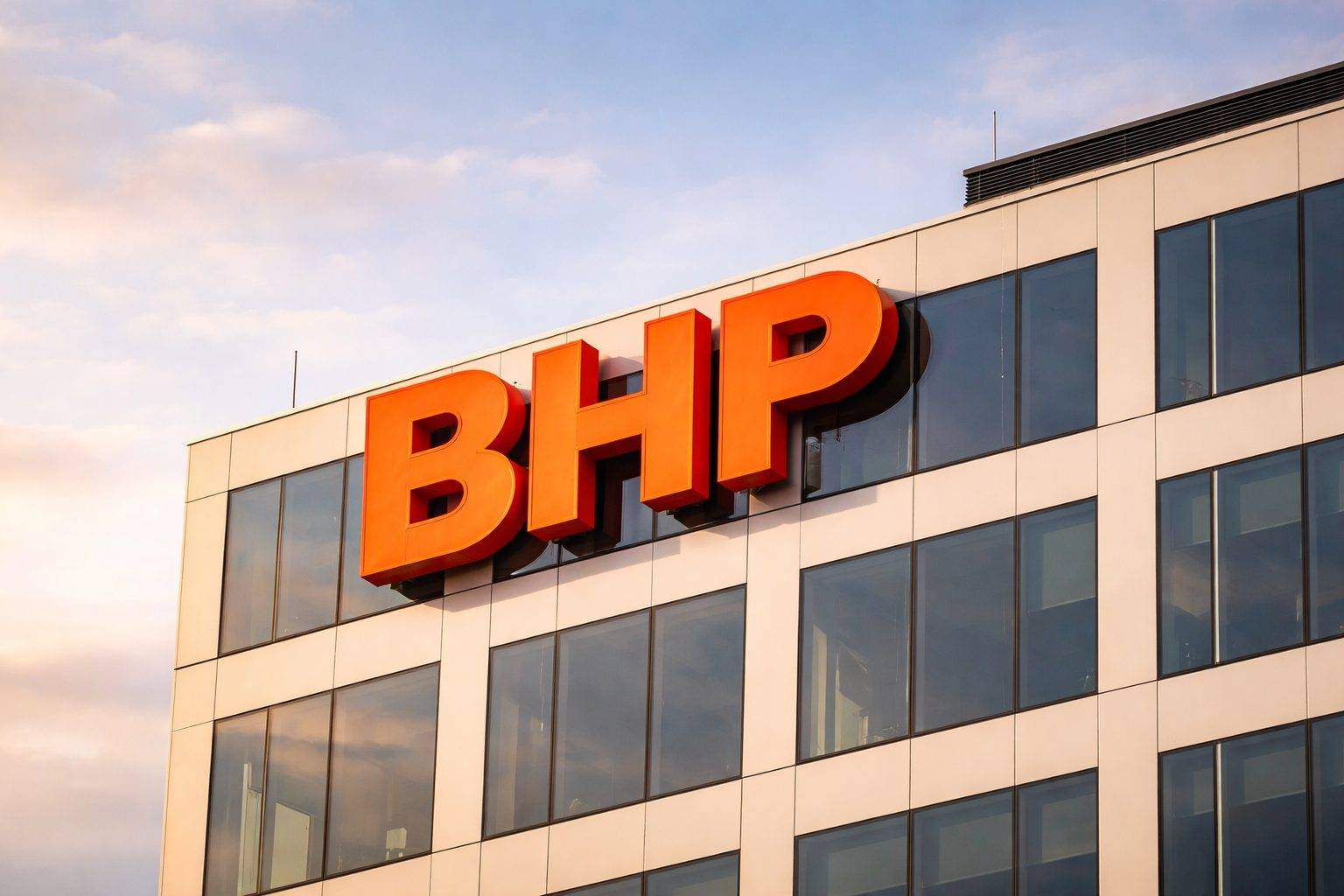
Sydney, Jan 28, 2026, 16:45 AEDT — Market closed
- BHP climbed 1.8% by the close, hitting a new 52-week high
- Australian core inflation jumped past expectations, boosting wagers on an RBA rate hike next week
- Traders are eyeing commodity prices, the Australian dollar, and BHP’s interim results due next month
BHP Group Ltd shares closed Wednesday up 1.8%, hitting A$50.64. During the session, the stock ranged between A$49.88 and A$50.86, following a previous close of A$49.75. The last quote came at 16:06 local time. Intelligent Investor
This shift is significant as BHP now stands out as the purest single-stock bet on Australia’s commodity sector, which has been notably volatile. Gold soared above $5,200 an ounce once more, drawing renewed capital into materials and diverting it from areas of the market that behave more like bonds. Reuters
In Australia, the spotlight returned to interest rates. The trimmed-mean CPI, which excludes the largest price swings to measure core inflation, climbed 0.9% in the December quarter and hit 3.4% year-on-year, surpassing the RBA’s 2%-3% target range. “We think the RBA will conclude that demand is running ahead of supply,” said Adam Boyton, ANZ’s head of Australian Economics, after money markets pushed the odds of a 25-basis-point hike next week to around 73%. Reuters
The broader S&P/ASX 200 slipped roughly 0.1%, with gains in some resource stocks offset by weakness in rate-sensitive sectors. Investing.com
Global cross-currents complicated the story. The U.S. dollar steadied following a steep selloff, while the Australian dollar climbed to a three-year peak above 70 U.S. cents. Brent crude surged to a four-month high near $68 a barrel, pushing commodities back into the spotlight. Reuters
Broker talk remained upbeat. BofA Securities nudged up its target price for BHP to A$57 from A$56, maintaining a Buy call. The boost followed a hike in coal price forecasts, driven by expectations of tighter Indonesian exports and steady seaborne demand. BofA raised its 2026 Newcastle thermal coal estimate to $123 a tonne, up from $109, and lifted its Australian hard coking coal forecast — crucial for steelmaking — to $235 from $186. Investing.com
Brazil’s Vale projects its iron ore output for 2025 at 336.1 million metric tons, marking the highest volume since 2018. This recovery signals a bigger supply influx into a market still largely dependent on China. For BHP, iron ore continues to be the core profit driver. Reuters
Iron ore prices have fluctuated recently. The benchmark Singapore contract hovered near $103.8 a ton during Asian trading, while the most-active Dalian contract closed around 788 yuan a ton. Traders remain cautious on demand from China, the largest consumer. Business Recorder
The recent surge in the stock has had a distinctly local edge. On Tuesday, a Reuters report noted BHP overtaking Commonwealth Bank to become Australia’s largest listed company, as miner gains pushed the ASX 200 to a three-month peak. Indo Premier
There’s a catch. Earlier this month, BHP revealed it accepted lower prices on some iron ore sales for 2026 in talks with China Mineral Resources Group, a state-backed buyer, showing that “headline” iron ore benchmarks don’t always match up with actual prices. The company also warned of higher expected costs for its Jansen Stage 1 potash project in Canada and said it will release interim results on Feb. 17. Reuters
Traders are set to monitor if the Australian dollar holds steady following the inflation shock and whether that currency shift begins to weigh on exporter sentiment. The Reserve Bank of Australia’s next decision comes Feb. 3.
Looking ahead, the focus will be on BHP’s guidance. When the company reports on Feb. 17, investors want clarity on iron ore prices, coal markets, and capital expenditure. China’s demand signals and volatile commodity prices are expected to shape the narrative for the week.