NEW YORK, Dec. 28, 2025, 3:14 a.m. ET — Market closed (weekend).
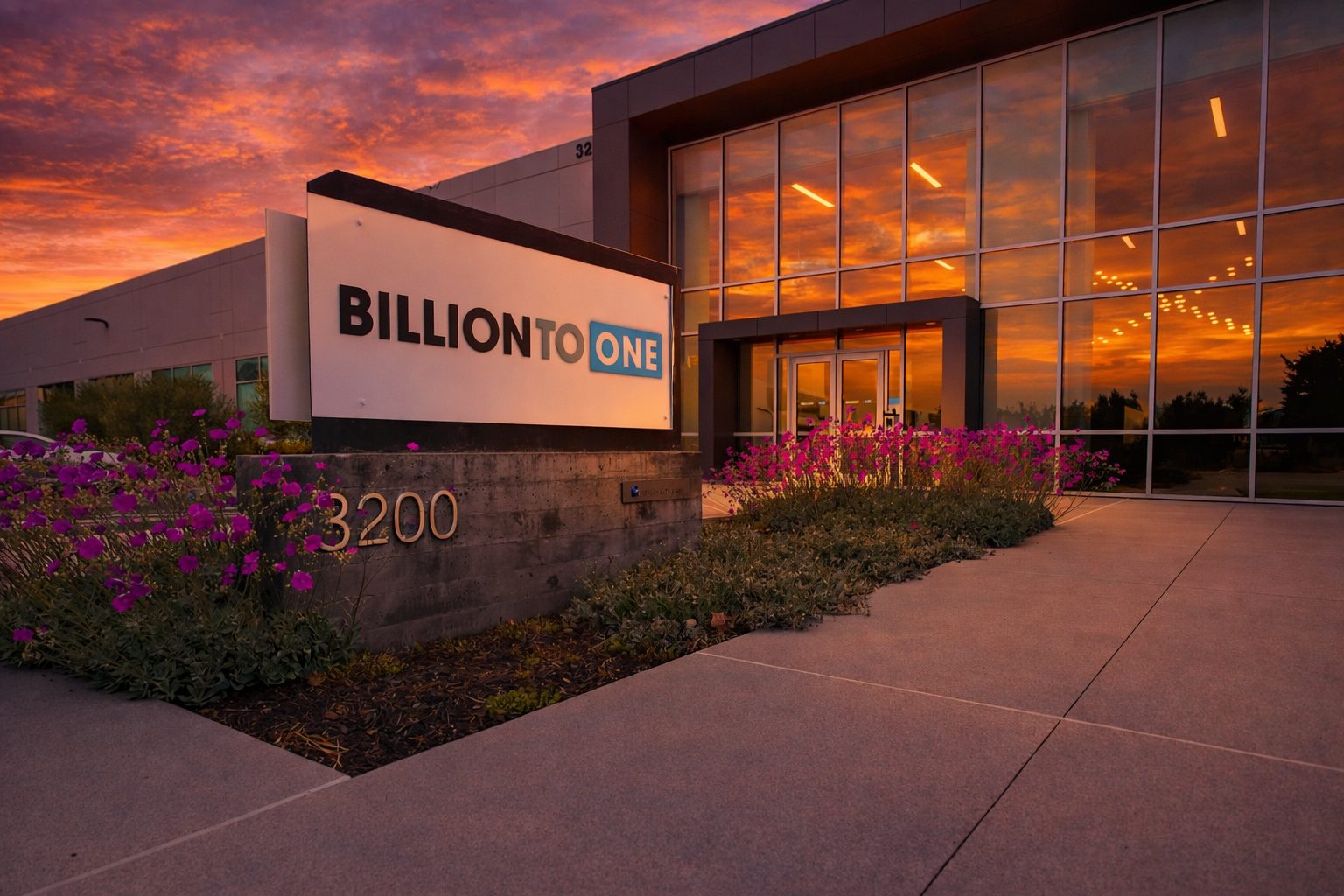
BillionToOne, Inc. (NASDAQ: BLLN) heads into the final trading stretch of the year with investors juggling two competing truths: the diagnostics newcomer has posted eye-catching growth and profitability metrics for a just-public company, but the stock remains volatile after a headline-grabbing debut and a sharp December pullback.
With U.S. markets closed for the weekend, the most actionable “now” story is what happened in the last session—and what could plausibly move the shares when trading resumes Monday: Wall Street’s early wave of coverage and price targets, the company’s newly issued full-year outlook, and a looming January investor spotlight at the J.P. Morgan Healthcare Conference.
BLLN stock: where it left off after Friday’s session
BillionToOne shares last closed at $89.30 on Friday, up $2.96 (+3.43%) from the prior close, after trading roughly between $85.62 and $89.99. MarketBeat+1
Even after Friday’s bounce, the stock is still well off its recent highs. Data providers list a 52-week range of about $81.51 to $138.70, putting Friday’s close roughly 9.6% above the low and about 35.6% below the high. MarketBeat+2Investing.com+2
By market value, BillionToOne is currently in “mid-cap biopharma/diagnostics” territory: Barchart lists market capitalization around $4.09 billion (as of the latest available update tied to recent pricing). Barchart.com
What’s new in the last 24–48 hours: price action and fresh roundups of analyst sentiment
Company-specific headlines over the past two days have been light—no splashy press release, no new blockbuster trial readout. Instead, the most current coverage has centered on Friday’s move and roundups of analyst ratings.
MarketBeat’s late-week write-ups highlighted that BLLN rose roughly 3%+ in Friday trading on light volume versus its recent average, and emphasized that Wall Street’s early coverage skewed positive with a “Moderate Buy” consensus and price targets well above the latest close. MarketBeat+2MarketBeat+2
That dynamic—thin, year-end liquidity plus a newly public stock still being “priced” by analysts in real time—can amplify day-to-day swings. (It’s less a conspiracy and more: fewer shares changing hands means each trade has a bigger vote.)
The fundamental anchor: Q3 results, margin expansion, and newly initiated guidance
The core “fundamentals” narrative around BillionToOne has been set by its latest quarterly report and forward outlook.
In its Q3 2025 results (quarter ended Sept. 30, 2025), BillionToOne reported:
- Total revenue of $83.5 million, up 117% year over year
- Gross margin of 70% (vs. 53% a year earlier)
- Operating income of $9.6 million (vs. an operating loss in the prior-year quarter)
- Positive cash flow of $6.2 million for the quarter
- Net income attributable to common shareholders of $1.5 million, or $0.10 diluted EPS SEC
Just as important for many growth investors: the company initiated guidance for the remainder of 2025, saying it expects full-year 2025 revenue of $293 million to $299 million and Q4 2025 revenue of $84 million to $90 million, while also expecting positive GAAP operating income for both Q4 and the full year. SEC
CEO Dr. Oguzhan Atay framed the quarter as validation that “disciplined execution” plus differentiated technology can produce a stronger financial profile in molecular diagnostics—language that signals the company wants to be valued not just as a “cool science” story, but as an operating model that scales. SEC
Why the market cares: prenatal scale today, oncology optionality tomorrow
BillionToOne is best known for prenatal testing scale, but the bull case many analysts are underwriting depends on two engines:
1) Prenatal: big volume, improving economics.
In Q3, prenatal clinical testing revenue was $74.1 million, while total tests accessioned were 162,900. SEC
2) Oncology: smaller base, faster growth rate.
Oncology clinical testing revenue was $8.7 million, up from $1.1 million in the year-ago period, and management highlighted strong sequential growth. SEC
Analysts have also focused on BillionToOne’s pipeline and potential future assays, including a tissue-free minimal residual disease (MRD) concept targeted for 2026—an area that could expand the company’s oncology footprint if execution matches ambition. Reuters+1
Wall Street forecasts: price targets imply big upside, but they’re not a scoreboard
Because BillionToOne only began trading publicly in November, analyst coverage is still early—and that can create unusually wide “fair value” debates.
MarketBeat’s compiled analyst snapshot shows:
- Consensus rating: “Moderate Buy” (8 analysts tracked)
- Average 12-month price target: $137.83
- High target: $160 / Low target: $110 MarketBeat
Those targets imply sizable upside from Friday’s close, but investors should treat price targets as scenario-weighted opinions, not promises.
Named analyst views and firms currently shaping the conversation
A few of the most-cited calls in the post-IPO coverage wave include:
- William Blair initiated coverage with an Outperform view, and analyst Andrew Brackmann estimated revenue of $280.9 million (2025) and $378.2 million (2026), arguing the company reached profitability faster than many peers and pointing to differentiated prenatal and oncology testing. William Blair
- Piper Sandler and J.P. Morgan were among firms that began coverage with optimistic takes on technology and growth prospects, while Jefferies struck a more cautious note (a “hold” stance) on valuation versus execution timelines. Reuters
- Other coverage tracked in market roundups includes Stifel (Buy, $145), Jefferies (Hold, $117), and BTIG (Buy, $160), with JPMorgan also shown trimming a target from $150 to $145 in December updates. TipRanks+3MarketBeat+3MarketBeat+3
Governance update: a new audit chair arrives January 1
Beyond numbers and narratives, newly public companies also get judged by governance signals.
BillionToOne announced the appointment of Anthony Pagano to its board effective Jan. 1, 2026, with Pagano also serving as Chair of the Audit Committee. The company noted Pagano is CFO and EVP of Genmab (since March 2020) and emphasized his finance and life sciences background. SEC+1
Pagano said he was “honored” to support the mission and praised the company’s “technology and team,” while CEO Atay said the appointment “significantly strengthens” the board—standard corporate language, but one investors often read as a “grown-up company” signal after an IPO. SEC
Next catalyst on the calendar: J.P. Morgan Healthcare Conference
The next widely watched, date-certain event for many healthcare stocks is the J.P. Morgan Healthcare Conference cycle in January.
BillionToOne says management will present on Monday, Jan. 12, 2026, from 9:45 a.m. to 10:25 a.m. Pacific Time, with a webcast available via its investor relations events page. GlobeNewswire
For investors, the JPM slot often matters less for surprise earnings math and more for:
- Updated market size commentary
- Reimbursement and commercialization momentum
- Pipeline timelines (especially around oncology/MRD ambitions)
- Any hints on 2026 investment levels (salesforce, R&D, EMR integrations)
Zooming out: the IPO hangover is real—and BLLN is living it
BillionToOne’s public-market story began loudly. Reuters reported the stock surged in its Nasdaq debut, following an upsized IPO priced at $60 per share, with shares opening far above that level and the company valued in the multi-billion-dollar range. Reuters+1
Then came the next phase that many hot IPOs face: price discovery. By early December, Reuters noted the stock had traded as high as $130.18 as coverage began, with bullish price targets (e.g., Piper Sandler’s $150) counterbalanced by more cautious takes on how long it may take oncology initiatives to fully prove out. Reuters
Friday’s close around $89 suggests the market is now attempting a more sober calibration: still above IPO price, but no longer priced like perfection.
What investors should know before the next session
Because the market is closed right now, the practical game is preparation, not execution.
1) Know the clock: when trading actually resumes
Nasdaq’s regular session runs 9:30 a.m. to 4:00 p.m. ET, with “extended hours” commonly cited as 4:00 a.m. to 9:30 a.m. ET (pre-market) and 4:00 p.m. to 8:00 p.m. ET (after-hours). Nasdaq also cautions that extended-hours trading can bring higher volatility and lower liquidity. Nasdaq
2) Watch for “thin market” behavior into year-end
The last days of December often see lower staffing, lighter volume, and occasional rebalancing flows. For a newer, more thinly traded name, that can exaggerate moves—up or down—without a dramatic change in fundamentals.
3) Headlines to monitor into Monday
For BillionToOne specifically, the next-session risk/reward tends to cluster around a few headline types:
- Analyst notes (initiations, target changes, channel checks) given how early coverage still is MarketBeat+1
- Conference updates ahead of the Jan. 12 presentation GlobeNewswire
- Any SEC filings typical for newly public companies (governance, equity plans, or other updates)—with the most recent major filing tied to Q3 results and board changes dated Dec. 9 SEC+1
4) A reality check on “forecast upside”
With the Street’s average target around the high-$130s, it’s easy to do the mental math and feel either greedy or annoyed. A healthier framing: price targets reflect assumptions about growth durability, margin trajectory, and oncology optionality. The questions that will matter most in early 2026 are the boring ones:
- Does prenatal growth stay strong while maintaining pricing and margin? SEC
- Can oncology scale without ballooning costs? SEC+1
- Does guidance prove conservative or aspirational? SEC
Bottom line: As of early Sunday morning in New York, BLLN is in a “market closed” holding pattern—fresh off a Friday rebound, backed by strong recent operating results and ambitious guidance, and surrounded by early Wall Street optimism that hasn’t yet been fully battle-tested by multiple quarters of life as a public company. When Nasdaq reopens Monday, investors will be watching whether the stock’s bounce has legs—or whether year-end liquidity and post-IPO volatility keep the ride bumpy into 2026. SEC+1