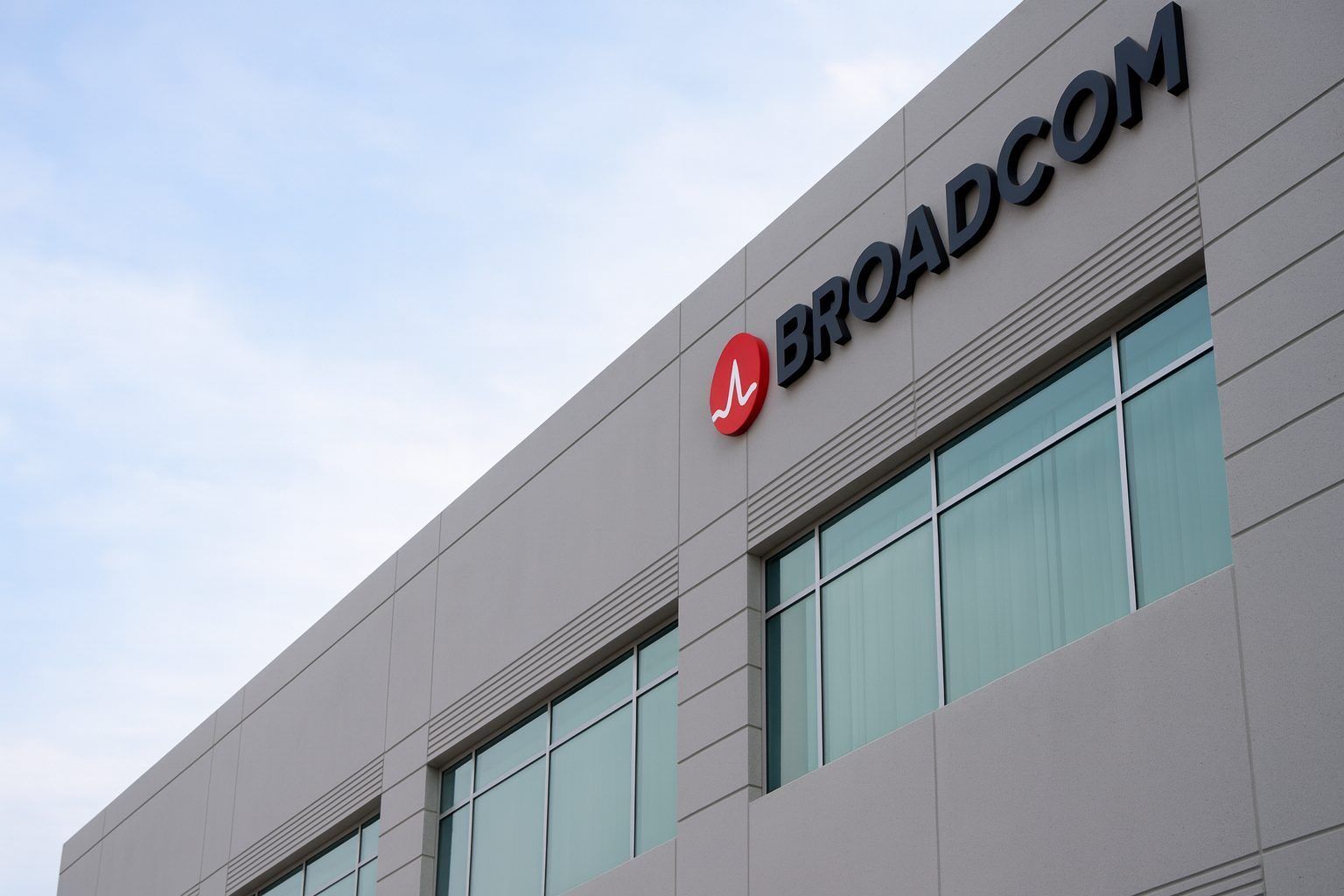
Broadcom Inc. (NASDAQ: AVGO) is back in the market spotlight. The semiconductor and infrastructure‑software giant is trading around $400 a share, near fresh all‑time highs, after a wave of bullish analyst calls, a multi‑year 10‑gigawatt AI accelerator deal with OpenAI, and growing anticipation for its fourth‑quarter and full‑year 2025 earnings on December 11. MarketBeat+2OpenAI+2
Below is a deep dive into the latest news, forecasts and analysis investors are watching on 9 December 2025.
Broadcom stock today: near highs after a blockbuster 2025 run
After Monday’s session, Broadcom shares traded around $401, up about 2.8% on the day and hitting an intraday high of $407.29, a new record. That leaves the stock more than 70% higher year‑to‑date and over 100% higher versus 12 months ago, with a market capitalization close to $1.8–1.9 trillion. Stock Titan+3MarketBeat+3TipRanks+3
Key snapshot as of 9 December 2025:
- Price: ~$400 per share, just below record highs near $407
- 52‑week range: roughly $138 to $407 MarketBeat+1
- Market cap: ~$1.8–1.9 trillion MarketBeat+1
- Trailing P/E: around 100x earnings, well above its historical average MarketBeat+1
- Dividend yield: about 0.6%, reflecting a modest payout but a rapid share‑price climb PR Newswire+1
From a technical perspective, Broadcom remains firmly above its 50‑ and 200‑day moving averages, and several services classify AVGO as a “buy” or “strong buy” on momentum and trend strength. Investor’s Business Daily notes that the stock is still trading in a buy zone after breaking out from a cup‑shaped base, while technical modeler StockInvest upgraded AVGO to a “Strong Buy Candidate” after the latest rally. Investors+2Investors+2
Recap: record Q3 2025 results and AI‑driven guidance
Broadcom’s latest reported quarter — Q3 fiscal 2025 (ended 3 August) — set the tone for today’s optimism.
From the company’s official earnings release: PR Newswire
- Revenue: $15.95 billion, up 22% year‑over‑year
- Non‑GAAP EPS:$1.69, up from $1.24 a year earlier (about 36% EPS growth)
- AI revenue:$5.2 billion, up 63% year‑over‑year, marking the 11th consecutive quarter of AI revenue growth
- Segment mix:
- Semiconductor solutions: $9.17B, +26% YoY
- Infrastructure software (including VMware): $6.79B, +17–43% YoY depending on metric Investors+1
- Free cash flow: $7.0B, or ~44% of revenue, up 47% YoY
- Dividend: Quarterly cash dividend of $0.59 per share (post‑split)
Management guided for Q4 2025 revenue of about $17.4 billion, implying 24% annual growth, and an adjusted EBITDA margin of 67% — an unusually high level even by semiconductor standards. PR Newswire
These numbers cemented the narrative that Broadcom has successfully morphed from a cyclical chip maker into a high‑margin AI hardware plus subscription‑software platform.
Dec. 11 earnings: what Wall Street expects this week
Broadcom reports Q4 and full‑year 2025 results on Thursday, 11 December 2025, after the market close, followed by a conference call at 5:00 p.m. ET (2:00 p.m. PT). Broadcom Investors+2Broadcom Investors+2
Across major data providers, consensus expectations for Q4 2025 look tightly clustered: Seeking Alpha+3Nasdaq+3Yahoo Finance+3
- Revenue: ~$17.4–$17.5 billion (+~24–25% YoY)
- Adjusted EPS: ~$1.87 (about 31–32% growth vs. last year’s $1.42)
- AI semiconductor revenue: management has previously guided to around $6.2 billion for Q4, up from $5.2 billion in Q3. PR Newswire
Research shops from Zacks to TipRanks, TradingView and Investing.com all highlight the same core storyline ahead of the print:
- Broadcom has beaten EPS estimates in 16+ consecutive quarters, making another beat statistically likely, though not guaranteed. Yahoo Finance+2Seeking Alpha+2
- The big swing factor is the outlook for 2026 AI revenue and updated commentary around hyperscaler spending and the OpenAI deal, more so than the backward‑looking Q4 headline numbers. Investing.com+2Investing.com+2
In short: the market already expects “strong.” What it wants to hear on Thursday is “even stronger for 2026.”
The OpenAI 10‑gigawatt collaboration: Broadcom’s defining AI catalyst
The single most important new development for AVGO in 2025 is its strategic collaboration with OpenAI.
In mid‑October, OpenAI and Broadcom jointly announced a multi‑year project to co‑develop and deploy 10 gigawatts (GW) of custom AI accelerators and rack‑scale systems. OpenAI+2Broadcom Investors+2
Key details from official statements and subsequent coverage: Investing.com+2Data Center Dynamics+2
- OpenAI designs the accelerators and systems, embedding what it has learned from training frontier models like GPT‑5 and beyond directly into the hardware.
- Broadcom leads development, Ethernet networking, and deployment, leveraging its strengths in custom ASICs, high‑speed interconnects, and data‑center networking.
- Initial deployments are slated to begin in the second half of 2026, with the rollout expected to continue through 2029.
- The project is sized at 10 GW of compute capacity — comparable to building a fleet of hyperscale AI data centers, and on par with or larger than some highly publicized Nvidia and AMD infrastructure deals.
Earlier in the year, Broadcom also disclosed a $10 billion AI chip order from a new customer, widely believed by analysts to be OpenAI. Reuters reported that the announcement sent AVGO shares up about 15% in a single session, adding more than $150–200 billion to its market capitalization. Reuters+2Los Angeles Times+2
Analysts at firms such as Bank of America, Bernstein and JPMorgan now see the OpenAI relationship as a multi‑year revenue and credibility milestone, reinforcing Broadcom’s role as the key custom‑silicon alternative to Nvidia in the data‑center AI race. Some houses now estimate AI‑related sales could exceed $40–50 billion in fiscal 2026 alone, up from market expectations closer to $30 billion earlier this year. Reuters+2Benzinga+2
Beyond OpenAI: Google, Meta and a possible Microsoft shift
Broadcom’s AI story isn’t built on a single customer. A wave of recent coverage underlines how deeply the company is embedded across hyperscalers:
Google TPUs and Gemini
Google’s Gemini 3 launch late in November highlighted Broadcom’s contributions to Tensor Processing Unit (TPU) chips. Investor’s Business Daily notes that Gemini’s debut sent Broadcom stock up double‑digits in a single session as investors recognized AVGO’s role in providing TPUs and networking for Google Cloud’s AI infrastructure. Investors+1
Recent analyst work suggests that ramping TPU v6 and upcoming v7 chips, along with Meta’s in‑house MTIA accelerators, are set to drive Broadcom’s AI revenue to $20–21 billion in fiscal 2025 and potentially over $50 billion in 2026. Benzinga+1
Meta, Amazon and other hyperscalers
Broadcom already supplies custom silicon and networking chips to Alphabet, Meta and Amazon, among others, helping them build data‑center infrastructure that’s more power‑efficient and tailored than off‑the‑shelf GPUs. Reuters and 24/7 Wall St. both highlight Broadcom as a core beneficiary of Big Tech’s push to diversify away from Nvidia due to price and supply constraints. Reuters+1
Microsoft vs. Marvell: new custom‑chip rumors
Another storyline emerging in early December: Microsoft may be considering shifting part of its custom AI‑chip business from Marvell Technology to Broadcom, according to a report summarized by Investor’s Business Daily. Marvell shares fell about 7% on the news, while analysts noted that Microsoft could be diversifying suppliers, a move that would benefit Broadcom’s XPU strategy. Investors
So far, none of the companies has confirmed a definitive Microsoft–Broadcom custom‑chip contract, and analysts at JPMorgan and Mizuho caution against assuming Marvell is losing existing designs. But at minimum, the rumor has reinforced the perception that Broadcom sits near the front of the line whenever hyperscalers look beyond Nvidia and AMD.
VMware, VMware Cloud Foundation 9.0 and the software stabilizer
The other half of Broadcom’s transformation story is software — especially VMware.
Q3 2025 numbers show the Infrastructure Software segment, anchored by VMware, generating nearly $6.8 billion in quarterly revenue, up around 17–43% year‑over‑year depending on metric and classification. PR Newswire+1
In early December, Broadcom announced that ING — a major European financial institution — will adopt VMware Cloud Foundation (VCF) 9.0 as its strategic private‑cloud platform across multiple regions. Stock Titan
Highlights from that announcement:
- ING is expanding its VMware environment into a multi‑region private cloud focused on workload mobility, operational consistency, security and data sovereignty.
- VCF 9 is described as an “AI‑ready” private‑cloud foundation, designed for regulated, global workloads — exactly the kind of sticky, high‑margin software Broadcom wants to sell.
- Broadcom emphasises that VCF 9 allows enterprise customers to retain control over data locality and regulatory compliance, while still modernising their infrastructure.
Analysts see VMware as a recurring‑revenue ballast that helps smooth out semiconductor cycles and supports Broadcom’s unusually high margins. Investing.com and other research pieces point out that software now accounts for roughly 40–45% of total revenue and carries gross margins in the mid‑80s, contributing to overall operating margins near or above 60%. Investing.com+2PR Newswire+2
Analyst sentiment: overwhelmingly positive, with valuation caveats
On 9 December 2025, Wall Street’s stance on AVGO is almost uniformly bullish:
- TipRanks: “Strong Buy” consensus based on roughly 23–28 Buy ratings and only 2 Hold ratings in recent months. Average 12‑month price targets cluster around $425–$433, implying about 8–11% upside from current levels. TipRanks+4TipRanks+4TipRanks+4
- MarketBeat: “Buy” consensus from 35+ analysts, with an average target around $391, slightly below the latest share price — a sign that some older targets haven’t yet caught up with the stock’s surge. MarketBeat+2MarketBeat+2
- MarketWatch / MLQ.ai / other aggregators: Typically show average targets in the low‑to‑mid $420s, again indicating mid‑single‑ to low‑double‑digit upside. MarketWatch+2MLQ+2
- UBS recently lifted its price target to $472 while maintaining a Buy rating, one of the highest targets on the Street. Benzinga+1
Several recent opinion pieces go even further. A Motley Fool article (behind a partial paywall) dubbed Broadcom a top candidate to be the best‑performing chip stock of 2026, while a TipRanks feature labeled it a “top pick for 2026,” citing its unique AI and software mix. Fool+2TipRanks+2
Longer‑term, a detailed forecast from 24/7 Wall St. projects that Broadcom’s earnings per share could climb from around $6.19 in 2025 to nearly $18.66 by 2030, with a hypothetical share price path that reaches about $709 by the end of the decade — roughly double today’s levels. These projections assume sustained double‑digit revenue growth and gradually compressing P/E multiples. 24/7 Wall St.
Still, most of these bullish targets come with a common caveat: valuation is rich, and expectations are high. With the stock already up more than 70% this year and trading near 100x trailing earnings, even enthusiastic analysts warn that any disappointment — particularly on AI demand or margins — could trigger sharp volatility. TechRadar+3Investing.com+3TipRanks+3
Dividend, balance sheet and credit quality
Broadcom is not a classic high‑yield dividend stock, but it has one of the strongest capital‑return profiles in the semiconductor sector:
- Quarterly dividend: $0.59 per share (post‑split), or $2.36 annually, for a yield around 0.6% at current prices. PR Newswire+1
- Dividend history: Broadcom has increased its dividend aggressively over the past decade; even after the 10‑for‑1 split in 2024, the payout trend remains firmly upward. DividendMax+1
- Next dividend: Market data providers show the next ex‑dividend date falling in late December 2025, with payment expected around 31 December, although exact dates can differ slightly between services and should be confirmed with a broker or the company. Stock Events+1
On the balance‑sheet side, Broadcom carries significant debt from its VMware acquisition, but rating agencies and analysts generally see its leverage as manageable:
- Recent analyses show net debt‑to‑EBITDA below roughly 2.3x and robust interest coverage, supported by double‑digit billion‑dollar free cash flows. Investing.com+2PR Newswire+2
- In September, S&P Global Ratings upgraded Broadcom to ‘A‑’, citing its durable cash generation and the visibility provided by large AI orders, including the $10 billion deal from a new customer. SP Global+1
The upshot: Broadcom looks more like a capital‑return compounder than a cyclical chip stock, even if its current yield is modest.
Valuation, risks and the “AI bubble” question
Despite the overwhelmingly positive narrative, there are meaningful risks around AVGO at today’s levels:
- AI capex cyclicality
The AI data‑center build‑out has been extraordinarily aggressive. If hyperscalers slow spending, delay projects or shift designs to other vendors, Broadcom’s AI revenue trajectory could flatten or dip, especially after 2026. Reuters, TipRanks and others repeatedly note that investor expectations for 2026 AI revenue (often $40–50 billion+) leave little room for disappointment. Reuters+2Benzinga+2 - Concentration risk
A relatively small group of cloud and AI leaders — OpenAI, Google, Meta, Amazon, possibly Microsoft — account for a large share of Broadcom’s AI pipeline. Any strategic shifts at these companies could have outsized effects on AVGO’s growth profile. Investors+3Reuters+3OpenAI+3 - Competition from Nvidia, AMD and in‑house silicon
While Broadcom specializes in custom ASICs, it still competes for wallet share with Nvidia’s GPUs, AMD’s accelerators, and increasingly with first‑party chips developed inside Google, Amazon, Microsoft, Meta and OpenAI itself. The OpenAI‑Broadcom collaboration is a response to this trend, but it also illustrates how fast the landscape can change. The Next Platform+3Financial Times+3TechRa… - Valuation risk
With a near‑trillion‑plus valuation and a triple‑digit earnings multiple, any stumble on guidance, margins or AI bookings could trigger a sharp re‑rating. Multiple recent articles — even bullish ones — highlight concerns that parts of the AI sector may already be in bubble territory, or at minimum priced for near‑perfection. StockInvest+3TipRanks+3TechRadar+3 - Regulatory and integration challenges
The VMware acquisition remains under regulatory scrutiny in some jurisdictions, and Broadcom’s pricing and licensing changes have been controversial among enterprise customers. While ING’s adoption of VMware Cloud Foundation 9.0 is a vote of confidence, any serious pushback on licensing models could weigh on the software growth story. Stock Titan+2Investors+2
What to watch on December 11 and beyond
For investors and traders following AVGO this week, here are the key questions heading into Thursday’s earnings call:
- Updated AI revenue guidance for 2026–2027
- Does management formally quantify the OpenAI 10GW deal in terms of annual revenue?
- How does Broadcom’s own AI revenue outlook compare with analyst forecasts of $40–50+ billion in 2026? Investing.com+2Benzinga+2
- Hyperscaler pipeline commentary
- Any color on Microsoft, following reports about a potential shift from Marvell?
- Updates on Google TPUs, Meta MTIA and other large programs. Investors+2Investors+2
- VMware momentum and customer sentiment
- Growth rates for VMware Cloud Foundation and subscription software.
- Customer reaction to pricing and licensing changes, and more examples like the ING private‑cloud deal. Stock Titan+2Investors+2
- Capital returns
- Whether Broadcom plans another dividend increase or expanded share repurchases in 2026, leveraging its growing free cash flow. PR Newswire+2Investing.com+2
- Management’s view on AI demand sustainability
- Any commentary on whether the current pace of AI spending is sustainable or likely to normalize over the next few years. Investors will listen closely for hints that management sees the AI cycle as a super‑cycle, rather than a shorter‑lived boom. Reuters+2TechRadar+2
Bottom line
As of 9 December 2025, Broadcom stock sits at the crossroads of several powerful themes:
- A record pipeline of AI hardware orders, anchored by the landmark 10GW OpenAI collaboration and long‑standing Google and Meta partnerships. OpenAI+2Investing.com+2
- A rapidly scaling software business via VMware, which adds recurring, high‑margin revenue and reduces cyclicality. PR Newswire+2Stock Titan+2
- Wall Street enthusiasm, with a Strong Buy consensus and average price targets pointing to further upside — but also growing debate about valuation and the durability of the AI capex boom. Reuters+4TipRanks+4Finbold+4
For now, Broadcom remains one of the clearest pure‑play beneficiaries of the generative‑AI infrastructure build‑out, and Thursday’s earnings call is likely to be one of the most closely watched events of the week across both tech and broader equity markets.
Disclaimer: This article is for informational purposes only and does not constitute investment advice, a recommendation to buy or sell any security, or a substitute for professional financial advice. Always do your own research and consider consulting a licensed financial adviser before making investment decisions.