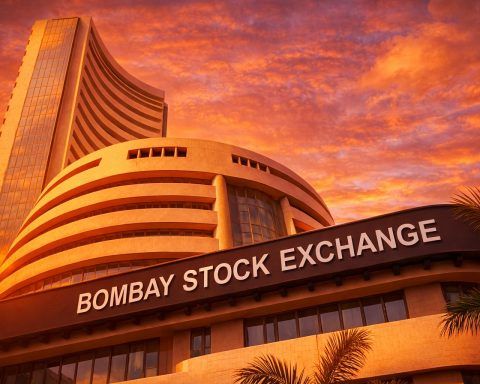
Mumbai, 2 December 2025 – BSE Ltd, the Bombay Stock Exchange operator, remains one of Dalal Street’s most spectacular multi‑bagger stories. But as the stock hovers near its all‑time high with rich valuations and regulatory questions hanging over the derivatives boom, investors are increasingly asking: is there still upside left in BSE, or is most of the good news already priced in?
BSE Ltd share price on 2 December 2025: Near record zone after a massive rally
As of the latest end‑of‑day data (1–2 December 2025), BSE Ltd’s share price is around ₹2,886–₹2,900 per share, giving the company a market capitalisation of roughly ₹1.17 lakh crore.Smart Investing+1
Key price and return metrics:
- 52‑week high: ~₹3,030
- 52‑week low: ~₹1,228
- 1‑month return: ~18%
- 1‑year return: ~90–95% (depending on the exact window)Smart Investing+1
Economic Times data shows BSE is up about 61% in 2025 year‑to‑date, after rallying 139% in 2024 and more than 4x in 2023, making it one of the most powerful compounders in the Indian financials space.The Economic Times
On 2 December 2025 specifically, MarketsMojo and other analytics platforms show BSE closing around ₹2,886.60, down a modest 0.5% on the day, with intraday moves between roughly ₹2,875 and ₹2,950 and healthy value turnover (over ₹2,300 crore).Markets Mojo+1
So the headline for traders: BSE is consolidating just below its record highs after an extraordinary three‑year run.
Q2 FY26 results: 61% profit growth, 10th consecutive record revenue quarter
The current optimism around BSE stems from a genuinely strong operating performance.
For Q2 FY26 (July–September 2025), BSE reported:Moneycontrol+2Business Today+2
- Consolidated revenue: ~₹1,068–1,070 crore
- Up 44% year‑on‑year (YoY)
- Up about 12% quarter‑on‑quarter (QoQ)
- Consolidated net profit: ~₹558–560 crore
- Up 61% YoY
- Up ~5–6% QoQ
- Transaction charges: ~₹794 crore
- Up 57% YoY and 8% QoQ
- Operating margin (EBITDA): mid‑60s %, up over 1,000 bps YoY
Management also highlighted that this is roughly the 10th consecutive quarter of record revenue, underlining how broad‑based the growth has been across derivatives, mutual fund platforms and listing services.PublicNow+1
For the first half of FY26 (H1), revenue rose around 50% YoY to about ₹2,030 crore and profit after tax surged nearly 78% YoY to roughly ₹1,090 crore.Business Standard+1
Under the hood, the story is clear: BSE is no longer mainly a cash‑equity exchange; it’s become a derivatives‑ and platform‑driven business.
What’s driving the growth: derivatives, SME listings and the StAR MF platform
1. Derivatives: the new growth engine
Jefferies and other brokerages note that BSE’s index options business is now the main profit driver:NDTV Profit+1
- Index options premium ADTO (average daily turnover) is around ₹15,000 crore, up ~83% YoY.
- Derivatives now contribute roughly 58% of BSE’s revenue, versus about 46% a year ago.
- BSE’s premium market share in index options is in the mid‑ to high‑20s percentage range (roughly 24–29%, depending on the source and month).
Nuvama and Centrum point out that BSE’s premium turnover market share in index options rose to about 27.1% in Q2 FY26, with October 2025 premium turnover up over 30% month‑on‑month even after the expiry reshuffle.Business Standard+2HDFC Sky+2
This is especially noteworthy because back in June 2025, investors were worried that SEBI’s rule allowing only one weekly index options expiry per exchange – and BSE’s shift from Tuesday to Thursday – would hurt BSE’s derivatives market share. A Reuters report at the time flagged broker concerns that BSE’s options volumes and profitability could take a 10–15% hit.Reuters
Fast‑forward to Q2 and October: the data suggests BSE has held its ground or even gained share, easing fears that the expiry swap would knock it out of the derivatives race.Business Standard+2NDTV Profit+2
BSE also formalised a Settlement Guarantee Fund (SGF) policy, voluntarily contributing 5% of derivatives transaction revenue every month until the fund reaches 150% of the minimum required corpus. That sounds like a drag on profits, but Jefferies notes the actual provision rate is lower than initially feared, slightly improving the earnings outlook.NDTV Profit+1
2. SME platform: 600+ listings and counting
On the primary market side, BSE’s SME platform has quietly become a major differentiator.
- As of August 5, 2025, BSE SME had crossed 600 listings, helping companies raise about ₹10,652 crore with a combined market capitalisation of around ₹1.84 lakh crore.The Economic Times+1
- By late October 2025, analytics platforms tracking BSE data indicate around 657 listed SMEs, with cumulative fund‑raising exceeding ₹13,000 crore, including a particularly busy October with 27 SME IPOs raising over ₹1,050 crore.TS2 Tech
At the same time, the BSE SME IPO Index – after four years of absurdly strong gains (up 1,100% in 2021, 43% in 2022, 96% in 2023 and 147% in 2024) – has slipped around 6% in 2025, reflecting a comedown from the IPO frenzy.TradingView
Even so, the steady flow of SME issues and big oversubscriptions on select listings (Glen Industries, Gallard Steel and others) show that the platform still commands serious investor interest.The Economic Times+1
3. BSE StAR MF: the mutual fund backbone
The BSE StAR MF platform is another growth engine that doesn’t always get headlines:
- Q2 FY26 StAR revenue was around ₹70 crore, up ~18% YoY.
- The platform processed ~20.1 crore mutual fund transactions in the quarter, up ~24% YoY.
- In October 2025 alone, StAR MF handled a record 7.13 crore transactions.TS2 Tech
In effect, BSE has quietly turned itself into a crucial transaction backbone for Indian mutual fund investing.
4. India INX and new leadership
BSE is also pushing its international ambitions via India INX at GIFT City:
- In November 2025, BSE invested about ₹41.28 crore in a rights issue, lifting its stake in India INX to roughly 65.27% (subject to full subscription).angelnews.in+2Stock Insights+2
While India INX’s own revenue is still tiny (low single‑digit crores), the additional capital underscores that BSE is playing a long game in offshore markets.
Alongside that, BSE appointed Rudresh Kunde – a derivatives microstructure specialist with over 17 years at NSE – as Chief – Product, Policy & Strategy from 20 November 2025.TS2 Tech+1
For an exchange whose fortunes now hinge on product design, expiry structure and trading infrastructure, that is a strategically interesting hire.
Fundamentals: a debt‑free, high‑growth, mid‑cap “exchange platform”
Data compiled by Screener, Smart‑Investing and other analytics portals paints a striking fundamental picture:Screener+2Smart Investing+2
- TTM revenue: ~₹3,650–3,700 crore
- TTM net profit: ~₹1,750–1,800+ crore
- 5‑year profit CAGR: ~65%
- 3‑year profit CAGR: ~70%+
- Return on capital employed (ROCE, FY25): ~47%
- Return on equity (last year): mid‑30s %
- Dividend payout ratio: ~40%
- Net debt: effectively zero
Shareholding has broadened sharply:
- FII stake: from ~7.6% in mid‑2023 to about 16.25% in September 2025
- DII stake: ~19.9%
- Public shareholding: ~63.8%
- Number of shareholders: ~12.9 lakh (up from ~4.7 lakh in March 2023)Screener+1
In short, BSE is now a widely‑held, debt‑free mid‑cap with very high profitability and several distinct growth engines (derivatives, SME listings, StAR MF, India INX).
Valuation check: high‑quality but “priced for perfection”
Here’s the part that makes value investors twitch.
Based on current prices around ₹2,900, Smart‑Investing and other valuation tools show:Smart Investing+1
- P/E (TTM): ~65–68x
- P/B: low‑to‑mid‑20s
- P/S: ~32x
- Dividend yield: comfortably below 1%
Smart‑Investing’s intrinsic value models (using long‑term EV/EBITDA, EV/Sales and Price/Sales medians) estimate a “median fair value” of about ₹520 per share, implying BSE trades at roughly 450% above that modeled intrinsic value – over five times their fair value estimate.Smart Investing+1
That doesn’t mean the stock must crash – valuation models are just models – but it does underline how much future growth the market is already discounting.
Broker research backs that sense of “expensive but high‑quality”:
- HDFC (HDFC Sky): ADD rating, target ₹2,750, modeling ~24% revenue CAGR and ~31% EPS CAGR over FY25–28, but highlighting that BSE trades at about 47x FY26E and 42x FY27E earnings and flagging regulatory risk around weekly index options.HDFC Sky+1
- Smart‑Investing labels fundamentals as “Good”, valuations as “Bad (stock is expensive)”, with zero debt and no pledged shares.Smart Investing
From a big‑picture standpoint: BSE combines a rare growth profile with equally rare valuation multiples.
What are analysts and brokers saying about BSE stock?
The Street view right now is constructive on the business, cautious on the stock price.
Street consensus
TS2’s synthesis of Investing.com and Trendlyne data (as of 1 December 2025) shows:TS2 Tech
- Coverage from around 14 analysts
- Overall stance: “Buy”
- Breakdown: 8 Buy, 5 Hold, 1 Sell
- Average 12‑month target price: ~₹2,680–2,690
- Implied downside vs price near ₹2,900: ~8–10%
- Target range: roughly ₹900 to ₹3,200
So even though the average rating is “Buy”, the current price already sits above the average target, which explains the cautious tone you see in recent notes.
Individual broker calls
Recent commentary from major brokerages includes:HDFC Sky+3Moneycontrol+3Business Standard+…
- Jefferies
- Rating: Hold
- Target price: ₹2,930
- Key points: robust options revenue, lower‑than‑feared SGF costs, but stresses that clarity on index‑expiry rules is crucial for further re‑rating.
- Goldman Sachs
- Stance: broadly neutral/Hold
- Target price: around ₹2,460, implying meaningful downside from current levels.
- Motilal Oswal
- Rating: Neutral
- Target price: ₹2,800, valuing BSE at about 40x Sep‑27E EPS after raising FY26–28 earnings estimates by 14–15%.
- Nuvama
- Rating: Buy
- Target price: around ₹3,130, valuing the stock at ~45x earnings plus the embedded value of BSE’s 15% stake in CDSL.
- Centrum
- Rating: Buy
- Target price: about ₹2,701, projecting 31% PAT CAGR and 34% “core” PAT CAGR over FY26–28 and calling out strong growth in equity derivatives and colocation revenues.
- HDFC
- Rating: ADD
- Target price: ₹2,750, as noted earlier, with a big asterisk around regulatory risk.
Put differently: the growth story is widely acknowledged, but most target prices cluster around or below the current market price, not far above it.
Technical view: bulls still in control, but resistance looms near ₹3,000
From a technical analysis lens, the picture is still bullish, but not without overhead supply.
Economic Times’ “Stock Radar” column recently highlighted that BSE:The Economic Times+1
- Has broken out of a four‑month trading range,
- Trades above 7 of 8 key simple moving averages (10‑, 20‑, 30‑, 50‑, 100‑, 150‑ and 200‑day),
- Shows a Relative Strength Index (RSI) near 70, flirting with overbought territory, and
- Has a chart target slightly above ₹3,000, with suggested support around ₹2,600.
MarketsMojo and other platforms add that:Markets Mojo+1
- The stock is above key moving averages,
- MACD and trend indicators remain bullish,
- But some momentum oscillators and Dow‑Theory signals are showing signs of mild fatigue, consistent with a stock consolidating near resistance.
Technically, the market seems to be saying: the uptrend is intact, but fresh breakouts may need either another earnings surprise or a macro tailwind.
Macro and regulatory backdrop: opportunity and risk in equal measure
You can’t analyse BSE in isolation; it is effectively a leveraged play on India’s capital market cycle.
On the positive side:
- Indian benchmarks Sensex and Nifty have been hovering near record highs in late 2025, supported by strong domestic flows and optimism on growth.Reuters+1
- The Nifty Capital Markets Index has surged nearly 40% in FY26, reflecting a broad rally in brokers, asset managers and exchange stocks.The Economic Times+1
On the risk side:
- SEBI’s push to curb excessive speculation in F&O has already hit NSE’s earnings, with Reuters reporting a 33% YoY drop in NSE’s Q2 FY26 net profit amid lower derivatives volumes and lower transaction fees.Reuters+1
- Any fresh tightening of rules around weekly options, margins or position limits would directly affect BSE, whose profits now depend heavily on derivatives.NDTV Profit+1
BSE’s management has tried to pre‑empt some of this risk by voluntarily beefing up the SGF and by tweaking its product design and expiry structure. But ultimately, regulators hold the steering wheel in this part of the market.
Key risks to the BSE Ltd stock story
Based on broker reports and recent commentary, the main risk factors investors are watching include:TS2 Tech+2NDTV Profit+2
- Regulatory risk in derivatives
- Changes to weekly expiries, lot sizes, margins or product design could hit volumes and transaction revenue.
- Competitive response from NSE
- NSE remains the dominant derivatives venue; strong pushback (pricing, products, technology) could slow or reverse BSE’s market‑share gains.
- Market‑cycle risk
- With P/E in the mid‑60s, BSE’s stock is likely more sensitive than the average mid‑cap in any broad‑based correction from record index levels.
- Execution and tech risk
- As colocation and high‑frequency trading grow, BSE must keep technology and risk systems robust; any outage or glitch would be heavily penalised by the market.
- India INX and new initiatives
- Extra capital has been deployed into India INX and new product initiatives (like futures pre‑open). If these don’t scale, the payoff may be slower than the market hopes.
So, is BSE a buy, hold, or sell right now?
From a news and analysis perspective (not a personal recommendation):
- Business quality: objectively high. BSE is debt‑free, asset‑light and generating high returns on capital with multiple structural growth engines.Screener+2Smart Investing+2
- Growth trajectory: still strong, especially in derivatives, SME listings and the StAR MF platform, with H1 FY26 numbers showing 50% revenue growth and near‑80% PAT growth.Business Standard+2NDTV Profit+2
- Valuations: clearly demanding, with earnings, book and sales multiples far above market averages and most fair‑value models flagging the stock as expensive or “priced for perfection”.Smart Investing+1
- Street view: generally positive on the business, but target prices on average sit slightly below the current market price, implying limited near‑term upside on consensus assumptions.TS2 Tech+2Business Standard+2
For traders, the battle line is obvious: support zones near ₹2,600–2,700 versus resistance around ₹3,000–3,030. For long‑term investors, the question is more philosophical: how much growth is already priced in, and what odds do you assign to regulatory and market‑cycle risk?
Either way, BSE is now a bellwether for India’s entire capital‑markets ecosystem. Watching how this stock behaves into 2026 is, in a sense, watching how India’s financialisation story itself evolves.